
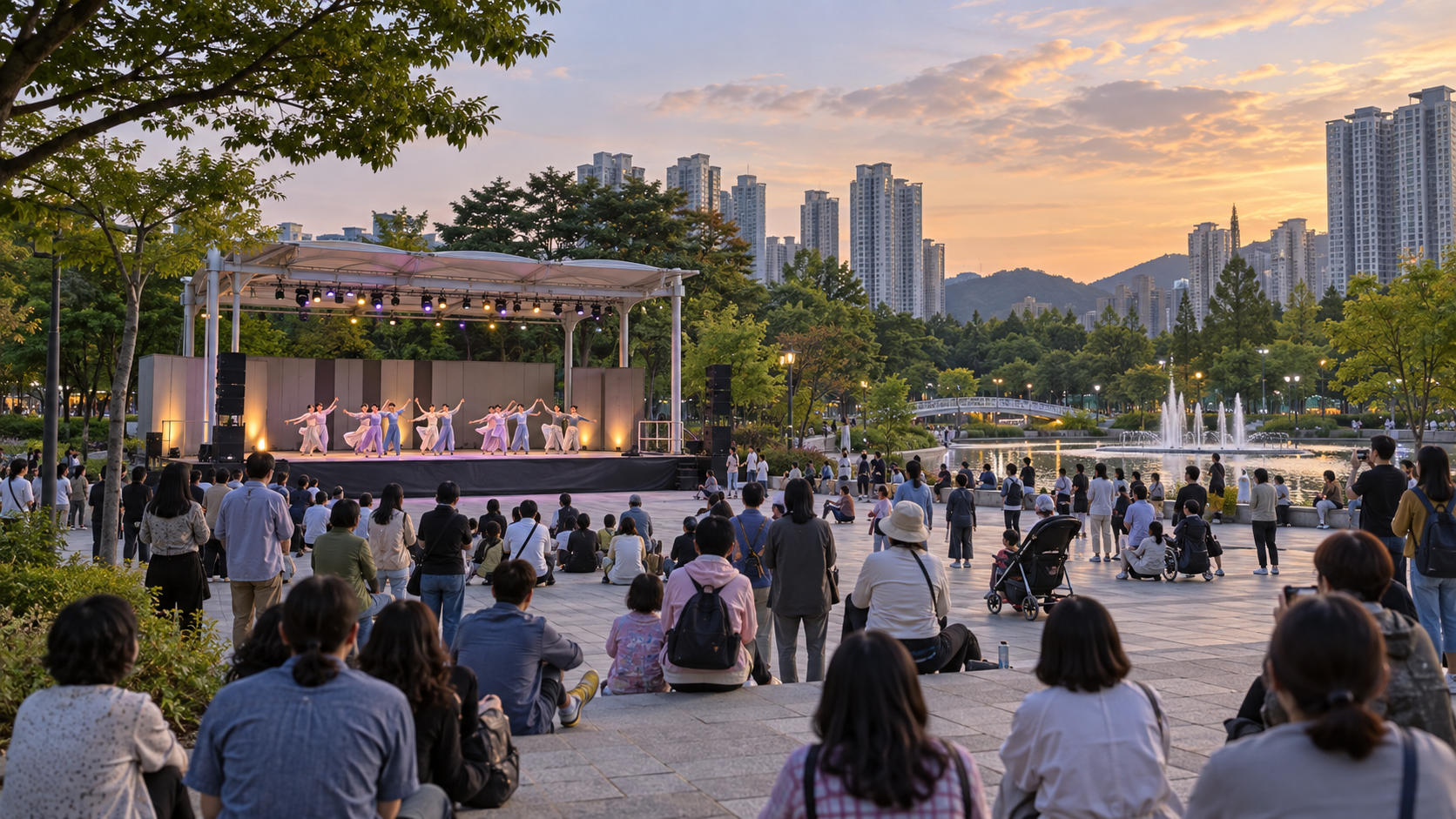
Anyang Dance Festival is not confined to one stage or even one park. The 2026 event runs across Pyeongchon Central Park in Dongan-gu and Samdeok Park in Manan-gu from September 18 to 20, with published overall hours of 12:00-21:00. That split is the first thing to understand before travelling: these are separate venues in different parts of Anyang, served most conveniently by different subway lines.
The event began in 2000 as the Anyang Citizens Festival. Its current format keeps the civic emphasis but uses dance as the organising idea. The official programme groups activity into dance, play and movie zones, alongside citizen stages, competitions and evening concerts. Entry is listed as free by Korea Tourism Organization. Food, flea-market shopping and any separately priced activity should be treated as personal spending rather than part of free admission; no reliable item-by-item 2026 price list was available at this update.
What you actually do here
At Pyeongchon Central Park, the event is designed for movement between zones rather than sitting in front of the main stage all day. The dance zone near the waiting-room area is intended for approachable public participation. KTO’s 2026 listing specifically names random-play dance among the supporting programmes, along with citizen performances and the Anyang Golden Dance Contest. The main programme includes the Crown Competition dance contest, the Stain to Groove dance battle and dance concerts.
The programme also deliberately stretches beyond dance battles. A movie zone at the park’s badminton-court area combines screen material and dance performance with space to pause. The play zone around the central fountain is aimed at family groups. Exhibition, experience and promotional booths, a flea market and citizen performances fill out the daytime programme. These elements make the event workable for a mixed group in which not everyone wants to watch a full competition.
Samdeok Park has its own programme, not an overflow screen for Pyeongchon. On the opening Friday, the city has announced a Dance Movie Day there, combining a performance connected to a film with a film screening. Later in the weekend, it hosts citizen stages and named concerts. Decide whether a Samdeok event is central to your plan before you set out; moving between the parks casually can cost the part of the programme you came to see.
Programme and timetable
The official overall operating window is noon to 21:00, but the most useful confirmed detail is the day-by-day distinction.
On Friday, September 18, the Pyeongchon main stage follows the Anyang Citizens’ Day awards with performances by Lim Chang-jung and ARTMS, plus dance crew HolyBang. Samdeok Park holds Dance Movie Day on the same date. This is the sensible choice for visitors who want the opening-night combination of a civic ceremony, pop performance, a professional dance crew and the separate film programme.
On Saturday, September 19, the Pyeongchon main stage turns toward competition: young dancers and 12 finalist teams are due to perform. The Anyang Citizens’ Song Festival at Samdeok Park names Park Hye-shin and Park Se-wook. Separately, the foundation’s recruitment notice schedules selected citizen teams between 13:00 and 18:00 on Saturday and Sunday at the Pyeongchon food-event substage and the Samdeok main stage. Those citizen appearances include dance but also music, traditional performance, magic, jump-rope and taekwondo-style performance, so do not expect every daytime slot to be a dance battle.
On Sunday, September 20, the city places Bada, tripleS, The Jadu and idntt in the Pyeongchon K-pop concert, followed by the closing event and drone show. At Samdeok Park, the Always Youth Concert names Kang Jin, Ryu Ji-kwang, Chunja, Kim Seung-jin, CLASS:y and Kim Yu-seon. The Anyang Golden Dance Contest is scheduled for 13:00-18:00 on the Pyeongchon car-free street, with teams whose average member age is at least 50 competing across forms including line dance, dance sport, shuffle, K-pop, salsa, jazz and Korean dance.
This is enough information to choose a date, but not a licence to assume an exact stage time for every named act. The city announcement identifies the day and sequence, while the dependable full minute-by-minute grid was not available in a form suitable for this guide. If one performer is the sole reason for your trip, check the official festival notice board again on the day.
Tickets, fees and food
General admission is free. There is no confirmed gate ticket or advance admission reservation to arrange. That removes one layer of planning, but it does not mean every transaction on the grounds costs nothing. The programme includes experience booths, a flea market and food-related events, and no official source reviewed for this article established that all of them are free.
Anyang City’s separate 2026 Food Festival runs alongside the dance festival at Pyeongchon’s multipurpose field from September 18 to 20. The city says it will comprise 40 booths, including prepared-food sales, food-manufacturer promotion, food-safety activities and urban-agriculture experiences. Pickle-making on Saturday and low-sodium salt-making on Sunday are announced for 14:00-16:00 with first-come participation. The notice does not provide a complete vendor menu, stall prices, vegetarian guide or payment policy, so none is promised here.
The same restraint applies to a “local specialty.” Anyang is part of a large metropolitan food market, but a municipal wholesale price listing does not prove that an ingredient was grown in Anyang or is a city specialty. No sufficiently clear official source was found for a product that met this site’s local-specialty rule, so this guide leaves that field empty.
Getting there without a car
For Pyeongchon Central Park, take Seoul Subway Line 4 south to Pyeongchon Station. A current route calculation from Seoul Station is about 41 minutes before the final walk. Anyang City’s English transport page independently identifies Pyeongchon Station as the subway stop for Jungang Park and lists local buses 5-1, 22, 52, 52-1, 333, 3330 and 5 to the Jungang Park stop. Subway frequency and the final walking route should be checked live rather than treated as a fixed festival timetable.
For Samdeok Park, use Anyang Station on Line 1. Anyang City’s tourism page gives the park’s address as 106 Samdeok-ro and describes it as a ten-minute walk from Anyang Station. The park occupies a former paper-mill site donated for public use; a reduced-scale chimney in the park recalls that history. This physical description is useful for recognising the venue, especially because “Anyang Dance Festival” in a map search may default to the larger Pyeongchon site.
Do not travel to Pyeongchon and assume you can walk over to Samdeok between acts. The official material treats them as two venues, and the nearest-station guidance places them on different lines. If your plan includes both, look up the live cross-city route and leave a generous gap. A two-park itinerary is much easier when you choose one daytime block and one evening block instead of alternating repeatedly.
Day trip or overnight
This is a practical Seoul day trip. The Pyeongchon subway leg is roughly 41 minutes from Seoul Station, the event closes at 21:00, and there is no intercity rail booking to manage. The simplest version is an afternoon arrival at Pyeongchon, time in the participation and movie zones, food before the main evening crowd, and one chosen concert or closing programme.
An overnight stay is not necessary on the verified transport and operating-hour evidence. It may still suit someone attending all three days or combining both parks, but no hotel availability or festival lodging partnership was confirmed. The stronger planning decision is venue selection, not accommodation: staying late at the wrong park will not help you see an event scheduled at the other one.
Honest assessment
The event’s real strength is range. A visitor can watch local clubs, an age-specific amateur contest, youth and finalist competition, professional dance, films and pop stages without buying an admission ticket. Dance is not treated only as something performed by professionals; the random-play format and citizen programme leave room for participation and for forms outside K-pop choreography.
That range also creates the main weakness. Two parks, several zones and overlapping stage identities make the event less legible than a single-site festival. The published 12:00-21:00 window helps, but it does not replace the final daily grid. Save the official programme page, confirm the park beside every must-see item, and do not build a tight transfer around an act whose precise stage time has not been posted.
Crowding claims need similar care. The organiser has not published a verified forecast for the busiest hour, so this guide does not invent one. It is nevertheless reasonable to expect audience concentration at the named evening concerts and Sunday’s closing drone show because those are fixed headline events in a limited stage area. Arrive early enough to identify an exit and a meeting point, especially with children, and allow the first departing wave to clear before making a tight subway connection.
The fairest one-day plan is to pick one park as the anchor. Choose Pyeongchon for the broadest mix of zones, competitions and headline closing programme; choose Samdeok when its film day, citizens’ song festival or Always Youth Concert is your priority. Trying to collect every named act across both sites will turn a participatory city festival into a transport exercise. With one anchor venue and one reason for choosing the date, the free format is flexible and the trip from Seoul is straightforward.