
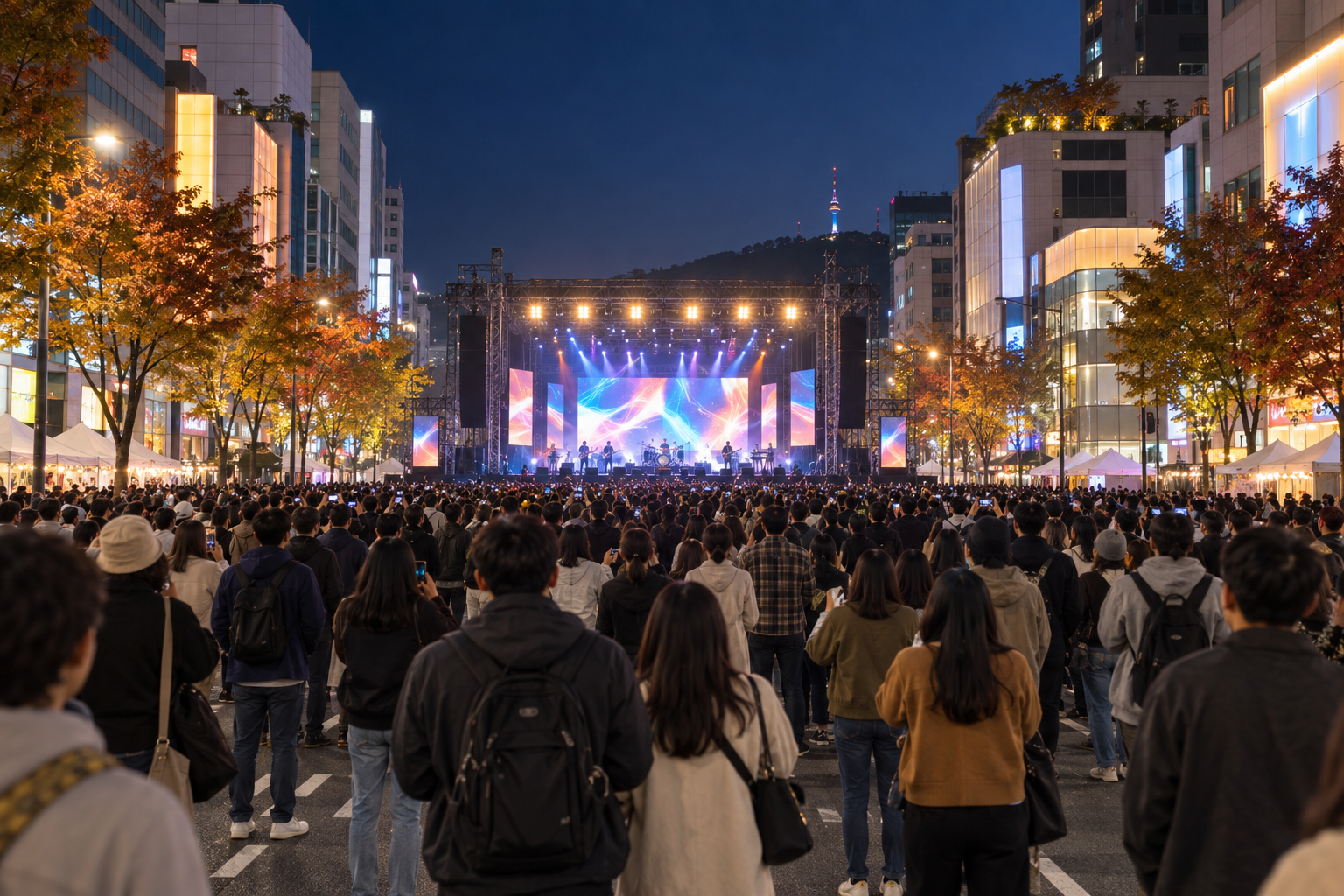
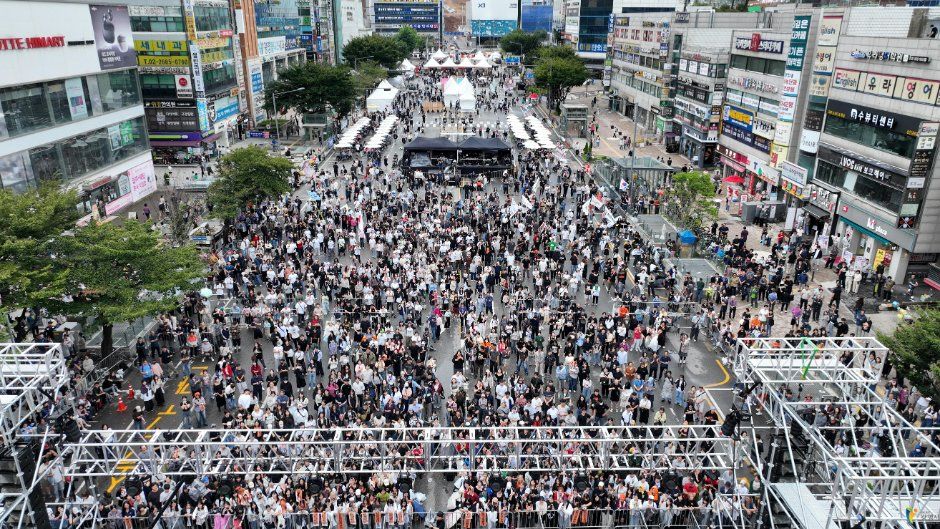
Festival Gwangmyeong takes over Cheolsan-ro, the wide commercial street in front of Cheolsan Station, for one weekend each autumn. For 2026 the confirmed dates are October 3-4, a Saturday and Sunday, and the whole thing is free. The organiser, Gwangmyeong City, closes an eight-lane road in its main shopping district and turns it into a linear festival ground: a large concert stage at one end, a parade route down the middle, and market, dance and rest zones filling the rest.
The name needs one note for English readers. There is no separate translated title — the festival brands itself in Latin letters as “Festival Gwangmyeong” (its website is festivalgm.or.kr, its Instagram is @festivalgm_official, and the main stage is called GM Live, with “GM” standing for Gwangmyeong). The Korean name is itself the English loanword festival followed by the city name, so this guide uses “Festival Gwangmyeong” as written rather than inventing a translation.
What you actually do here
The core of the event is a street you can walk end to end. Because Cheolsan-ro is closed to cars, the road itself becomes the venue, and the experience is closer to a neighbourhood block party scaled up to a headline concert than to a fenced festival site. You wander between the main stage, the parade route and the participation zones, stopping where something is happening rather than following a single fixed programme.
Gwangmyeong is a dense commuter city on Seoul’s south-western edge, not a scenic or heritage destination, and this festival leans into that: it is an urban music-and-street event in a shopping district, not a cultural pilgrimage. That framing matters for expectations. What you get is easy access, a big free concert and a lively closed-off street; what you do not get is a quiet setting or a seated show.
GM Live: the two-night line-up
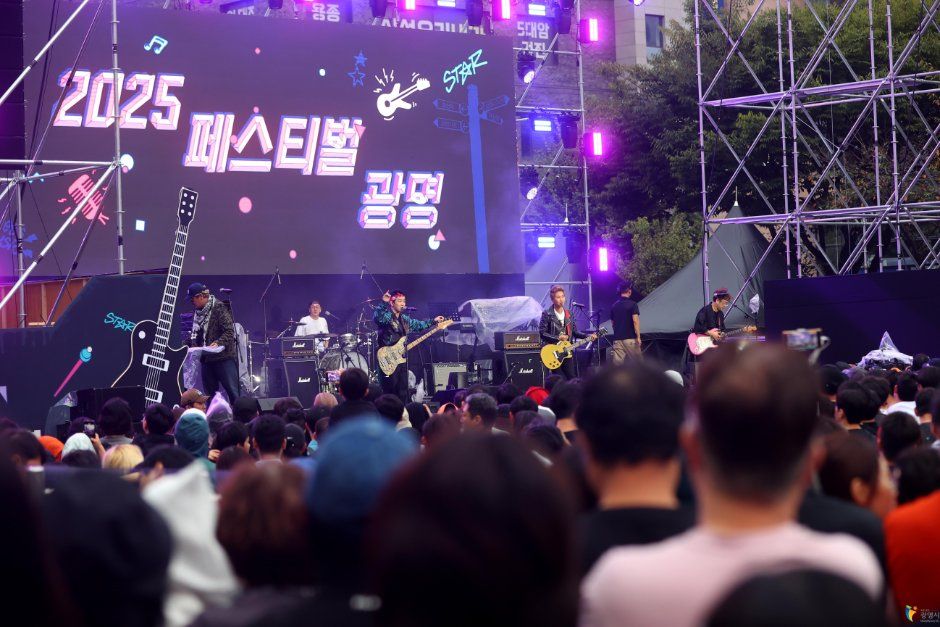
The anchor is GM Live, the main-stage concert programme, and the city has confirmed a full bill of eleven acts across the two nights. On October 3, the singer-songwriter 10CM headlines, joined by Daybreak, Jack Kingkong, Asrai and Asadal. On October 4, the rock veteran Kim Jong-seo leads, followed by Romantic Punch, the Bulnabang Star Sausage Club, the Shin Hyun-hee Band, Cactus and Luamel.
That is a band-and-indie line-up rather than a mainstream K-pop bill, which is worth knowing before you travel: the draw here is live Korean rock and indie, spread across two evenings. The headline sets run in the evening, so if a specific act is your reason for coming, pick the matching day and treat the afternoon as warm-up. Set times beyond the day-by-day split were not published in a reliable form when this guide was written, so check the official site or Instagram close to the date for the running order.
An evening event, and how big the crowd gets
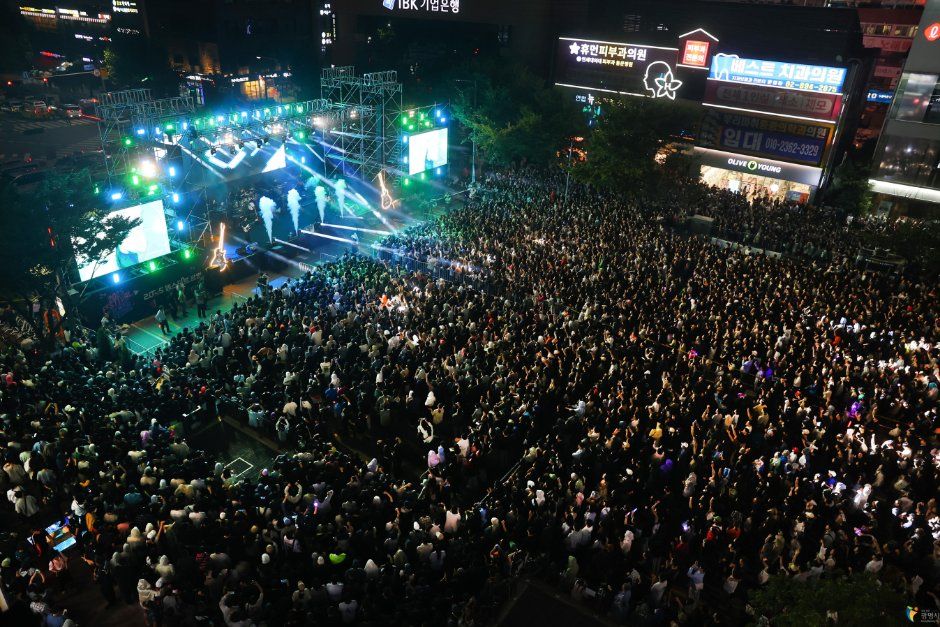
Although the street opens in late morning, this is fundamentally an after-dark event. The stage lighting, the LED screens and the headline sets all land in the evening, and photographs from the 2025 edition show the road in front of the stage filled shoulder to shoulder once the concerts start. Plan for a large standing crowd rather than a relaxed stroll during the headliners.
If crowds are not your thing, the practical move is to enjoy the daytime programmes and the market when the street is calmer, then decide whether to push toward the stage for the evening set or watch from further back. There is no reserved seating on the road, so your view depends on when you arrive and how close you are willing to stand.
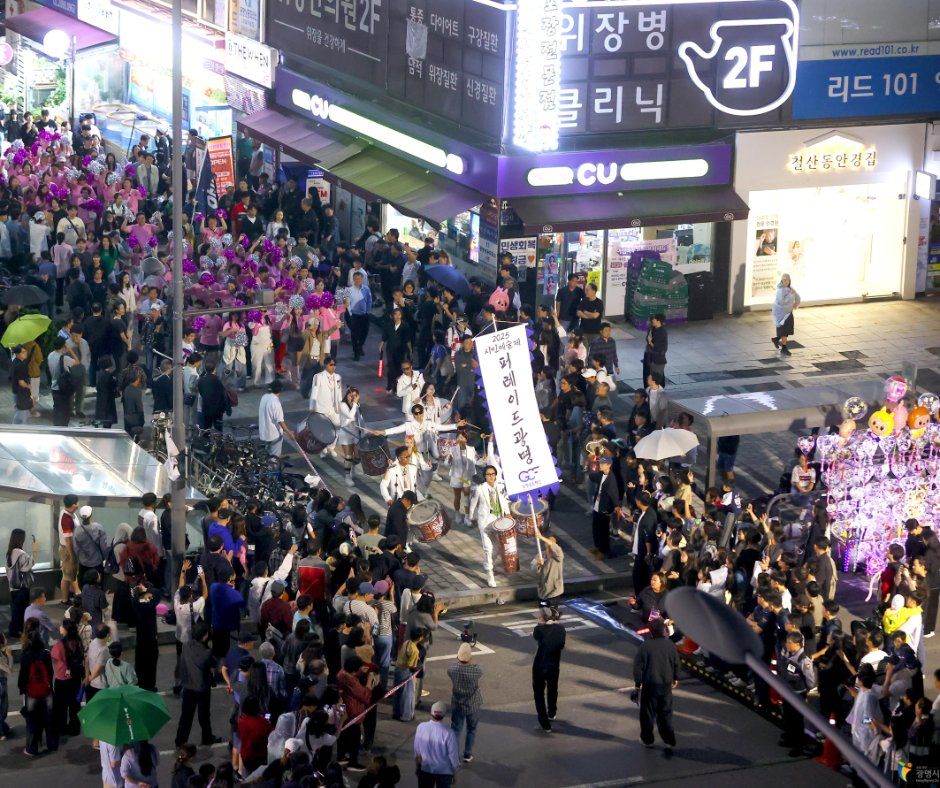
The parade through Cheolsan
A citizen parade — branded “Parade Gwangmyeong” — moves along the closed street and is one of the festival’s signature sights, with drum lines, costumed groups and large props among the residents taking part. It is a participatory event as much as a spectacle: much of the procession is made up of local groups rather than professional performers, which gives it a community feel.
Because the parade uses the same road as everything else, it is easy to catch without planning; you simply position yourself along Cheolsan-ro and wait for it to pass. As with the concerts, exact parade times were not confirmed in a dependable source, so use the official channels for the day’s schedule.
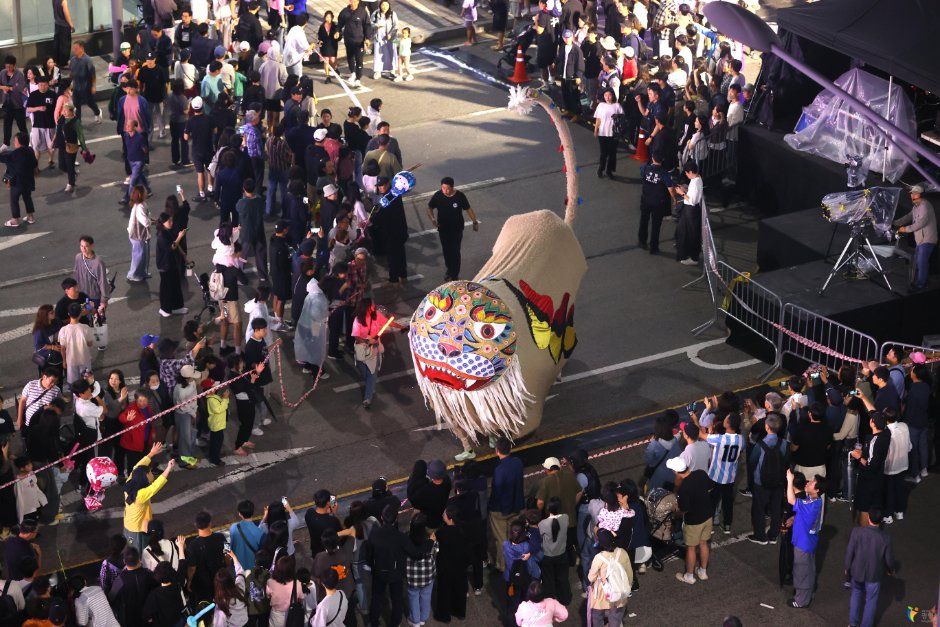
Street performances, markets and rest zones
Away from the stage and the parade, the programme fills the street with smaller, drop-in activities. The city lists random-play dance, street karaoke and busking by local youth performers, along with street acts such as stilt-walkers and mime. There is a social-economy zone with hands-on and market booths, a flea-market (“sharing market”) zone, and a Green Zone of rest areas with turf and seating where you can get off your feet.
There is also a “Gwangmyeong 9 Scenes” play zone built around the city’s designated local sights, using simple board- and mini-games as an introduction to what else is in the area. None of this needs a ticket, and much of it is aimed at families and casual passers-by rather than dedicated concert-goers, which makes the daytime hours a gentler way to experience the festival before the evening crowd builds.
Getting there without a car
This is one of the most transport-friendly festivals in this guide, because the venue is a subway station. Cheolsan Station is on Seoul Subway Line 7, and the festival grounds are the streets right at its exits — there is no intercity train, no shuttle to hunt for and no taxi leg at the end.
From Seoul Station, route-planners put the trip at about 44 minutes with a single transfer onto Line 7. From stations already on Line 7 — including Express Bus Terminal, Gangnam-gu Office and Konkuk University — it is a direct ride with no change at all. Because Line 7 runs across southern and eastern Seoul, most visitors can reach Cheolsan with one transfer or fewer. Check a live map app on the day for your specific starting point, and note which station exit puts you on the festival side of the street.
Road closures: do not drive
Driving is the single approach that will fail. For 2026, Gwangmyeong City is closing the roughly 300-metre stretch of Cheolsan-ro from the Cheolsan Station junction to the Jung-ang-ro intersection to all traffic from 09:30 on October 2 until 05:00 on October 5 — the closure runs well before and after the two festival days to allow setup and teardown.
The closure also affects buses. The city has said that branch buses 3, 6616 and 6638 and the Gwangmyeong 01 village bus, which normally use this section, will be diverted or re-routed during the event. If you were planning to arrive on one of those routes, check its temporary path, or default to Line 7, which is unaffected and drops you at the door.
Honest assessment
The case for Festival Gwangmyeong is straightforward: it is free, it is easy, and it delivers a real headline concert. Reaching a big outdoor music event on a single subway line from central Seoul, with the stage essentially at the station exit, is a genuine convenience that few festivals match, and a two-night band line-up topped by 10CM and Kim Jong-seo is more than a token programme. For a spontaneous evening out, or for anyone who likes Korean indie and rock, it is an easy yes.
The honest caveats are about what it is not. This is an urban street festival in a shopping district, not a destination with scenery, history or a distinctive local cuisine — Gwangmyeong has no signature regional food to build a day around, so the festival is the whole reason to come. It is a standing event on a closed road, so expect dense crowds at the headline sets and no seat, and it is genuinely unsuitable for driving given the multi-day road closure. Come by Line 7, treat the afternoon street programmes and the parade as the relaxed part of the day, and stay for the evening concert if the line-up is yours. As a low-cost, low-effort night out from Seoul it works well; as a full day-trip “experience” of Gwangmyeong itself, it is thinner, because the festival is essentially the attraction.