
Autumn · Seoul · Field listing
Gumcheon Siheung Haenggung Cultural Festival 2026
The essentials first: whether it is open, what it costs, how hard it is to reach and what to expect if you do not speak Korean.
When
Oct 4 — 4ConfirmedConfirmed dates
Where
Eunhaengnamu-ro, Siheung-dong, Geumcheon-gu, SeoulSeoul
Admission
FREEAdmission is free. The Korea Tourism Organization and the official Seoul festival page both list the event as free to attend, and no paid ticket for entry is published. Some hands-on craft sessions in previous years asked for materials on site, but no 2026 activity price list has been published.
From Seoul
About 30 minutes from central Seoul by Metro Line 1The festival is inside Seoul. Take Metro Line 1 to Geumcheon-gu Office Station, then a short ride on the Geumcheon 01 village bus toward the Siheung-dong ginkgo-tree stop, or walk up into Eunhaengnamu-ro. Eunhaengnamu-ro between Daeudang Pharmacy and the Siheung 5-dong Community Center is closed to traffic from 19:00 on October 3 to 04:00 on October 5, and buses 5537 and 6516 skip their usual stops there (temporary stops are set up near the ginkgo-tree market and the Eunhaengnamu-ipgu intersection), so check a live map app for stop changes before you set out.
Day trip
DOABLE IN A DAYThis is a single-day event inside Seoul that ends around 21:00, so it is a half-day trip from anywhere in the city rather than an overnight destination. There is no need to plan accommodation around it.
Hours
12:00-21:00 (three-part programme on October 4)
Organiser
Geumcheon-gu / Geumcheon Cultural Foundation, 070-4118-3354
Is this one for you?
Who it suits. This suits visitors already in Seoul who want a low-key, free half-day of traditional performance and a genuine royal-procession reenactment without leaving the city, and it works well for families because the craft and stage programming is aimed at residents of all ages. It is a poor fit if you are expecting a large headline festival or a single seated show: it is a compact one-day neighbourhood event, and outside the late-afternoon procession hour it is mostly local-artist stage performances along one street.
When to go. Come in the late afternoon. Stage performances run from midday, but the centrepiece — the royal-procession reenactment at roughly 17:00-18:00 and the 'Siheung Haenggung Night' of lanterns and music from about 18:00 to 21:00 — is what separates this from an ordinary neighbourhood stage event. Because it runs on a single day, October 4, there is no second chance if you arrive only for the midday programme and leave before the procession.
LOCAL WEATHER
Weather near the festival
The festival date is outside the current forecast window. Check again closer to your trip.
Korea Meteorological Administration forecast
Need something we do not list — a stall menu, a parking gate, a last bus? The Korea Travel Helpline answers in English around the clock: dial 1330 inside Korea, or +82-2-1330 from abroad.
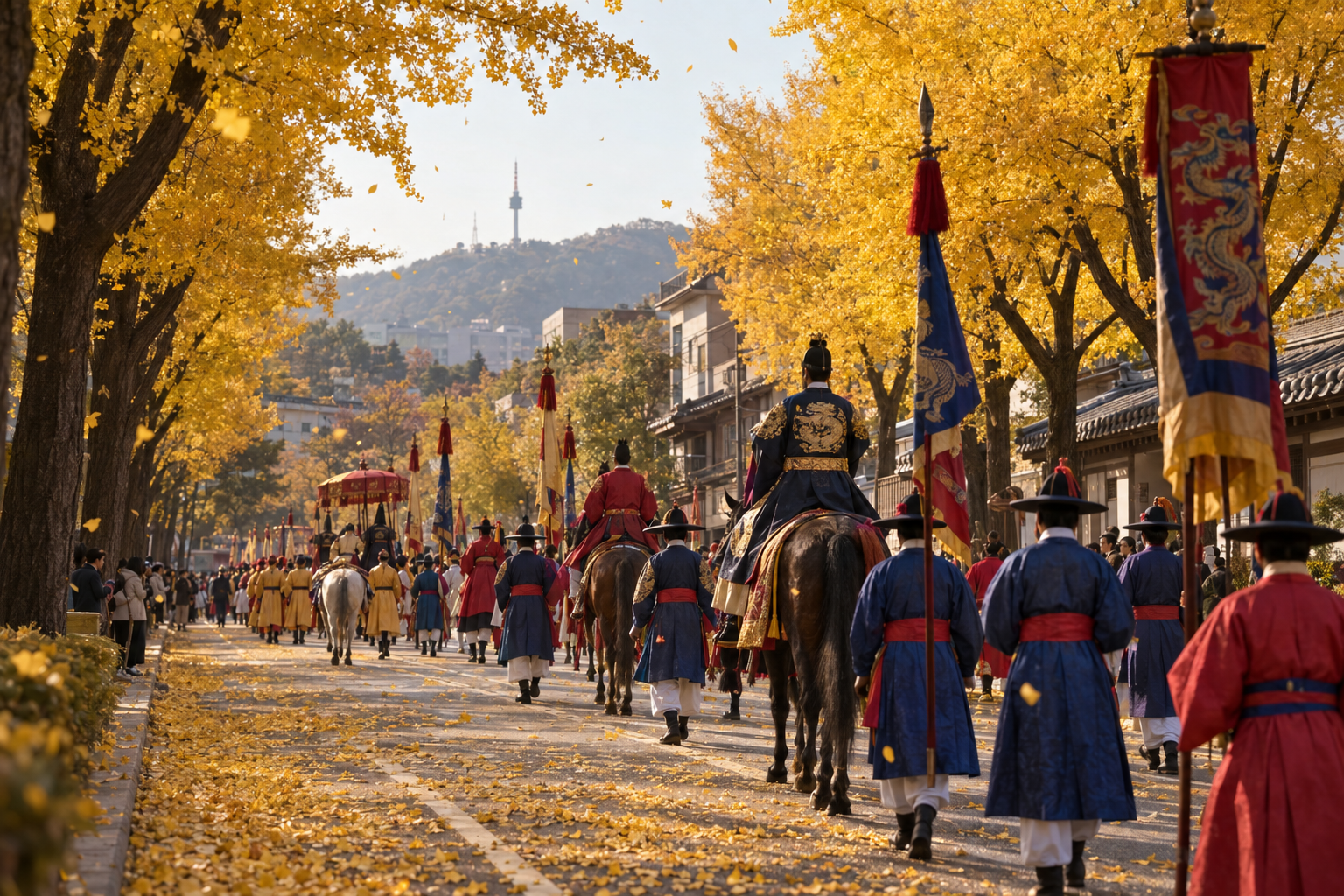
Geumcheon’s Siheung Haenggung Cultural Festival is a one-day neighbourhood event built around a piece of local history rather than a general autumn theme. In 1795, King Jeongjo travelled from Seoul toward Suwon on his eulmyo wonhaeng — the journey to mark his mother Lady Hyegyeong’s sixtieth birthday and to visit his father Prince Sado’s tomb. On the way he stopped for a night at Siheung Haenggung, a travel palace in what is now Geumcheon-gu. The festival takes that overnight halt as its reason for existing, and it is held along Eunhaengnamu-ro — literally “Ginkgo Tree Road” — in Siheung-dong.
For 2026 the festival is set for a single day, Sunday, October 4, running from around midday to 21:00. The Korea Tourism Organization and the official Seoul festival page both list it as free. The 2026 theme is yeomindongnak — roughly “ruler and people enjoying together” — and the day is timed to coincide with the wider Jeongjo royal-procession reenactment that moves through the region the same day.
What you actually do here
This is a street event, not a ticketed venue with one main stage. The confirmed 2026 programme is organised in three parts along Eunhaengnamu-ro, between Daeudang Pharmacy (대우당약국) and the Siheung 5-dong Community Center. As of the morning of October 4 the official Seoul festival page and the district’s news releases still show the event as scheduled, with no postponement, cancellation or sell-out notice.
The daytime block, billed as Haenghaeng Janchi, runs from 12:00 to about 17:30 and is made up of traditional performances: haegeum, pansori, Korean traditional music and dance, puppet theatre and street arts, with the National Traditional Arts High School (국립전통예술고) named among the performers in the district’s release, alongside local artists. This is the part to browse rather than plan around — you can arrive at any point and catch something on stage.
The centrepiece is the royal-procession reenactment at roughly 17:00-18:00. It sets off at 17:00 from the three-way junction at the Geumcheon-gu Office entrance and follows Eunhaengnamu-ro to the Siheung 5-dong Community Center, about 1.6 kilometres by the earlier published figure. The district’s release says around 100 residents take part, together with a traditional ceremonial band (chwitadae). What makes Geumcheon’s version distinctive is that the main royal roles are cast from residents: for 2026 the district recruited four people aged 19 and over to play King Jeongjo, Lady Hyegyeong, and the princesses Cheongyeon and Cheongson, selected by document review and interview. It is a community reenactment, so expect the tone of a neighbourhood celebration rather than a polished commercial parade.
After dark the programme becomes Siheung Haenggung Night, from 18:00 to 21:00. The district describes it as a recreation of the now-demolished travel palace through light, music and movement, in two shows: “Ya! Haenggung!!” (夜! 행궁!!), where lantern light and dancers evoke the palace buildings, and “Jeongjo Groove: Danshim Nanjang”, a set of traditional performances that includes lion dances and rope-jumping play. The official Seoul page also lists a citizen-participation traditional-music concert in this slot.
Alongside the stages there are hands-on activities. Visitors can take a role-card personality test that assigns a Joseon-era character, then complete five missions around the festival to earn a souvenir; there are also lantern-making, calligraphy and craft sessions, traditional games, themed photo zones, and the official page lists food trucks. No price list for the craft sessions was published, so bring a payment option in case a materials fee applies.
Programme and timetable
The single-day structure is unusually clear for a Korean festival, and it rewards timing your visit rather than dropping in at random:
- 12:00-17:30 — Haenghaeng Janchi: local-artist stage performances (haegeum, pansori, traditional dance, puppet theatre).
- 17:00-18:00 — Royal procession: the resident-led reenactment from the Geumcheon-gu Office entrance along Eunhaengnamu-ro (departure 17:00).
- 18:00-21:00 — Siheung Haenggung Night: the lantern-and-dance show “Ya! Haenggung!!”, the “Jeongjo Groove” traditional performances, and a participatory traditional-music concert.
These times come from the official Seoul festival page. The KTO listing gives a slightly narrower midday-to-20:00 window; where the two differ, the festival’s own page is the more detailed source, but if a specific hour matters to your plan, confirm it on the official page or by phone close to the date. The single most important point is that the procession and the evening programme are the reason to come — if you can only spend a couple of hours, spend them from mid-afternoon onward.
The procession, and what “joint reenactment” means
The Geumcheon procession is one leg of a much larger event. The 2026 Jeongjo Royal Procession Joint Reenactment is an annual relay in which Seoul and several Gyeonggi municipalities recreate Jeongjo’s route — from central Seoul through Geumcheon, Anyang and on to Suwon and Hwaseong — on October 4. The full reenactment involves thousands of participants and hundreds of horses across roughly 59 kilometres; Suwon and Hwaseong host the largest parade sections.
For a visitor, the practical takeaway is that Geumcheon is a good place to see the procession up close and free, on a human scale, within Seoul — but it is not the grand Suwon-Hwaseong parade. If the enormous version is what you want, that happens the same day further south and is a separate trip. If you want the local, resident-cast reenactment with a neighbourhood festival around it, Geumcheon is the place, and the timing is fixed at that single afternoon hour.
Getting there without a car
The festival is inside Seoul, which makes it easy to reach but also means driving is the wrong choice on the day. The nearest rail access is Metro Line 1 to Geumcheon-gu Office Station. From there the Geumcheon 01 village bus runs toward the Siheung-dong ginkgo-tree stop close to the festival street, and the walk up into Eunhaengnamu-ro is short from that point. Allow roughly 30 minutes from around Seoul Station before the local connection.
Road closures are now published, and they are wider than the procession hour. For the festival itself, Eunhaengnamu-ro from Daeudang Pharmacy to the Siheung 5-dong Community Center is closed to vehicles from 19:00 on October 3 to 04:00 on October 5. On top of that, the procession closes parts of the Geumcheon route from 16:30 to 18:00: the stretch from the intersection in front of Geumcheon-gu Office to the S-Oil station is partly controlled, and the stretch from the S-Oil station to the Siheung 5-dong Community Center is closed entirely. Plan to walk the last part.
Buses are rerouted as well. Route 5537 skips the stops at the Eunhaengnamu entrance, Hwain Electronics, Daeudang Pharmacy and Samhwa Pharmacy, with temporary stops near the ginkgo-tree market and the Eunhaengnamu-ipgu intersection; route 6516 also skips several stops along the street. If you were counting on a village bus along the street itself, expect it not to stop as usual and check a Korean map app on the day. No festival parking map or shuttle had been announced as of the morning of October 4, which is another reason to arrive by subway and walk in.
Is it worth the trip?
Because it is free, inside Seoul, and finished in an afternoon and evening, the bar for “worth it” is low, and the festival clears it if you match your visit to the schedule. The reenactment is a genuine one — cast from residents, tied to a real event that happened on this ground — and the after-dark lantern programme gives the day a second act. For travellers who want to see a Joseon-era royal procession without committing to the full Suwon-Hwaseong day, this is an efficient way to do it.
The honest limits are scale and duration. Outside the roughly 17:00-18:00 procession and the evening concert, this is a neighbourhood stage programme along one street, not a large festival with many simultaneous attractions. It runs on a single day, so there is no flexibility: miss October 4, or arrive only at midday and leave early, and you miss the part that makes the trip distinctive. Come in the late afternoon, watch the procession, stay for Siheung Haenggung Night, and treat the daytime performances as a bonus rather than the reason to travel.
Honest assessment
The strength of this festival is specificity. It is not a generic autumn event dressed in tradition; it commemorates an actual overnight stop on Jeongjo’s 1795 journey, on the street where the travel palace once stood, and it hands the lead roles to the people who live there. That local ownership, plus free admission and easy subway access, makes it an unusually low-effort way to see a royal-procession reenactment in Seoul.
Its weakness is that it is small and brief, and some detail is still unpublished as of the morning of the event — craft-session fees, the exact stage line-up, a rain plan and any parking or shuttle arrangement. Plan around the confirmed points: a single day on October 4, midday to about 21:00, free entry, the procession in the late afternoon, and public transport in and out. Bring a payment option for any on-site craft, arrive before 17:00 to claim a spot along the procession route, and check the official Seoul festival page, or call 070-4118-3354, before you go if the weather looks doubtful, since no rain plan has been published.
Questions worth asking
Is the Gumcheon Siheung Haenggung Cultural Festival free?
Yes. Both the Korea Tourism Organization and the official Seoul festival page list it as free to attend, and there is no entry ticket. No separate 2026 price list has been published for hands-on craft sessions, so bring a payment option in case a materials fee applies to something you want to make.
What time is the royal procession, and where does it pass?
The procession sets off at 17:00 from the three-way junction at the Geumcheon-gu Office entrance and runs along Eunhaengnamu-ro to the Siheung 5-dong Community Center; the official page gives the slot as 17:00-18:00. Around 100 residents take part, with a traditional ceremonial band (*chwitadae*) and residents in the royal roles. Line the street before 17:00 for a clear view rather than arriving as it begins.
Is this the same as the big Suwon and Hwaseong procession?
It is the Geumcheon section of the same day. The 2026 Jeongjo Royal Procession Joint Reenactment on October 4 is a relay across Seoul and Gyeonggi — Seoul, Geumcheon, Anyang, Suwon and on to Hwaseong. Geumcheon's festival is the local celebration built around the procession passing through, not the full Suwon-Hwaseong parade.
How do I get there from central Seoul?
It is inside Seoul. Take Metro Line 1 to Geumcheon-gu Office Station, then the Geumcheon 01 village bus toward the Siheung-dong ginkgo-tree stop, or walk up into Eunhaengnamu-ro. Allow roughly 30 minutes from around Seoul Station, and check a map app on the day because the procession closes part of the street.
Is there festival parking?
No festival parking map or shuttle had been announced as of the morning of October 4, and the street is closed to vehicles from 19:00 on October 3 to 04:00 on October 5. Use Metro Line 1 and walk or take a bus in rather than planning to drive and park nearby.
Which roads and buses are affected on the day?
Eunhaengnamu-ro from Daeudang Pharmacy to the Siheung 5-dong Community Center is closed from 19:00 on October 3 to 04:00 on October 5. Separately, the procession itself closes parts of the Geumcheon route from 16:30 to 18:00, with the stretch from the S-Oil station to the Siheung 5-dong Community Center fully closed. Buses 5537 and 6516 skip several stops on the street, with temporary stops near the ginkgo-tree market and the Eunhaengnamu-ipgu intersection. Details can change, so check a live map app.
What happens if it rains?
No rain plan, postponement or cancellation notice was found for this event as of the morning of October 4; the official Seoul festival page still lists it as scheduled. Ask the organiser on 070-4118-3354 or check the official page before you leave if the forecast is poor.
Before you goFestival Etiquette in Korea: What Visitors Get WrongBooking KTX Trains and Intercity Buses as a Foreign VisitorGetting Out of Incheon Airport and On to a FestivalKorean Festivals With Children: Toilets, Strollers and TimingStaying Online in Korea: SIM, eSIM and the Apps That MatterEating at a Korean Festival Without Speaking KoreanRain, Typhoons and Cancelled Festivals: How to Plan Around ThemHow to Pay for Things in KoreaT-money and Transit Cards in KoreaWhat to Wear to a Korean Festival, Season by Season
LAST UPDATED · Oct 4, 2026