
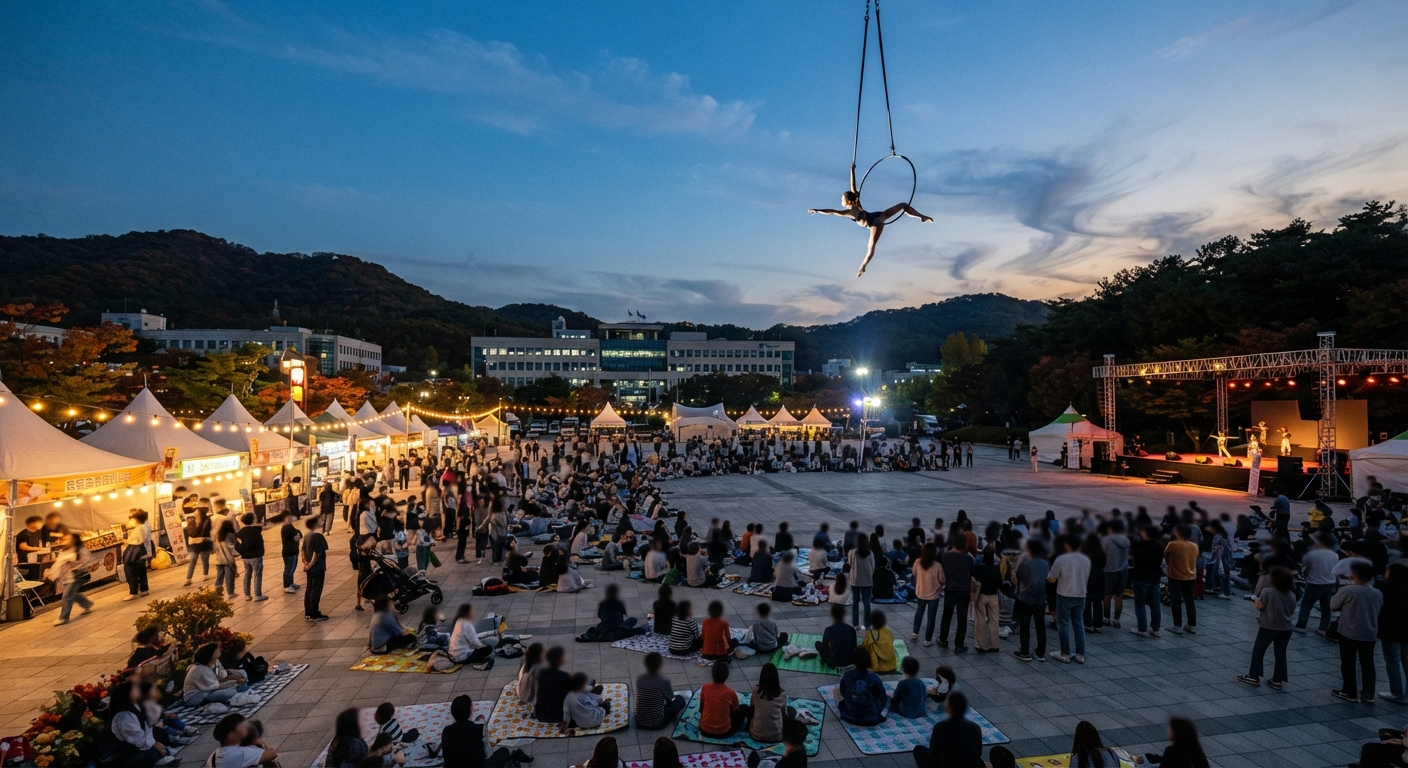
The Gwacheon Performing Arts Festival (과천공연예술축제), styled in English as GPAF, is an outdoor performing-arts festival held each September in Gwacheon, a small Gyeonggi city wedged against the southern edge of Seoul. It is not a music concert or a single ticketed show. The core of it is performance that happens in the open air — street theatre, outdoor madang plays (마당극), circus, aerial acts and processions — spread across the Citizens Plaza next to Gwacheon Citizens Hall, which visitors walk through rather than sit inside.
The festival has a long and slightly tangled history worth knowing, because its name has changed several times. It began in 1997 as an international outdoor-theatre event, and over the years passed through several titles before settling on its current “Performing Arts Festival” name in 2023. That is why you will see older references calling it the Gwacheon Festival or the Gwacheon Madang Festival; they describe the same lineage. For 2026 the confirmed run is September 18-20, a Friday-to-Sunday, and admission is free.
What you actually do here
The 2026 programme is built around scale and movement. The organisers list more than 50 performances across six distinct spaces in and around the plaza, and you are meant to move between them by preference rather than follow one fixed running order. Regional reporting notes this is roughly double the number of performances staged the previous year, so the site is fuller and the choice wider than in recent editions.
The formats are genuinely varied. Alongside Korean outdoor theatre there are invited international companies — the Dutch street-theatre group Close Act is confirmed among them — plus circus, aerial work and a parade that mixes professional artists with participating residents. The festival also runs its own recurring characters and worldbuilding: a mascot figure and a narrator thread the events together under a “GPAF City” concept, expanded for 2026 into a “GPAF City 2.0” theme with a new “GPAF Village” area. In practice that means themed zones and staging rather than a change to what you watch, but it explains the signage and layout once you arrive.
There is a strong participatory and family side. The published plan includes a citizen-and-artist parade through the adjoining roads, children’s experience zones, costume and make-up activities, and a flea market and farmers’ market alongside food stalls. Because so much is visual — aerial rigging, circus, procession — you can get a lot from a visit without following spoken Korean, though this guide has not field-checked how much English signage or interpretation is provided, so treat that as unconfirmed.
Programme and scale
Two set-piece ceremonies anchor the three days. The opening leans on aerial performance and a stage that mixes traditional and contemporary elements; the closing builds to a large stage finale with a fireworks display. Both are evening events. The detailed hour-by-hour daily grid is the document that matters if you are travelling for one specific act, and it is published by the organisers close to the event — check the official festival page before you go rather than assuming a fixed time here, because reliable per-performance start times were not confirmed at this writing.
The festival carries some track record behind the 2026 expansion. It has been recognised in Korea’s national festival-content awards in recent years and, for a fourth consecutive year, is run with reusable containers in its food areas as a sustainability measure. These are organiser and press claims about how the event is put together rather than things a first-time visitor will necessarily notice, but they point to a festival that is established and repeat-managed rather than improvised.
Tickets and what costs money
There is no admission ticket. Gwacheon City and the organising foundation describe the 2026 festival as free to attend across its programmes, and this guide found no gate charge for the performances, the parade or the ceremonies. That makes it an unusually low-commitment outing: you can turn up, watch several performances and leave without buying anything.
Free entry is not quite the same as everything being free. Hands-on experiences that use materials, and stalls at the flea market, farmers’ market or food zones, will naturally charge for what you take away. No separate price list for those was published in a form worth quoting, so bring a payment method but do not budget around a specific figure. The important, verifiable point is simply that there is no entrance fee.
Getting there without a car
This is the festival’s biggest practical advantage. The plaza sits directly on Seoul Subway Line 4 at Government Complex Gwacheon Station (정부과천청사). Seoul Station is on the same line, so you can ride straight there with no transfer in roughly 35 to 40 minutes. Leave the station by Exit 10, which connects to Gwacheon Citizens Hall through an underground passage, and the Citizens Plaza is immediately beside it. Few festivals in this guide are this simple to reach on public transport.
Local buses also serve the Government Complex stop for anyone coming from within Gyeonggi or from a different part of Seoul. If you are combining the trip with nearby attractions, note that Line 4 continues two stops south to Seoul Grand Park and the racecourse area, so the festival slots easily into a wider day around Gwacheon.
Driving is the weaker option. Parking by the venue is limited, and the organisers explicitly ask visitors to use public transport. During a three-day event that draws crowds into a compact plaza, arriving by subway will almost always be faster and less stressful than looking for a space near the Government Complex.
Day trip or overnight
For most visitors this is a day trip, and comfortably so. A single 35-minute subway ride each way, free entry and an evening finish mean there is little reason to book a hotel in Gwacheon specifically for the festival. Arrive in the late afternoon, walk the six spaces while it is light, and stay for an evening ceremony.
The one thing to plan around is the closing night. If the fireworks and the closing-stage finale are your priority, they run late on the final evening, so confirm a convenient last train back to Seoul before you commit to staying to the very end. Because the return is a short subway hop rather than an intercity journey, this is a much smaller constraint than at festivals several hours from the capital — but it is still worth a glance at the timetable.
Food on site and nearby
The festival runs food zones, food trucks and market stalls, and 2026 coverage mentions local Gwacheon restaurants taking part alongside a flea market and farmers’ market. That means there will be food on site, but this guide will not promise a particular dish, vendor or price, since the detailed 2026 food line-up was not published in a verifiable form.
Unlike many towns in this guide, Gwacheon is not known for a single geographic-indication food product — it is a dense administrative and parkland city on Seoul’s edge rather than a farming region — so this guide deliberately does not attach a “local specialty” to it. That is a more honest position than borrowing a neighbouring county’s produce. If you want a sit-down meal, central Gwacheon around the Government Complex has ordinary restaurants within walking distance of the plaza, and the city has separately promoted a shortlist of local eateries, but none is verified here as a specific recommendation.
Honest assessment
The Gwacheon Performing Arts Festival’s real strength is the combination of format and access. Outdoor theatre, circus, aerial work and a parade communicate quickly and read well to visitors who do not speak Korean, and the whole thing is free and about 35 minutes from central Seoul on a single subway line. For anyone who wants a taste of a Korean arts festival without a long journey, a ticket or a full-day commitment, it is one of the easiest choices around the capital this autumn.
Its limitations are the flip side of the same qualities. “More than 50 performances across six spaces” is a lot to navigate, and arriving without the daily schedule is a good way to see plenty of activity but miss the specific piece you wanted; the plaza is compact and busiest in the evenings, so it will feel crowded around the ceremonies. This guide could not confirm exact performance times, the organiser’s public contact number or the level of English interpretation on site, so treat those as things to check on the official festival page shortly before you travel. Come in the late afternoon, use the daylight to map the six spaces, and stay for an evening set piece — and if the closing fireworks matter, keep one eye on the last train home.