
Autumn · Seoul · Field listing
2026 Jungnang Yongma Waterfall Festival 2026
The essentials first: whether it is open, what it costs, how hard it is to reach and what to expect if you do not speak Korean.
When
Oct 10 — 10ConfirmedConfirmed dates
Where
Yongma Waterfall Park, Jungnang-gu, SeoulSeoul
Type
Culture & arts
Admission
MIXEDGeneral admission was free. The organizer stated that some hands-on programmes required a separate fee, but did not publish a dependable activity-by-activity price list in the event record.
Day trip
DOABLE IN A DAYThis was a one-day event inside Seoul with direct subway access, so it did not require an overnight stay for visitors already based in the city.
Hours
11:00-21:00
Organiser
Jungnang Culture Foundation Festival and Performance Team, 02-3407-6563
Is this one for you?
Who it suits. This suits families and visitors who want a compact district arts day with performances, exhibitions, simple making activities and food in one park. It is a weaker choice for travellers seeking a large destination festival, a detailed English-led programme or a full weekend event, because the 2026 edition ran for one day and no on-site language service was confirmed.
When to go. Arrive in the first half of the 11:00-21:00 operating window if the play and art zones matter, then stay later for the stage programme. Visitors coming only for DJ DOC, Simsin or Marronnier should check the final stage notice rather than assume an exact set time, because the official event page named the performers but did not publish their individual slots.
LOCAL WEATHER
Weather near the festival
The festival date is outside the current forecast window. Check again closer to your trip.
Korea Meteorological Administration forecast
Need something we do not list — a stall menu, a parking gate, a last bus? The Korea Travel Helpline answers in English around the clock: dial 1330 inside Korea, or +82-2-1330 from abroad.
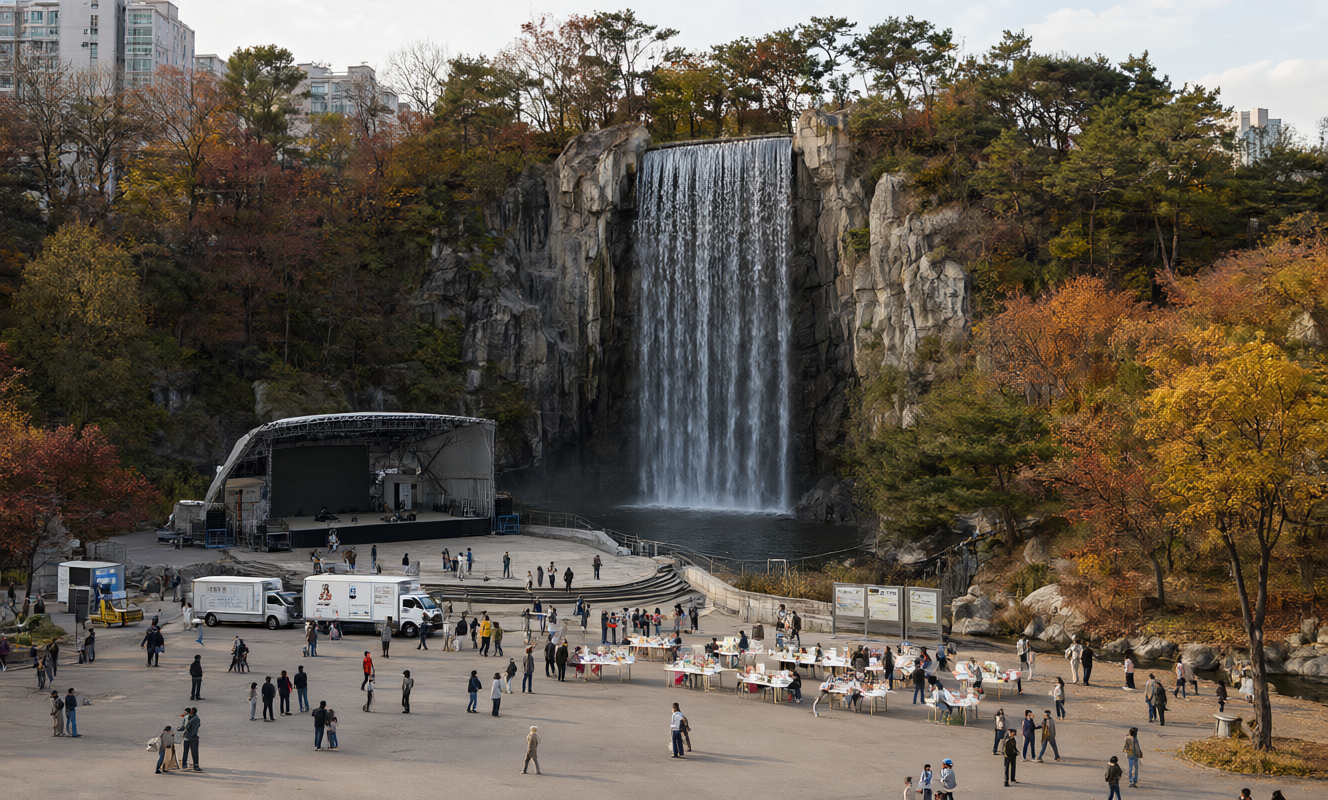
The official English listing uses the name 2026 Jungnang Yongma Waterfall Festival. This is a local culture-and-arts event in Yongma Waterfall Park, a former quarry landscape at the foot of Yongmasan in northeastern Seoul. The waterfall and cliff form the backdrop, but the festival itself is built around district performers, resident art groups, family activities and food rather than a waterfall show alone.
The final 2026 event record gives Saturday, October 10, from 11:00 to 21:00. This matters because an earlier Ministry of Culture annual plan listed October 16-17. The Seoul Culture Portal, Seoul at Night, the Jungnang Culture Foundation-linked listing, the national standard festival dataset and Jungnang-gu’s event publicity all converge on October 10. For an event guide, the later organiser announcement is the safer record.
General admission was free. Some hands-on programmes could charge separately, but the official overview did not supply a dependable list of prices or a single all-inclusive activity pass. The correct expectation was therefore a free park event with optional paid participation, not a completely free day in which every workshop material was included.
What you actually do here
The site was divided into four practical strands: the Yongma Stage, an art zone, a play zone and a food zone. That structure makes the event easier to understand than the long programme list. You could watch performances at the stage, move through exhibitions and a small market in the art area, take children to short craft activities in the play area, and use the food zone between programmes.
The Yongma Stage programme included the Jungnang History Quiz Contest, performances by Jungnang-gu municipal arts groups, a Jungnang Citizen Awards ceremony, Jungnang Cultural Center events and guest-singer performances. Jungnang-gu’s publicity also named a mime performer, Cotton Candy Man, plus youth artists and local artists. These were not described as one continuous concert; they were separate parts of a district festival programme across the day.
The published guest line-up was DJ DOC, Simsin and Marronnier. The official pages identified them but did not provide dependable individual set times in the text record checked for this guide. If one act was the only reason to attend, the sensible approach was to consult the final stage board or the organiser’s same-day notice rather than infer an evening slot from the overall 21:00 finish.
The art zone was more locally specific. It listed a poetry-and-painting exhibition by the Jungnang Writers Association, work by the Jungnang Photo Club and the Jungnang Digital Camera Poets Association, and a flea market connected with a sewing workshop. This is resident cultural activity presented in public, not a large commercial art fair. Browsing it gives context to the event’s community role, but visitors looking for museum-scale curation should keep their expectations modest.
The play zone listed an art truck, face painting, balloon art, chenille-stem doll making and mother-of-pearl keyring making in a norigae-inspired format. These are short, family-oriented activities rather than full classes. Because the organiser warned that some experiences were paid, ask the booth about price and remaining capacity before joining a queue. The main page did not confirm advance booking for these craft booths.
Programme and timing
The festival’s published operating window was 11:00-21:00. It was a single Saturday, so there was no quieter second day and no opportunity to return for programmes missed through overlap. A useful plan was to choose one priority: daytime family activities, local exhibitions, the history quiz or the later guest performances. Then use the other zones around it.
One precisely timed component was independently visible in Jungnang-gu’s official notice: the 7th Jungnang History Quiz Contest, scheduled for 13:00-15:00 on the main stage. The notice described a two-person-team preliminary round centred on true-or-false questions, followed by multiple-choice and written-answer questions for students in the final. Its advance application deadline was September 30, with on-site registration also announced. That timetable was for the quiz, not for the whole stage.
The named singers were presented as the closing concert line-up in local event publicity, but no exact start and finish for each artist appeared in the core official listing. Do not turn the overall 21:00 closing time into an invented concert schedule. Visitors who wanted the full range of activities had a reason to arrive earlier; visitors interested only in a named act needed the day’s stage notice.
Tickets, activities and food
No general gate ticket was required. The official Seoul records state free admission and describe the audience as open to everyone. There was no confirmed reservation requirement simply to enter the park or watch the public stage.
The qualification is important: some experience programmes were paid. The organisers did not publish a complete booth-by-booth tariff in the main listing, and payment methods were not field-checked. This guide therefore does not quote workshop prices or promise card acceptance. Treat each craft booth as a separate decision and confirm the amount before materials are handed out.
The food zone listed food trucks and a Jungnang Rose Cafe pop-up. That confirms that food and drinks were part of the site plan, but not which menus, prices, dietary options or payment methods were available. The rose-cafe name connects with Jungnang’s other major public event, the Seoul Rose Festival; it should not be read as proof of a particular rose-flavoured menu.
There is no local-specialty recommendation in this guide. The Ministry’s same-region clue, the Yeongyang Chili H.O.T Festival at Seoul Plaza, promotes produce from Yeongyang in Gyeongsangbuk-do and is not evidence that chilli is a Seoul or Jungnang specialty. No substitute product specific to Jungnang-gu was verified from an authoritative source, so inventing one would be less useful than leaving the field empty.
Getting there without a car
Yongma Waterfall Park is at 250-12 Yongmasan-ro, Jungnang-gu. The dependable public-transport anchor is Yongmasan Station on Seoul Subway Line 7, using Exit 2 and then following signs toward the park. Seoul and Jungnang public guidance place the park within a short walk of the station. The route enters a neighbourhood park rather than a purpose-built festival ground, so the permanent park name is the more reliable map destination.
From Seoul Station, an all-subway route is Line 4 to Dongdaemun History & Culture Park, Line 5 east to Gunja, and Line 7 to Yongmasan. Other starting points in Seoul will produce different transfers, so use the live Seoul subway planner rather than treating that sequence as universally fastest. No special rail ticket or intercity bus is needed: the festival remains inside the Seoul urban network.
The park’s proximity to Line 7 is also why a same-day visit is the natural choice. This is not an overnight destination from central Seoul. It can be paired with another city activity, but a tight schedule risks losing the later stage programme, and the single-day format leaves no recovery option if you arrive after a priority event.
Parking, shuttles and access limits
Yongma Waterfall Park has a public parking facility, but the sources checked did not provide a verified 2026 festival-day capacity, special fee, reservation system or overflow plan. They also did not confirm a dedicated festival shuttle or a dated road-control notice. Those omissions matter more than the mere existence of a parking pin on a map.
For that reason, Line 7 was the dependable recommendation. Anyone who drove needed to check same-day notices and be prepared for the regular park lot to be constrained. This guide does not repeat an unverified claim that parking would be easy, nor does it promise a shuttle that was not published.
The event was open to all ages, and several activities were clearly designed for children. However, an all-ages label is not the same as a verified accessibility survey. Step-free festival routes, accessible viewing areas, stroller storage and wheelchair access to each temporary booth were not confirmed in the event notice. Ask the organiser directly if one of those details determines whether the visit is workable.
Honest assessment
The strongest reason to go was the combination of a distinctive park setting and a programme made by the district: municipal arts groups, youth performers, resident writers and photographers, a local history contest and familiar pop acts all shared one site. It offered more variety than a single outdoor concert, while free admission made it reasonable to visit for only part of the day.
The trade-off was that this was still a compact, one-day borough festival. Much of the programme was community-facing, several activities were simple children’s crafts, and the official public text did not provide a minute-by-minute stage grid, detailed workshop pricing, parking operations or confirmed foreign-language support. International visitors could enjoy performances and visual activities, but should not assume English interpretation.
The waterfall is a real part of the setting, not proof that every hour revolves around it. The practical centre of the festival was the four-zone layout and main stage. Go for a local Seoul arts day in an unusual park, not for a large national festival or a wilderness waterfall experience. Arrive with one programme priority, use the subway, and leave room to adjust once you see the stage board and booth queues.
Questions worth asking
Was the 2026 Jungnang Yongma Waterfall Festival free?
General admission was free. The organiser noted that some hands-on activities charged separately, but a verified activity-by-activity price list was not published in the main event record.
When and where did the 2026 festival take place?
The final Seoul and organiser records give Saturday, October 10, from 11:00 to 21:00 at Yongma Waterfall Park, 250-12 Yongmasan-ro in Jungnang-gu. An earlier annual plan carried different dates, but the later event announcement superseded it.
Which subway station is closest to Yongma Waterfall Park?
Use Yongmasan Station on Seoul Subway Line 7 and leave by Exit 2. Official local guidance places the park a short walk from the station; follow the park signs rather than searching for a temporary festival entrance.
Who performed at the 2026 festival?
The published guest-singer line-up named DJ DOC, Simsin and Marronnier. The main listing did not give a reliable individual set time for each act, so visitors needed the final stage notice for exact sequencing.
Was parking or a festival shuttle confirmed?
The park has a public parking facility, but a verified festival-day capacity, road-control plan and dedicated shuttle timetable were not published in the sources checked for this guide. Subway access via Yongmasan Station was the more dependable plan.
Before you goFestival Etiquette in Korea: What Visitors Get WrongBooking KTX Trains and Intercity Buses as a Foreign VisitorGetting Out of Incheon Airport and On to a FestivalKorean Festivals With Children: Toilets, Strollers and TimingStaying Online in Korea: SIM, eSIM and the Apps That MatterEating at a Korean Festival Without Speaking KoreanRain, Typhoons and Cancelled Festivals: How to Plan Around ThemHow to Pay for Things in KoreaT-money and Transit Cards in KoreaWhat to Wear to a Korean Festival, Season by Season
LAST UPDATED · Oct 12, 2026