
Autumn · Seoul · Field listing
King Jeongjo's Royal Parade 2026
The essentials first: whether it is open, what it costs, how hard it is to reach and what to expect if you do not speak Korean.
When
Oct 4 — 4ConfirmedConfirmed dates
Where
Gyeongbokgung Palace, Jongno-gu, Seoul (Seoul segment)Seoul
Type
History & tradition
Admission
FREEGeneral viewing along the route is free, and the Korea Tourism Organization lists the event as free with separate charges for some participatory programmes. No reliable 2026 price list for those individual paid activities had been published at this update, so no figure is quoted here.
From Seoul
In central Seoul — about 3-5 minutes' walk from Gyeongbokgung StationThe Seoul segment centres on Gyeongbokgung Palace. Take Seoul Subway Line 3 to Gyeongbokgung Station and leave from Exit 5, which opens beside the palace, or use Line 5 Gwanghwamun Station and walk north. No intercity travel is needed for the Seoul portion; to follow the procession onward to Suwon, use a Line 1 train or a KTX toward Suwon Station separately.
Hours
09:00-21:00 (the overall multi-city window on October 4; the Seoul segment runs from a morning departure ceremony, and the Suwon Hwaseong Parade starts at 15:30)
Organiser
Seoul +82-2-786-0610; Suwon +82-31-5191-2367; Hwaseong +82-70-4202-1017
Is this one for you?
Who it suits. This suits visitors interested in Joseon-era pageantry and history who are happy to watch a moving street procession — costumes, horses, palanquins and a citizen parade read clearly without any spoken explanation, and central-Seoul access plus free viewing make it easy for families. It is a weak choice if you want a single seated performance, a quiet outing, or the whole spectacle in one fixed spot: the procession moves through the city and then continues in Suwon and Hwaseong, so following it means standing, walking and dealing with crowds and road closures.
When to go. This is a one-day event on Sunday, October 4, so there is no second chance the same week. For the Seoul segment, arrive before the morning departure ceremony at Gyeongbokgung to get a clear position rather than the back of a crowd. If the large street procession is your priority, pick a spot along the route early; if you would rather see the Suwon Hwaseong Parade, note it begins at 15:30 and plan the transfer with time to spare.
LOCAL WEATHER
Weather near the festival
The festival date is outside the current forecast window. Check again closer to your trip.
Korea Meteorological Administration forecast
Need something we do not list — a stall menu, a parking gate, a last bus? The Korea Travel Helpline answers in English around the clock: dial 1330 inside Korea, or +82-2-1330 from abroad.
King Jeongjo’s Royal Parade (정조대왕 능행차 공동재현) re-enacts one of the best-documented royal journeys of the Joseon dynasty. In 1795, King Jeongjo travelled from Seoul toward Suwon and Hwaseong to mark the sixtieth birthday of his mother, Lady Hyegyeong (혜경궁 홍씨), and to visit the tomb of his father, Crown Prince Sado (사도세자). The whole procession was recorded in detail in the “Wonhaeng Eulmyo Jeongni Uigwe” (원행을묘정리의궤), one of the Joseon royal protocols; the wider Uigwe collection was inscribed on UNESCO’s Memory of the World Register in 2007. That surviving record is why the modern re-enactment can reconstruct the order of march, the costumes and the ceremonies rather than guessing at them.
For 2026 the confirmed date is Sunday, October 4, a single day. The event is a joint re-enactment staged by Seoul, Gyeonggi Province, Suwon and Hwaseong, so it is not one show in one place — it is a procession that begins in Seoul and is carried on through Suwon and Hwaseong on the same day. This guide is written from the Seoul segment, which the Korea Tourism Organization registers at Gyeongbokgung Palace in Jongno-gu, but it flags where the day continues beyond the capital.
One date caution is worth stating plainly. The standalone parade microsite still showed a pop-up reading “October 6 (Sun)” when checked, but October 6, 2026 is a Tuesday, so that line contradicts its own day-of-week. The Korea Tourism Organization’s Korean and English records, the Suwon Cultural Foundation’s 2026 parade page and every September 2026 news report agree on October 4, which is a Sunday. This guide uses October 4 and treats the microsite line as leftover text.
What you actually do here
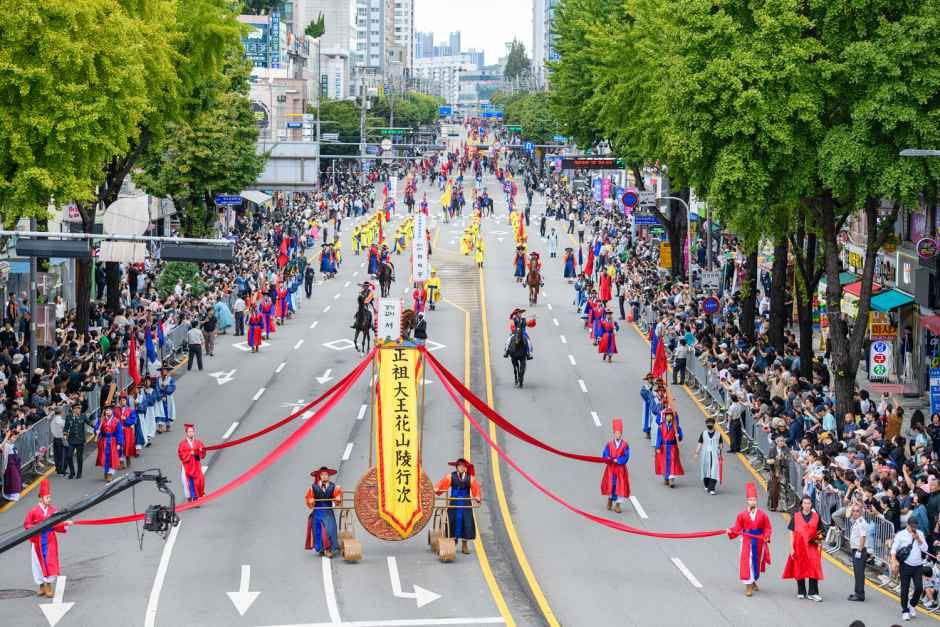
The Seoul segment is a procession you watch and, in part, walk with — not a seated performance. The Korea Tourism Organization lists a departure ceremony (“출궁의식”) and a citizen parade as the Seoul elements, and local listings add a walking event, a “narye” performance and a tea-serving programme. The citizen procession sets out from Gyeongbokgung, the foremost palace of the Joseon dynasty, and heads south along the historic route; Seoul-side reporting describes a Gangbuk stretch of roughly seven kilometres reaching toward Nodeulseom (노들섬) on the Han River.
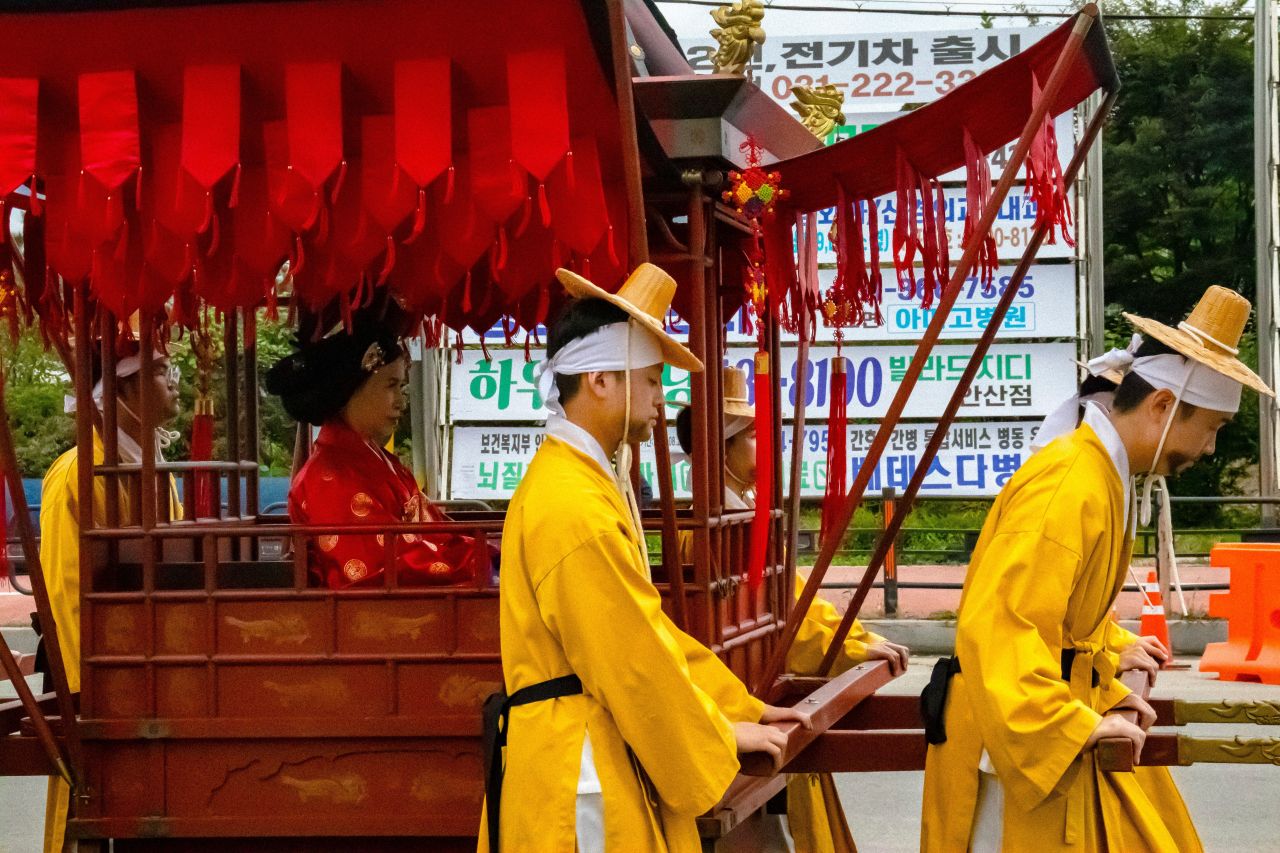
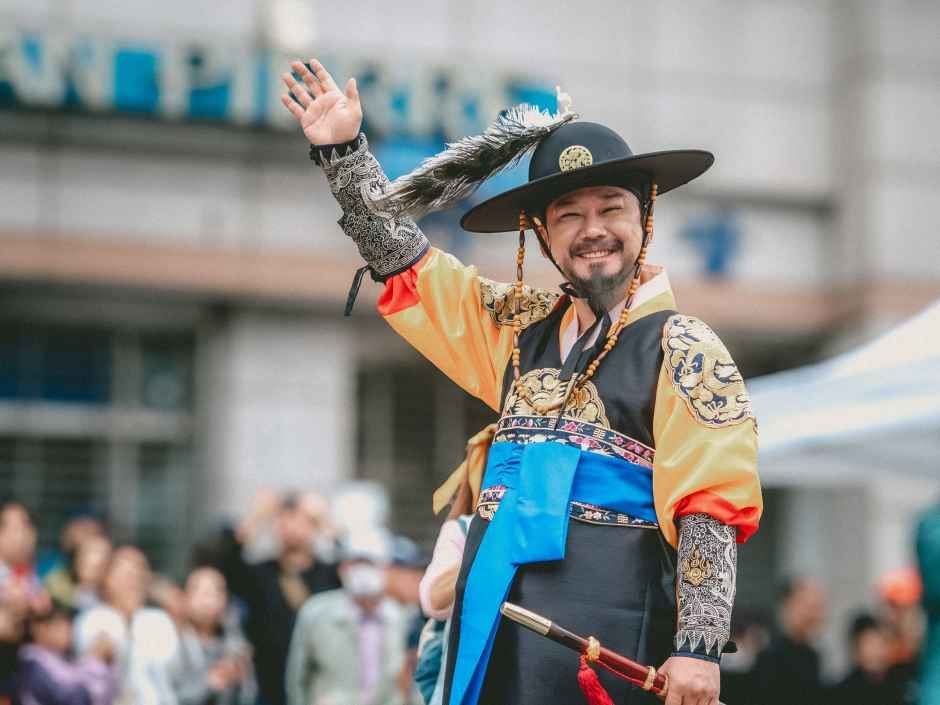
What you see is a long, ordered column: standard-bearers, mounted riders, officials in rank costume, musicians, and palanquins carrying the figures who represent the king and his mother. Because it moves, the best experience is less about one vantage point and more about choosing a stretch of the route, arriving early enough to stand at the front of the barrier line, and letting the whole procession pass. Families can treat it as an open-air history lesson that needs no ticket and no Korean to follow.
If you want the fuller picture of the day, the procession does not end in Seoul. It is designed to be handed on to Suwon and then Hwaseong, which is the point of a “joint” re-enactment: the 1795 journey took eight days over about sixty kilometres, and the modern version compresses that idea into cooperating city segments on one date.
The history behind the parade
The 1795 journey was political as much as personal. King Jeongjo used the trip to his father’s tomb and his mother’s birthday celebration to project authority and, according to the record, to meet ordinary people along the way — receiving petitions and sharing parts of the event with the public rather than keeping it inside palace walls. That “with the people” framing is what the organisers lean on when they describe the modern event as a citizens’ festival rather than a costume display.
The reliability of the re-enactment rests on the “Wonhaeng Eulmyo Jeongni Uigwe”, the official protocol that documented the procession’s composition, logistics and ceremonies. The Uigwe were the Joseon court’s meticulous records of state events, and it is that documentary tradition — not later imagination — that lets today’s organisers reconstruct the ranks and the ritual. It also explains why the procession is treated as heritage in Seoul, Suwon and Hwaseong alike.
Programme and timetable
Treat the times below as the confirmed anchors and check the official notice for the minute-by-minute grid, which was not published in a dependable 2026 form when this was written. The Korea Tourism Organization gives an overall operating window of 09:00-21:00 across the cities on October 4. That is the multi-city span, not proof that any one place is active for all twelve hours.
The Seoul segment runs in the morning, opening with the departure ceremony at Gyeongbokgung before the citizen procession moves off. The Suwon portion is later in the day: the Suwon Hwaseong Parade begins at 15:30, with a combined percussion troupe and the main re-enactment column setting out from the Suwon sports-complex area and moving through Janganmun gate toward Haenggung Square. Hwaseong runs its own modern-section and traditional-section processions as the third partner city.
Because this is a single-day, moving event, the planning question is not “which hours are open” but “which segment do I want and where do I stand.” If you only have the morning, stay in Seoul for the departure and the early procession. If you can give the whole day, position for the Seoul start, then travel to Suwon in time for the mid-afternoon parade.
Getting there without a car
The Seoul segment is unusually easy to reach because it is in the centre of the capital. Take Seoul Subway Line 3 to Gyeongbokgung Station and leave from Exit 5, which opens right beside the palace; Line 5 Gwanghwamun Station is a short walk to the south. There is no intercity leg for the Seoul portion, which is part of what makes this a low-effort outing compared with most festivals on this site.
Following the procession onward is where planning matters. Seoul and Suwon are connected by frequent Line 1 trains and by KTX services toward Suwon Station, but the parade’s own road closures and the crowds around Janganmun and Haenggung Square can slow the last stretch on foot. If you intend to catch the 15:30 Suwon Hwaseong Parade after the Seoul morning, leave a generous buffer rather than assuming a tight connection, and use a Korean map app on the day to route around any temporary controls. Detailed 2026 road-closure maps had not been published in a reliable form at this update, so confirm them on the official notice before travelling.
Tickets, fees and booking
There is no general admission ticket. You can watch the procession from the public route for free, and the Korea Tourism Organization records the event as free with separate charges only for some participatory programmes. That makes the core experience — the departure ceremony and the street procession — genuinely free to attend.
Free viewing is not the same as every activity being free. Some hands-on or participatory programmes are listed as separately charged, but a dependable 2026 price list, booking method and capacity for those had not been published when this guide was written. If a specific participatory programme is the reason for your visit, contact the relevant city office — Seoul at +82-2-786-0610, Suwon at +82-31-5191-2367 or Hwaseong at +82-70-4202-1017 — rather than relying on a previous year’s figure.
Honest assessment
The strength of this event is legibility. A royal procession communicates instantly: rank costume, horses, palanquins, banners and a marching column tell a clear story without a word of Korean, and the historical basis in a documented 1795 journey gives it more substance than a generic costume parade. In central Seoul it is also one of the easiest things on this site to reach, and free general viewing makes it a low-risk plan for families and first-time visitors.
Its weaknesses are the flip side of the same design. It is a moving, one-day, multi-city event, so there is no single seat and no second chance the same week. Following it properly means standing in a crowd, walking a route and, if you want more than the Seoul morning, adding a train transfer to Suwon around road closures. Anyone hoping for a quiet, contained outing or a fixed stage show will be better served elsewhere.
Two practical cautions carry over from the research. First, use October 4 as the date and ignore the microsite’s inconsistent “October 6” line, but still check the official notice board close to the day. Second, the fine-grained schedule and the road-closure maps were not published in a dependable 2026 form at this update, so treat the anchors here — the morning Seoul departure and the 15:30 Suwon parade — as the fixed points and fill in the rest from the official site immediately before you go.
Questions worth asking
What date is the 2026 parade, and is it really October 4?
Yes. The Korea Tourism Organization, the Suwon Cultural Foundation and every September 2026 news report give Sunday, October 4, 2026. The standalone parade microsite still displayed a stray 'October 6 (Sun)' in a pop-up, but October 6 is a Tuesday, so that line is inconsistent with its own day-of-week and reads as leftover text. Treat October 4 as the date and check the official notice board shortly before travelling.
Is it free?
General viewing along the route is free. The Korea Tourism Organization lists the event as free with separate charges for some participatory programmes, but no dependable 2026 price list for those individual activities was published at this update, so no amount is quoted here.
Where does the Seoul segment start, and how do I get there?
The Seoul segment centres on Gyeongbokgung Palace. Take Seoul Subway Line 3 to Gyeongbokgung Station and use Exit 5, which opens beside the palace, or use Line 5 Gwanghwamun Station and walk north. No intercity travel is needed for the Seoul portion.
Is this all in Seoul, or does it move?
It moves. The full event is a joint re-enactment across Seoul, Suwon and Hwaseong on the same day, organised by Seoul, Gyeonggi Province, Suwon and Hwaseong. The Seoul citizen procession runs in the morning; the Suwon Hwaseong Parade begins at 15:30. Following more than one city means using the train between them.
What actually happens during the day?
The Korea Tourism Organization lists a departure ceremony and a citizen parade in Seoul; welcoming ceremonies and the Suwon Hwaseong Parade in Suwon; and modern-section and traditional-section processions in Hwaseong. Expect costumed marchers, horses and palanquins rather than a single stage show.
Before you goFestival Etiquette in Korea: What Visitors Get WrongBooking KTX Trains and Intercity Buses as a Foreign VisitorGetting Out of Incheon Airport and On to a FestivalKorean Festivals With Children: Toilets, Strollers and TimingStaying Online in Korea: SIM, eSIM and the Apps That MatterEating at a Korean Festival Without Speaking KoreanRain, Typhoons and Cancelled Festivals: How to Plan Around ThemHow to Pay for Things in KoreaT-money and Transit Cards in KoreaWhat to Wear to a Korean Festival, Season by Season
LAST UPDATED · Sep 21, 2026