
Autumn · Seoul · Field listing
Maponaru Salted Shrimp Festival 2026
The essentials first: whether it is open, what it costs, how hard it is to reach and what to expect if you do not speak Korean.
When
Oct 16 — 18ConfirmedConfirmed dates
Where
Peace Plaza (Pyeonghwa Gwangjang), World Cup Park, Mapo-gu, SeoulSeoul
Type
History & tradition
Admission
FREEEntry is free, and the experiences named in the district's announcements (shrimp catching, salting, the mock auction, the kimjang session, the 19-metre kimbap roll and the bossam lunch) are reported as free. What you pay for is whatever you buy: salted shrimp, specialty goods and food from the booths. Some free events are first-come and limited, so being free does not mean you can join every one.
From Seoul
About 20-30 minutes by subway from central Seoul, plus a walk of around 10 minutesTake Seoul Subway Line 6 to World Cup Stadium Station and leave by Exit 1; the park's Peace Plaza is a walk of roughly 10 minutes. From Seoul City Hall, route-planner listings give about 21 minutes via Line 2 to Hapjeong and a change to Line 6. Mapo-gu Office Station (Line 6, Exit 8) is the other approach listed on the district's older festival page; the opening procession starts at the district office.
Hours
Fri Oct 16 10:30-21:00; Sat Oct 17 09:00-21:00; Sun Oct 18 10:00-20:30. Sales market and booths 10:00-20:00 daily; traditional-games and experience grounds 10:00-18:00 daily.
Organiser
Mapo-gu Office, Culture and Art Division, 02-3153-8350
Is this one for you?
Who it suits. This suits people who like food markets and want to see a Seoul kimjang-season ritual as locals actually do it: browsing a dozen salted-shrimp stalls, watching the magistrate's procession, and joining family-style activities. It is a weaker choice if you want a quiet or photography-focused outing, since the park is expected to be crowded and the headline events are stage shows with Korean-language hosting. It also helps to have a use for what you buy, because the main product is a cooking ingredient rather than a snack.
When to go. Go on Friday morning if you want the opening procession, which leaves Mapo-gu Office at 10:30 and arrives at the park for the barge-landing ceremony. Go on Saturday or Sunday around midday for the busiest programme, but note that the bossam lunch (Sunday 13:30) and the children's kimbap roll (Saturday 14:00) are first-come, so arrive well before the listed time. Evenings are for the stage concerts; the sales market closes at 20:00 on every day.
LOCAL WEATHER
Weather near the festival
Korea Meteorological Administration forecast
Need something we do not list — a stall menu, a parking gate, a last bus? The Korea Travel Helpline answers in English around the clock: dial 1330 inside Korea, or +82-2-1330 from abroad.
Maponaru was a river port on the Han in the Joseon period. Salted shrimp, salt and other goods from the coasts were landed there and sold on to the capital, which is why Mapo is associated with saeujeot, the tiny salted shrimp used to season kimchi. Mapo District began this festival in 2008, and 2026 is the 19th edition. It is held in October because kimjang, the household kimchi-making season, is about to start.
The confirmed dates are October 16-18, 2026, at Peace Plaza in World Cup Park. Seoul’s festival portal lists admission as free and gives daily hours of 10:30-21:00 on Friday, 09:00-21:00 on Saturday and 10:00-20:30 on Sunday. The district expects a large crowd: coverage cites more than 500,000 visitors a year.
What you actually do here
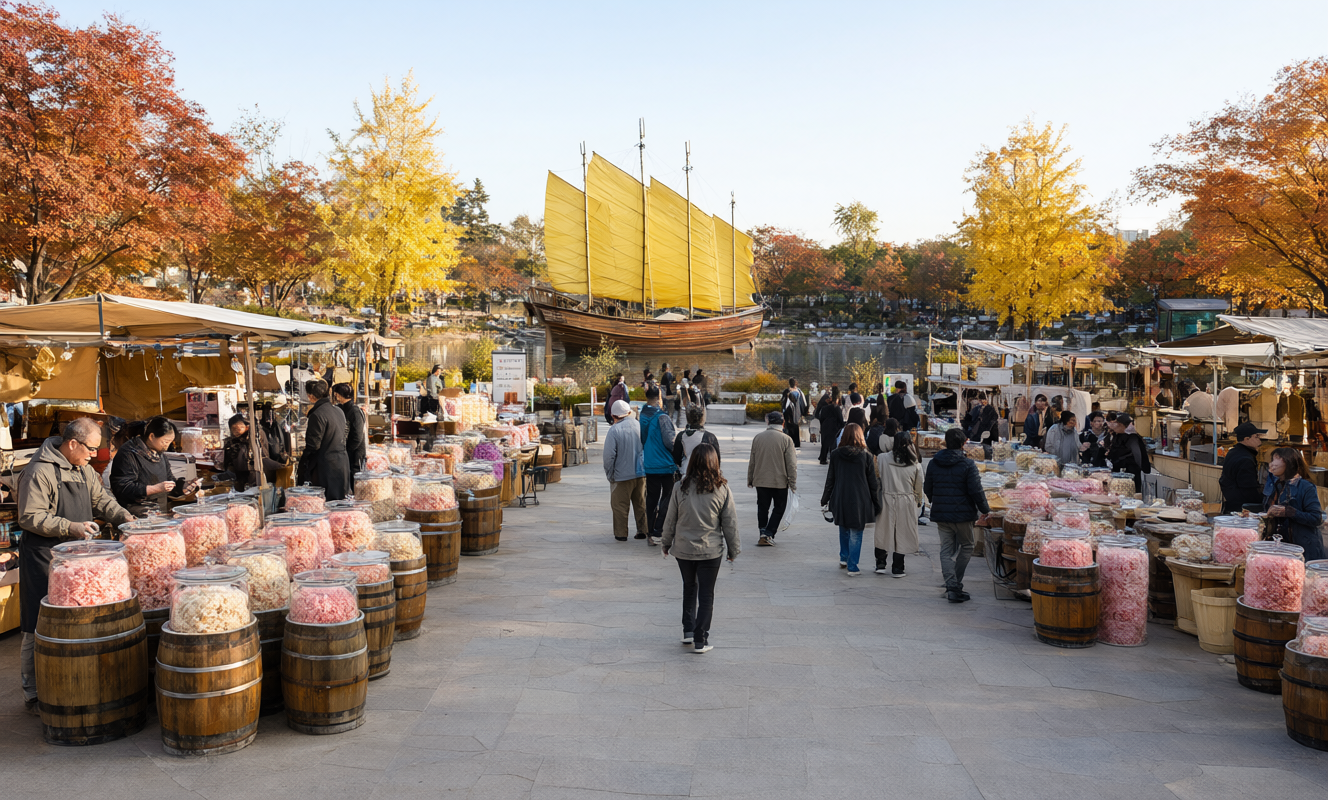
The core of the festival is a market. Local reporting counts 12 salted-shrimp booths this year, up from eight, selling product from Ganggyeong, Gwangcheon, Sinan, Buan and Sorae, at prices announced as 10-15% below normal market rates. The range covers the three grades Koreans buy for kimjang: ojeot, yukjeot and chujeot, named for the fifth month, the sixth month and autumn. The district says origin labelling is strictly enforced, so every jar should say where it came from. A new shrimp-food booth serves dishes such as shrimp pasta and shrimp fried rice. Alongside it are about 14 booths of specialty goods from sister cities, plus ordinary festival food such as barbecue, banquet noodles and bindaetteok. The official programme also lists a sales market, district information booths and a shaded rest area with photo spots.
There are free hands-on activities running through the festival, according to the district: shrimp catching, making salted shrimp, and a mock auction. Traditional games, snacks and a children’s air-bounce area sit in the experience grounds, open 10:00-18:00. The district also describes an old-Mapo photo exhibition (the “Maponaru Memory Tunnel”), and press reports a shrimp-themed AR game, a limbo contest and shrimp-necklace and slime making for families.
Two extras are easy to miss. A “Flag Bridge” over Bulgwang Stream is hung with the festival’s posters from its 19 years, and a photo booth prints pictures on the spot (the “Hangang Photography Studio”). In the evenings an LED-lit traditional boat is displayed on Nanji Pond. The district also runs a free tax-consultation booth near the specialty-goods market from 09:00 to 18:00 on all three days, with 15-minute one-to-one sessions and no reservation; it is aimed at Korean residents, so most visitors can skip it.
Programme and timetable
These are the official slots; treat each as subject to change on the day.
Friday, October 16
- 10:30-12:00: parade, a re-enactment of a yellow-sailed barge landing, and a madang-nori open-air folk play. The procession of about 200 people, led by the district mayor in magistrate’s costume, starts at Mapo-gu Office and walks to the park.
- 14:00-15:00: kimjang with foreigners (shrimp-paste kimchi making) on the special stage. Coverage mentions roughly 20 foreign participants, so ask or check before assuming you can drop in.
- 17:00-18:00: Mapo cultural concert, the first part of the opening ceremony.
- 18:00-19:30: opening ceremony part two, with Jung Dong-ha, Hong Kyung-min, Ali and Maya.
- 19:30-21:00: a TBS special public-broadcast concert at the waterside stage, with veteran singers including Jung Su-ra (정수라).
Saturday, October 17
- 09:00-12:00: a residents’ walking event run by the district sports association.
- 11:30-12:30: tightrope performance.
- 14:00-15:30: the 19-metre kimbap roll, led by the cooking researcher Lee Hye-jung (이혜정); reported for 38 children in two teams, first-come.
- 17:30-20:00: the nationwide “Mom and Dad” singing contest, with guest singers including Jadu (자두) and Yoon Su-hyun (윤수현). Around 200 entrants took part in the preliminary round on October 9.
- 20:00-21:00: classical and jazz concert.
Sunday, October 18
- 10:00-11:00: district residents’ talent stage.
- 11:30-13:00: a Hongdae indie-band relay.
- 13:30-14:30: bossam lunch of pork, shrimp paste and kimchi, about 200 people, first-come.
- 17:00-18:00: ceremony for Mapo residents’ day.
- 18:00-20:30: closing show with fireworks and laser show, featuring Park Hyun-bin and Hong Jin-young among others.
Tickets, fees and booking
There is no ticket. The festival is free to enter, and the announced experiences are reported as free. Buying product is the only cost: check the origin and price on the label before you buy salted shrimp. I did not find a registration system for the first-come events, so plan on turning up early. The organiser’s number is 02-3153-8350, a Korean-language line.
Two limits are worth knowing. The Saturday kimbap roll takes only 38 children, so it is not an activity for adults. The Sunday bossam lunch is for about 200 people, which is a small number against a crowd the district puts at 500,000 a year. Treat both as bonuses if you happen to be nearby, not as the reason for the trip.
Getting there without a car
Line 6 is the simplest route: ride to World Cup Stadium Station, take Exit 1, and walk about 10 minutes via the market and parking area to Peace Plaza. Route planners put the trip from Seoul City Hall at about 21 minutes (Line 2 to Hapjeong, then Line 6); allow about 20-30 minutes from central Seoul, plus the walk.
Mapo-gu Office Station, also on Line 6, is the alternative: the district’s older festival page lists Exit 8 for it. That page dates from 2019, so confirm the walk on a map. Buses that serve the Mapo Agricultural Market and World Cup Park stops include 271, 571, 710, 7011, 7013, 7715, 9711 and village bus Mapo 08, according to the park listings. Route numbers can change, so check a live app on the day.
Parking, shuttles and traffic control
I did not find a published parking plan, shuttle or road-control notice for 2026, on the official portal, the district’s festival page or in press coverage. With a crowd of this size, the district says it will deploy about 600 staff over the three days, including safety officers, officials and volunteers, with duties that include traffic management, order and medical support. Take that as a sign that roads near the park may be busy, but do not assume a particular shuttle exists. A park car park near Peace Plaza does exist, but its event-day rules and fees for this weekend are not confirmed, so I have not quoted any.
Food on site and nearby
Food booths are on the grounds, and the district lists the festival market as open until 20:00. Press reports about 12 food stalls serving ordinary festival fare such as barbecue, banquet noodles and bindaetteok (mung-bean pancakes), plus a new shrimp-food booth with dishes like shrimp pasta and shrimp fried rice. That booth is the one place the festival’s theme turns up on a plate, so try it if you want to taste shrimp without buying a jar. The bossam lunch on Sunday is the only free meal in the programme, and it is limited. Expect the booths to be busier on the weekend, and queues to build around the stage events.
I did not find a list of restaurants outside the park, so I am not recommending one. The park sits next to the Mapo agricultural and fisheries market, which the Line 6 walking route passes, but I could not confirm what is open there during the festival.
Language help for foreign visitors
Press coverage of the district’s plans says English leaflets and QR-code guides will be handed out for foreign tourists, including at tourist information centres and guesthouses. I could not confirm where the leaflets will be at the park itself. The stage shows, the hosting and most booth signs are in Korean, and the foreigners’ kimjang session on Friday is the one item built for non-Korean speakers. I did not check whether staff at the booths speak English, so the fact card leaves that blank.
Honest assessment
This is a local kimjang market with a festival wrapped around it, rather than a polished tourist spectacle. The appeal is seeing how Seoulites buy shrimp paste for the winter and sample the produce of the ports it comes from. The weaker points are the language and the crowd: the stage shows are in Korean, and the plaza will be busy, especially on Saturday and Sunday.
If you only have a few hours, go mid-morning, look at the booths, join one of the free activities, and leave before the evening concert crowd. Salted shrimp is a very salty cooking ingredient, so check whether you can take it with you and how you will carry it before buying a large jar. No rain plan was published on the official page, so check the district’s announcements the morning of your visit.
Questions worth asking
Is the Maponaru Salted Shrimp Festival free?
Yes. Seoul's festival portal lists the fee as free, and the experiences announced by the district are reported as free. You pay only for shrimp and other products or food you buy at the booths.
When is the festival and what are the opening hours?
October 16-18, 2026. Friday is 10:30-21:00, Saturday 09:00-21:00 and Sunday 10:00-20:30. The sales market runs 10:00-20:00 each day and the traditional-games grounds 10:00-18:00.
How do I get to the festival by subway?
Take Line 6 to World Cup Stadium Station, Exit 1, and walk about 10 minutes through to Peace Plaza in World Cup Park. Mapo-gu Office Station on the same line (Exit 8) is another option on the district's festival page, and the opening procession starts from the district office.
Is there parking or a festival shuttle?
I did not find a published 2026 parking plan or shuttle for this festival, so none is stated here. With about 500,000 visitors expected, public transport is the safer plan; if you drive anyway, check the district's notices first.
Is there English information for foreign visitors?
Coverage of the district's plans says English leaflets and QR-code guides will be available at the festival, and a kimjang session with foreign participants is scheduled on Friday. The stage programme itself is hosted in Korean.
Is the salted shrimp really cheaper at the festival?
The district says the shrimp is priced 10-15% below normal market rates, and press reports say origin labelling is strictly enforced. I did not compare prices myself, so check the label and the weight before you pay.
Which events are first-come?
The children's 19-metre kimbap roll on Saturday is reported for 38 children, and the pork-shrimp-kimchi bossam lunch on Sunday for about 200 people. Both are first-come, so arrive early.
Before you goFestival Etiquette in Korea: What Visitors Get WrongBooking KTX Trains and Intercity Buses as a Foreign VisitorGetting Out of Incheon Airport and On to a FestivalKorean Festivals With Children: Toilets, Strollers and TimingStaying Online in Korea: SIM, eSIM and the Apps That MatterEating at a Korean Festival Without Speaking KoreanRain, Typhoons and Cancelled Festivals: How to Plan Around ThemHow to Pay for Things in KoreaT-money and Transit Cards in KoreaWhat to Wear to a Korean Festival, Season by Season
LAST UPDATED · Oct 14, 2026