
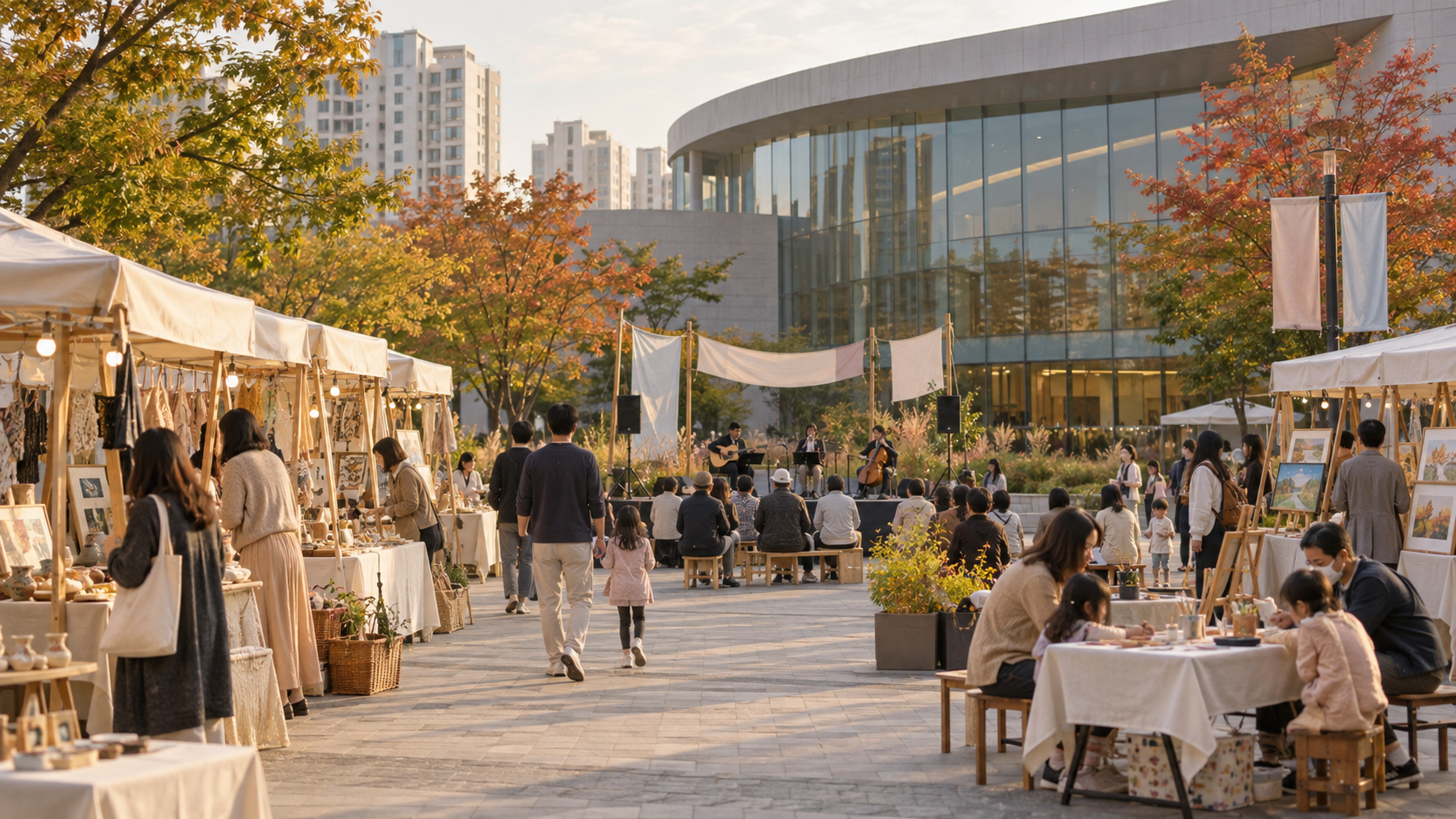
The Seogot Culture and Arts Festival is a district-level arts event in Seo-gu, Incheon, not a headline attraction on the national calendar. “Seogot” (서곶) is the old name for this part of Incheon, and the festival has run under it since 1995; the 2026 edition, from September 11 to 17, is the 31st. It is organised by the Incheon Seo-gu Cultural Foundation and built around local artists and residents rather than touring headliners. The 2026 theme is Dasi Hana-ui Won, Saeroun Sijak — “One Circle Again, a New Beginning” — a phrase that recurs in the programme, from the exhibition title to a hands-on “One Circle Project.”
The base is Seo-gu Culture Hall at 190 Seodal-ro in Gajeong-dong, with the neighbouring Family Life Culture Center also in use. That matters for expectations: the hall’s grand auditorium seats about 951, so the indoor performances are theatre-sized, and the market and busking spill onto the plaza outside. This is a compact, mostly local event, and admission to everything is free.
What you actually do here
There are four strands, and they are easy to separate. The first is an exhibition that runs the full week, September 11–17, titled after the festival theme and covering visual art, calligraphy, ceramics, literature and wood carving by local artists. It is the one part of the festival that is available on weekdays as well as the weekend.
The second strand is stage performance. The confirmed pieces for 2026 include a theatre production of Waiting for Godot on Saturday, September 12, and a music-and-dance programme billed in English as “Where There Is Sound and Dance! Seo-gu,” mixing traditional and contemporary work, on Sunday the 13th. These are the reason the culture hall’s auditorium is the anchor venue.
The third strand is the art market and busking, held outdoors. The organiser’s 2026 line-up for the busking stage lists cheerleading, dance, ukulele, choir, Korean dance, acoustic sets, magic and mime — short, rotating acts rather than a single seated show. Alongside it runs an art market and the Seo-gu Student Art Contest, which brings school-age participants and their families in for the day.
The fourth strand is hands-on experience booths — around a dozen of them for 2026. Named activities include decorating your own small keepsake, a colour-themed art session called “Color DNA,” the “One Circle Project,” a “circus jump” area and a family juggling workshop. This is the part of the festival aimed squarely at children and families, and it is the clearest reason to treat the event as a family afternoon rather than a concert.
Programme and timetable
The festival is best read as a busy opening weekend wrapped around a week-long exhibition, not as seven equally full days.
Saturday, September 12 is the anchor. The Seo-gu Student Art Contest and the art market with busking run from mid-morning to late afternoon — the organiser’s announcement gives roughly 10:30 to 16:00 — and the experience booths operate alongside them. The theatre production of Waiting for Godot is scheduled for 16:00 the same day. If you can only come once, this is the day the plaza, the booths and a stage performance all coincide.
Sunday, September 13 carries the music-and-dance programme, keeping performance on the bill for a second day. The exhibition is open across the whole run from September 11 to 17, so a visit on the weekdays that follow is realistic if the artwork is what you came for — but you should not expect the market, the busking or the booths outside the opening weekend.
Two honest caveats. Exact start times beyond the ones above were not published in a form worth copying, so treat the mid-morning-to-late-afternoon window for the market as approximate and check the foundation’s own page or notices close to the date. And the festival is spread between the culture hall and the Family Life Culture Center rather than sitting on one plaza, so confirm which building a given programme is in before planning a tight sequence.
Tickets and practicalities
There is no admission ticket. The Seo-gu reservation portal lists the festival as free, and the organiser’s 2026 announcement states that all programmes are run free of charge — the exhibition, the stage performances, the market and busking, and the experience booths. That is unusually clean for a festival listing, and it is the single most useful planning fact here: you can turn up, watch, and let children use the booths without budgeting for entry.
What is not confirmed is worth stating plainly. No English-language interpretation, guiding or signage has been verified, so this should be treated as a Korean-language event. Card acceptance at any market stalls has not been checked either; carry some cash if you intend to buy from the art market. General opening hours for the hall on each day were not published as a single operating window, which is why this guide leans on the dated events above rather than a “10:00–18:00” claim it cannot support. For anything specific — a performance time, a booth reservation, accessibility — the festival contact is the Incheon Seo-gu Cultural Foundation on 032-510-6041, with the culture hall reachable on 032-567-1160.
Getting there without a car
This is a metropolitan trip, not an intercity one, so forget KTX. From Seoul Station, the most reliable route is the Airport Railroad (AREX) to Geomam, then a change to Incheon Subway Line 2 for the Gajeong-dong area where the hall sits. Allow roughly an hour and a half from central Seoul before the final leg; the exact figure depends on where in Seoul you start and your connections, so check a live planner on the day.
The last leg is the part to plan. Seo-gu Culture Hall is not beside a subway exit. The municipal culture-hall page and local references list city buses 14, 526 and 592 stopping in front of the building, so the cleanest options from the nearest Line 2 station are a short local bus or a taxi. Because bus routings and stop names near Gajeong-dong can be confusing, set the destination as “Seo-gu Culture Hall” or the address, 190 Seodal-ro, in a Korean map app rather than navigating to the station and hoping to walk.
If you are coming from elsewhere in Incheon, the same buses and Incheon Subway Line 2 apply, and the trip is short. The car-free verdict is straightforward: the journey is easy by metro-area standards, but the walk-from-the-station convenience that a big station-side festival offers is not here — budget for one bus or taxi hop at the end.
Honest assessment
The strength of this festival is exactly what it does not pretend to be. It is a free, well-organised neighbourhood arts event with a clear shape: a week-long exhibition, two days of stage performance, an outdoor market with rotating busking, a student contest and a set of family craft booths. For anyone already in the Seoul–Incheon area with a free September Saturday — especially with children — that is a genuinely pleasant, low-cost afternoon, and the “everything is free” point is real rather than nominal.
The weakness is scale and reach. This is a district cultural festival, indoors as much as out, run in Korean, with no confirmed English support and no single spectacle to build a long trip around. Someone travelling a great distance expecting a major event will be underwhelmed, and a weekday visitor will find mostly the exhibition. It also lives partly on its own page and notices rather than a slick multilingual site, so the fine detail of times can shift.
The fair plan is a half-day on the opening weekend, weighted to Saturday, September 12, when the booths, the market, the busking and a stage performance overlap. Come for what it is — a free, family-friendly local arts festival in Seo-gu — and it holds up well. Come expecting a marquee autumn festival and it will not, and this guide would rather say so than dress it up.