
Autumn · Seoul · Field listing
Seoul Autumn Festa Opening Ceremony 2026
The essentials first: whether it is open, what it costs, how hard it is to reach and what to expect if you do not speak Korean.
When
Sep 18 — 18ConfirmedConfirmed dates
Where
Ttukseom Hangang Park waterside stage, Gwangjin-gu, SeoulSeoul
Type
Culture & arts
Admission
FREEThe opening ceremony is free. A block of seats was offered by advance online pre-registration on a first-come basis, and that pre-registration closed on September 6. Anyone can still watch on the night: the organiser has set aside a picnic zone and a standing zone at the waterside stage for people who arrive without a booked seat.
From Seoul
Within Seoul — direct on Metro Line 7 to Jayang Station (roughly 30-45 minutes from the central districts)The venue is inside Seoul, at Ttukseom Hangang Park in Gwangjin-gu. Take Metro Line 7 to Jayang Station (renamed in 2024 from Ttukseom Resort Station) and use Exit 2 or 3, which feed into the Jabeolle riverside complex that bridges over the road into the park. The waterside stage is a short walk from there along the river.
Hours
Pre-show from 18:30; main performance 19:30-21:00 (about 90 minutes)
Organiser
Seoul Foundation for Arts and Culture, 02-758-2037
Is this one for you?
Who it suits. This suits visitors who want one free, well-produced evening of Korean dance, gugak and media art beside the Han River, with the option of bringing a mat and treating it as a riverside picnic. It is a weak choice if you need a guaranteed seat — the pre-registered seating closed on September 6, so late arrivals depend on the standing and picnic zones — or if you cannot be at a riverside park until roughly 21:00, since this is a single night rather than a multi-day event you can catch later.
When to go. There is only one date and one performance: the evening of September 18. Arrive well before the 18:30 pre-show if you want a good spot in the picnic or standing zone, because the booked seats are already gone and this is an after-dark, open-air show that runs to about 21:00. Coming early also lets you settle on the grass and see the river and skyline in the last of the daylight before the stage lighting takes over.
LOCAL WEATHER
Weather near the festival
The festival date is outside the current forecast window. Check again closer to your trip.
Korea Meteorological Administration forecast
Need something we do not list — a stall menu, a parking gate, a last bus? The Korea Travel Helpline answers in English around the clock: dial 1330 inside Korea, or +82-2-1330 from abroad.
The Seoul Autumn Festa opening ceremony is a single free evening on September 18, 2026 at the waterside stage of Ttukseom Hangang Park, on the north bank of the Han River in Gwangjin-gu. It is the launch event for a much longer season: the Korea Tourism Organization and the Seoul Foundation for Arts and Culture describe Seoul Autumn Festa as a citywide performing-arts brand that runs for 73 days, from September 18 to November 29, gathering many separate festivals and shows under one banner. The opening night is the moment the season is declared open, staged as a riverside dance performance rather than a speeches-and-ribbon ceremony.
The confirmed shape of the night is compact. A pre-show starts at 18:30, the main performance runs 19:30 to about 21:00, and the whole thing lasts roughly 90 minutes. Entry is free. The venue is inside Seoul and easy to reach on the subway, which makes this one of the rare festival events on this site that genuinely works as a spontaneous evening out rather than a planned expedition. The trade-off is that it is over in one night: there is no second date to fall back on.
What you actually do here
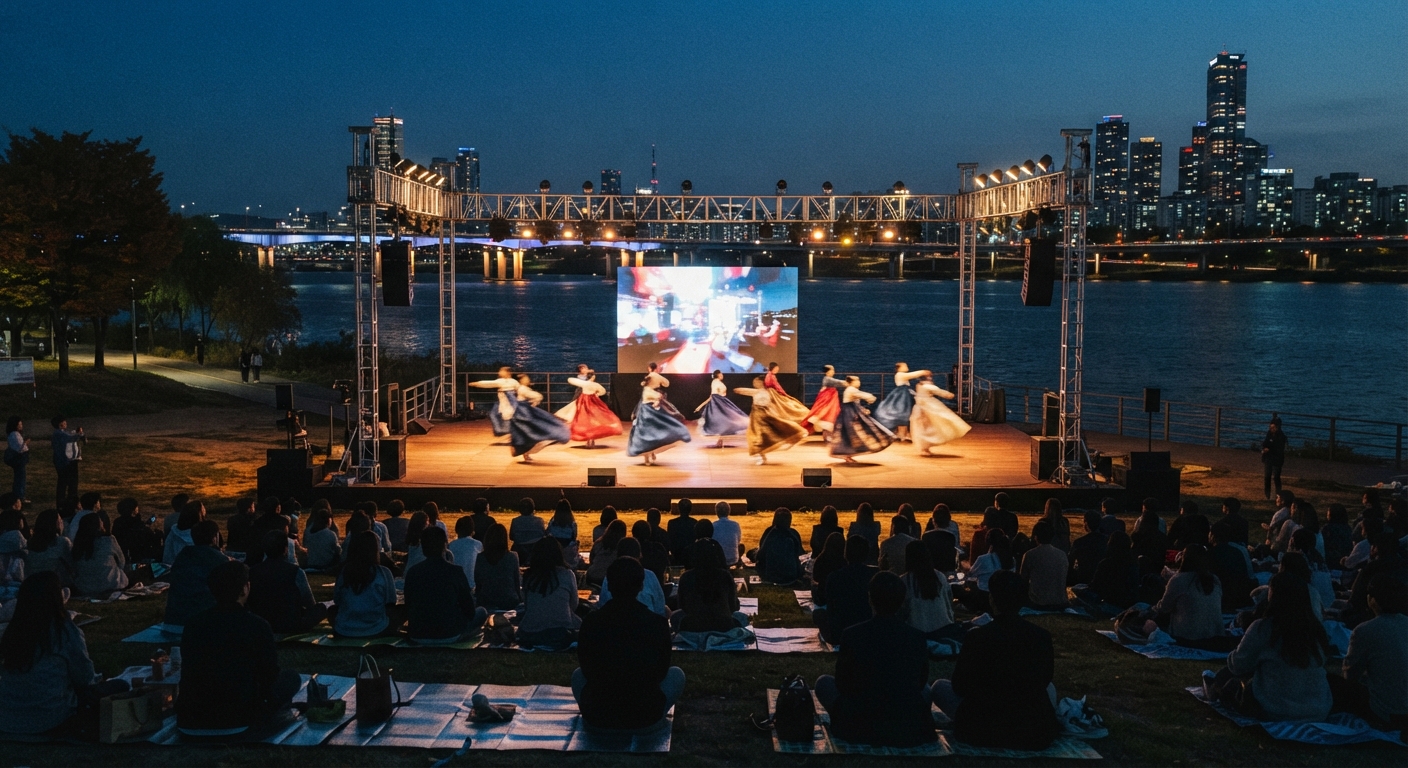
The core of the evening is a produced dance performance, titled in Korean as Seoul, Dancing at the Han River. The organiser’s programme describes it as a 90-minute work directed by Lee Ru-da that moves across traditional Korean dance, contemporary dance, gugak (Korean classical music) and media art, using the river and the night sky as a backdrop. So what you actually do is watch a single continuous show from the grass or a seat, not wander between stalls or stages. That is a different experience from most festivals covered here, and worth knowing before you travel across the city for it.
The announced line-up is unusually deep for an opening ceremony. Korean coverage from early September names the pansori singer and actor Oh Jung-hae, the dancer Choi Ho-jong, the Seoul Metropolitan Dance Theatre, BlackToe Dance Company, the Ahn Sung-soo Pick-up Group, LINKINART, Melancholy Dance Company and The Storiz Crew, with media-art elements layered over the staging. These are confirmed performers rather than a rumoured wish-list, but a running order — who appears when within the 90 minutes — had not been published, so treat the names as the cast of one show rather than a timetable you can plan around.
Because the whole event is one seated performance, there is little “activity” in the participatory sense. You are an audience member. That makes it a good fit for travellers who want an evening of watching rather than doing, and a poor fit for anyone hoping for hands-on programmes, food-stall grazing or a fair-style layout to explore.
The opening-night programme and timing
The timing is the single most important planning fact, because it is unusually front-loaded and short. The pre-show at 18:30 is worth arriving for; the main performance is 19:30 to roughly 21:00. There is no daytime programme at the waterside stage tied to this ceremony, and no repeat the following day. If you turn up at 20:30 expecting a festival that runs late into the night, you will catch only the closing stretch of a show that is already ending.
The opening ceremony also sits at the front of an “opening week” rather than standing alone in the calendar. Korean reporting notes that the day after the ceremony the Seoul Street Arts Festival begins, and a separate strand, Seoul Stage in Autumn at nearby Seoul Forest, runs musical-theatre programming from September 18 to 20. Those are distinct events at distinct venues, not part of the same waterside bill, so do not assume one ticket-free stroll covers all of them. If you want more than the single opening performance, plan the following days as separate outings and check each event’s own venue and times.
Free entry, seating and pre-registration
Admission is free, but “free” here has a specific structure. A block of seats was released ahead of time through online pre-registration on a first-come basis, and that pre-registration closed on September 6 — before this guide was written. If you did not secure one of those seats, you have not missed the event: the organiser has set up a picnic zone and a standing zone at the waterside stage so that people who simply show up on the night can still watch. The festival also publicised special invitations for groups such as young people, foreign residents and international students, and nearby residents, which signals an event designed for a broad public audience rather than a ticketed-insider crowd.
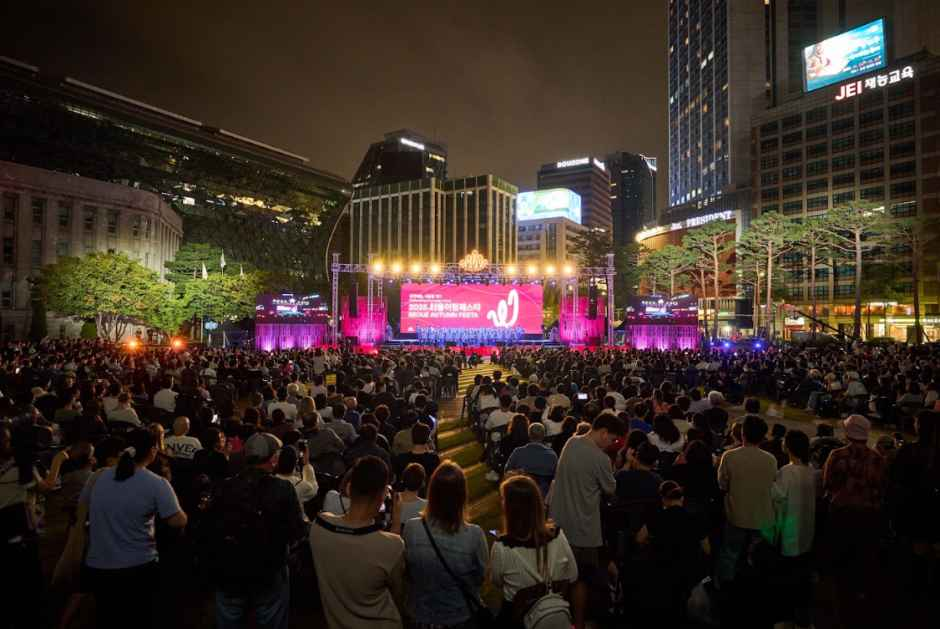
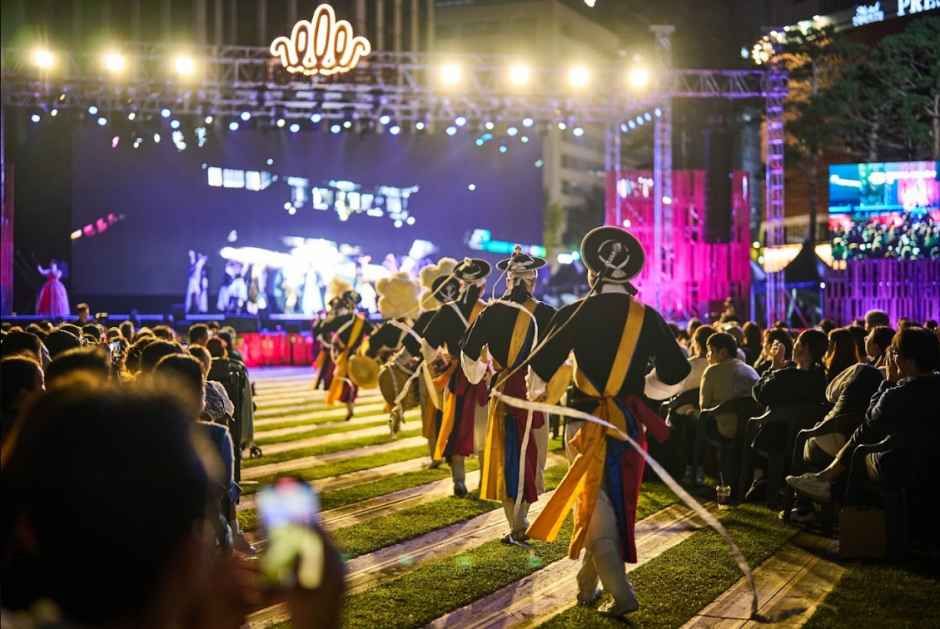
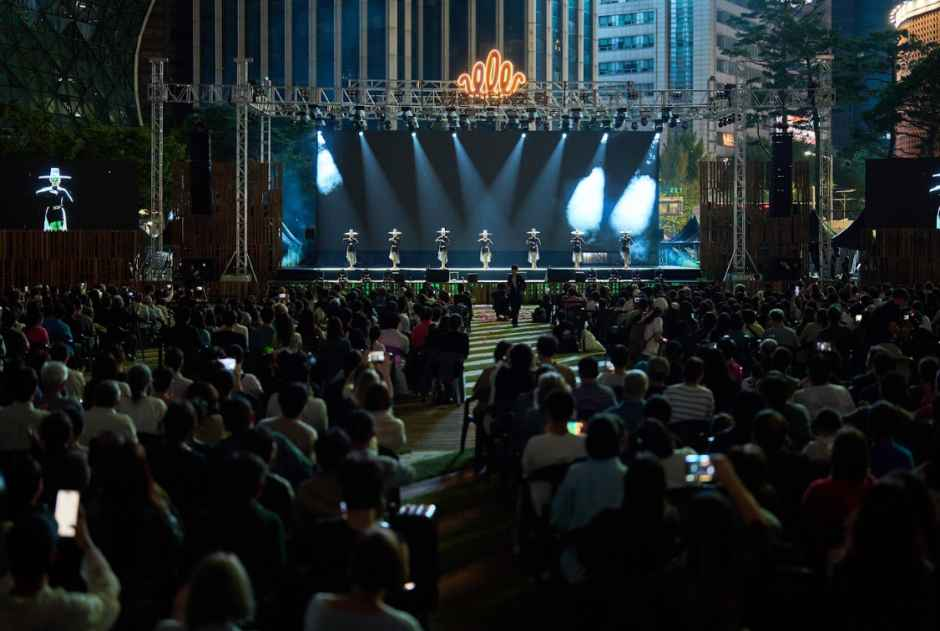
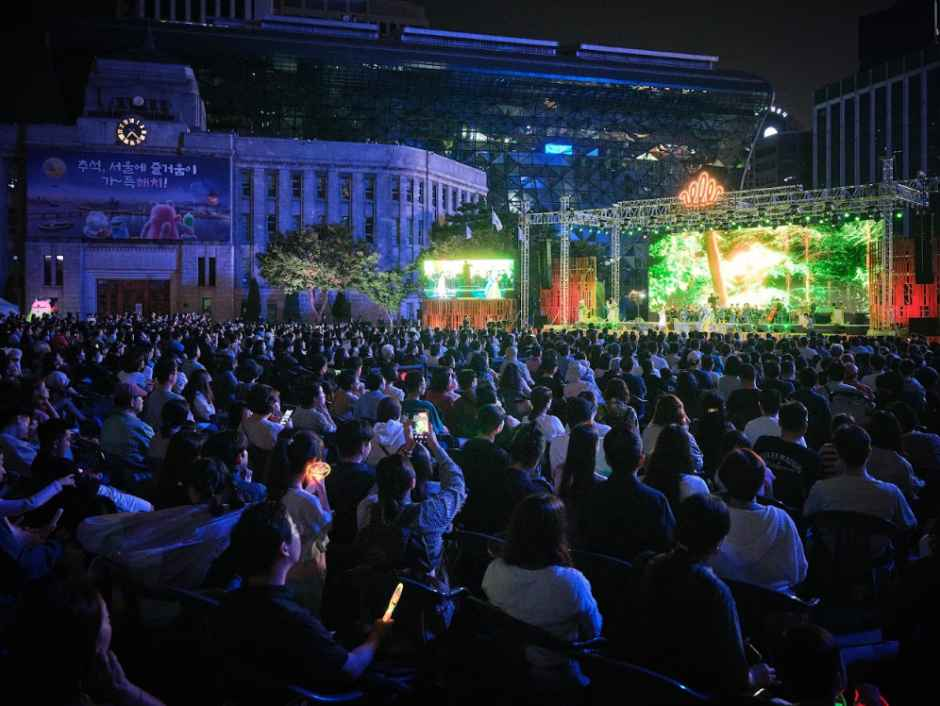
The photographs in this guide are the festival’s own opening-ceremony images, registered with the Korea Tourism Organization. They are from the 2025 first edition, which was held on October 4 last year at Seoul Plaza in front of City Hall — you can see the old City Hall building and the downtown towers behind the stage. They are included here because they honestly show the scale and style of a Seoul Autumn Festa opening: a large evening crowd, a wide lit stage, and Korean traditional and contemporary dance. For 2026 the opening moves out of the downtown plaza and onto the Ttukseom waterside stage by the river, so read the pictures as “what this event looks like,” not as a photo of the exact 2026 setting.
Getting there without a car
This is the easy part. The venue is Ttukseom Hangang Park, and the nearest station is Jayang Station on Metro Line 7. The naming here trips people up: the station was called Ttukseom Resort Station until it was renamed Jayang in 2024, precisely because visitors kept confusing it with Ttukseom Station on Line 2, which is a different place in Seongsu-dong. For this event you want Jayang Station on Line 7, not Ttukseom Station on Line 2.
From Jayang Station, use Exit 2 or 3, which connect into the Jabeolle — the long, caterpillar-shaped Ttukseom Observatory Culture Complex that bridges over the riverside road and drops you into the park. From there the waterside stage is a short walk along the water. Because the whole trip is on the Seoul Metro, there is no intercity train or shuttle to plan and no last-train-home calculation of the kind that makes many festivals on this site awkward as evening events. From most central districts the ride is direct on Line 7 and takes roughly half an hour to three-quarters of an hour depending on where you start.
If you are already near Seoul Forest for the Seoul Stage in Autumn programme, note that Seoul Forest and Ttukseom Hangang Park are close but on opposite sides of the transport layout; give yourself walking time rather than assuming they are the same access point.
The wider Seoul Autumn Festa season
It helps to understand what the opening ceremony is opening. Seoul Autumn Festa is not one festival but an umbrella season: the organiser’s overview describes around 260 performances of theatre, dance, music and traditional arts spread across the city over the full 73-day run to November 29. The stated aim is to define Seoul’s autumn through the performing arts and to make it easier for residents and visitors to find shows across many venues under a single brand.
To support that, the festival runs an integrated information point — a combined online-and-on-site guide platform at the Seoul Foundation for Arts and Culture’s Daehangno centre, listed as operating from September 16 to November 29 and closed on Mondays and public holidays. If you are in Seoul for a longer stretch of the autumn, the opening ceremony is a reasonable place to start, but the season itself is the larger offering; the single night by the river is the headline, not the whole programme.
Honest assessment
The opening ceremony’s strengths are specific and real. It is free, it is easy to reach on one subway line, and it is a properly produced 90-minute dance-and-media performance with a named cast, set against the Han River at night. For a traveller already in Seoul on September 18, that is a strong, low-commitment evening: bring a mat, arrive before the 18:30 pre-show, and treat it as a riverside picnic with a good stage in front of you. The setting does a lot of the work, and you do not need to spend anything to get the core experience.
The weaknesses are equally clear and worth stating. It is one night only, so there is no flexibility if your schedule slips or the weather turns; the pre-registered seats are already gone, so a comfortable spot depends on arriving early for the standing or picnic zone; and it is an open-air show ending around 21:00, with no published rain or cancellation policy at the time of writing. There is also no verified information on English-language support at the event, so this guide does not promise interpretation or English signage — the performance is largely visual, which helps, but plan on following along by watching rather than by reading a programme in English.
The fairest way to use this event is as the opening move of a longer autumn in Seoul rather than a destination in itself. If you can be at Ttukseom Hangang Park early on the evening of September 18, it is an easy and rewarding free night out. If you cannot, the good news is that the season it launches runs until November 29, and there are many more performances across the city to catch instead.
Questions worth asking
Is the Seoul Autumn Festa opening ceremony free?
Yes. Entry is free. A set of seats was released by advance online pre-registration on a first-come basis, and that pre-registration closed on September 6. If you did not book a seat you can still come: the organiser runs a picnic zone and a standing zone at the waterside stage for on-the-night visitors.
What time does the opening ceremony start and end?
It is a single evening on September 18. A pre-show begins at 18:30, and the main performance runs 19:30 to about 21:00 — roughly 90 minutes. There is no repeat performance on another day, so this is a fixed one-night event.
How do I get to the Ttukseom waterside stage?
The venue is inside Seoul at Ttukseom Hangang Park in Gwangjin-gu. Take Metro Line 7 to Jayang Station, which was renamed from Ttukseom Resort Station in 2024, and use Exit 2 or 3 into the Jabeolle riverside complex that crosses over the road into the park. From there it is a short riverside walk to the stage.
Do I need a ticket, or can I just show up?
There is no paid ticket. The booked seats came from the free pre-registration that has already closed, but the picnic and standing zones are open to anyone who arrives on the night. Coming early gives you a far better chance of a good position for a show that starts after dark.
What happens if it rains on September 18?
This is an open-air riverside event, so weather matters. No rain or cancellation policy had been published for the opening night when this guide was written. Check the festival's official site or its Instagram account on the day rather than assuming the show will or will not go ahead.
Before you goFestival Etiquette in Korea: What Visitors Get WrongBooking KTX Trains and Intercity Buses as a Foreign VisitorGetting Out of Incheon Airport and On to a FestivalKorean Festivals With Children: Toilets, Strollers and TimingStaying Online in Korea: SIM, eSIM and the Apps That MatterEating at a Korean Festival Without Speaking KoreanRain, Typhoons and Cancelled Festivals: How to Plan Around ThemHow to Pay for Things in KoreaT-money and Transit Cards in KoreaWhat to Wear to a Korean Festival, Season by Season
LAST UPDATED · Sep 16, 2026