
Autumn · Seoul · Field listing
Yangjae Art Salon 2026
The essentials first: whether it is open, what it costs, how hard it is to reach and what to expect if you do not speak Korean.
When
Oct 2 — 25ConfirmedConfirmed dates
Where
Yangjaecheon-gil Salon Stream (waterside stage to Yeongdong 1 Bridge), Yangjae-dong, Seocho-guSeoul
Admission
FREEEntry is free. Goods sold by the flea-market vendors are not included, and KTO does not give prices for the workshops or the food trucks, so none are quoted here.
Hours
13:00-20:00 on market days; Friday 2 October opens earlier, 11:00-20:00
Organiser
Seocho-gu (host) and Seocho Women's Jobs Corporation (operator), 02-6951-0291 (KTO Korean record); KTO's English page lists 070-4694-1024
Is this one for you?
Who it suits. This suits people who like browsing handmade goods and eating from food trucks on a riverside walk, and it costs nothing to turn up and look. It is a poor fit if you want a ticketed headline concert or a single big spectacle, because the programme is a market with small stages and weekly themes. Anyone who dislikes weekend crowds should note that the spring edition drew about 190,000 visitors.
When to go. Most of the run is Saturday and Sunday 13:00-20:00, so weekends are when everything is open together. The first Friday, 2 October, is the one weekday session and it starts at 11:00. The themes change by week, so pick the weekend whose theme interests you instead of assuming every weekend is the same.
LOCAL WEATHER
Weather near the festival
Korea Meteorological Administration forecast
Need something we do not list — a stall menu, a parking gate, a last bus? The Korea Travel Helpline answers in English around the clock: dial 1330 inside Korea, or +82-2-1330 from abroad.
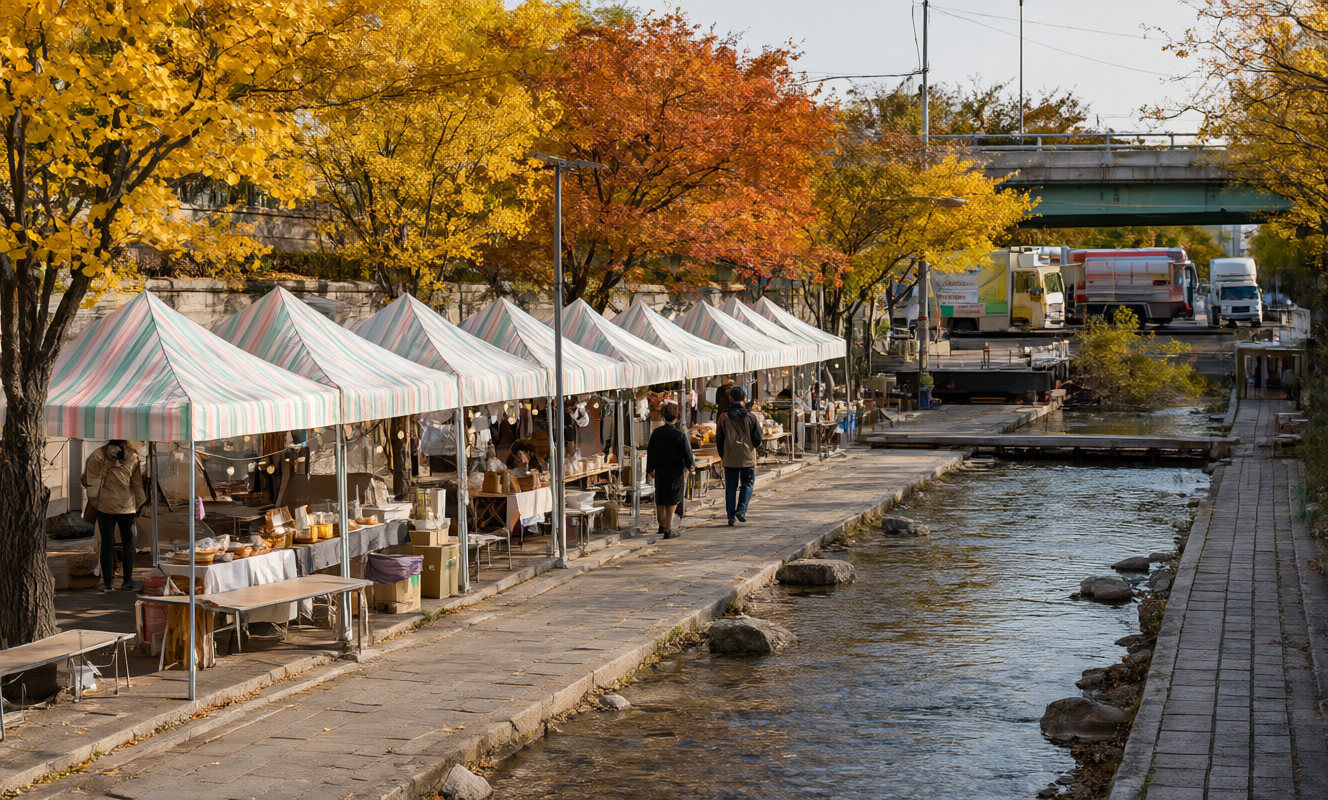
Yangjae Art Salon is a weekend craft-and-culture market laid out along a stretch of the Yangjaecheon stream in Seocho-gu, southern Seoul. KTO describes it as a complex cultural festival where visitors enjoy changing seasons against the stream, with weekly themes for the performances, markets and activities. The host is Seocho-gu and the operator is Seocho Women’s Jobs Corporation. This is the autumn run; the same event ran in spring 2026 from 3 April to 17 May, and Herald Business reported about 190,000 visitors and roughly 520 million won in sales for that run, which the district says was up 11 percent on the previous year. The official site also lists a separate Seoripul Music Festival on 19-20 September, which has already finished and is not part of the autumn market.
The autumn dates are 2-3 October and then every Saturday and Sunday from 10 to 25 October. The market area is called the Salon Stream and runs between the waterside stage and Yeongdong 1 Bridge. Hours are 13:00-20:00, with a longer first day on Friday 2 October, 11:00-20:00, which the press release says is meant to let nearby office workers visit at lunchtime and after work.
What you actually do here
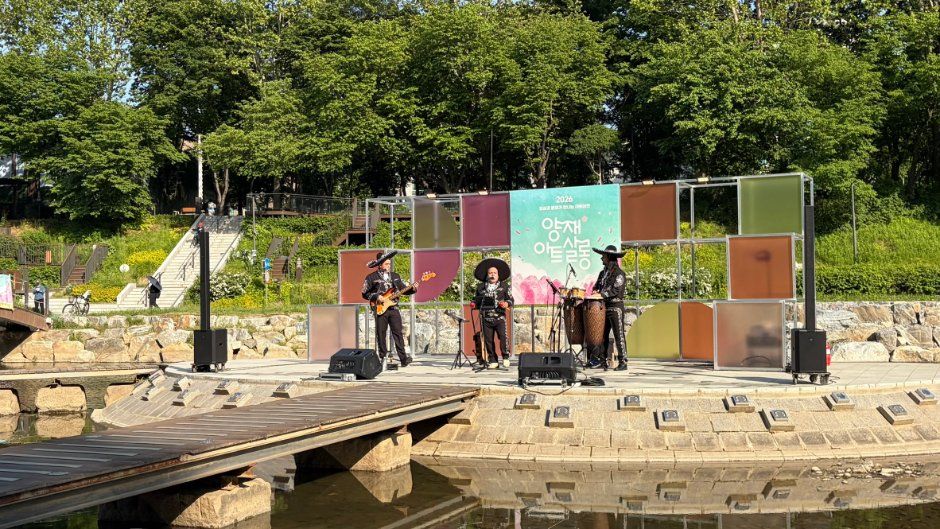
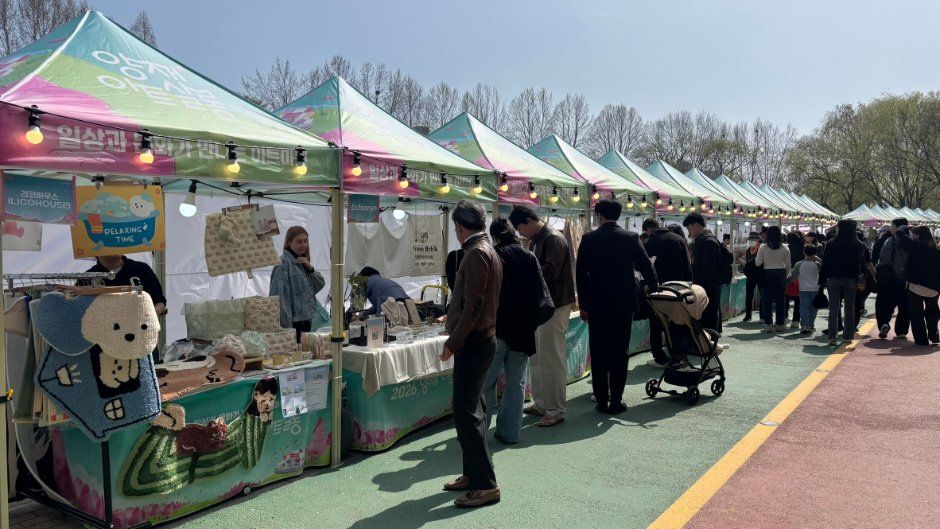
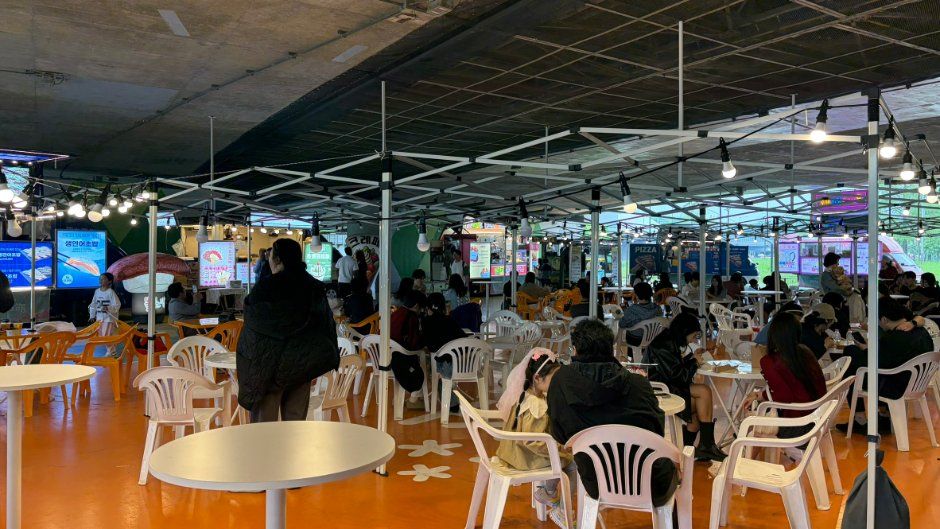
You walk. The site is a linear riverside promenade, not a walled venue, and KTO divides it into four zones. The Sunset Stage is the waterside stage, with busking acts, special performances and a stream-side noraebang (karaoke) sing-along. Yangjae Atelier is the handicraft flea market, listed as 55 teams in total. The Healing Lounge on the lawn has an air-balloon photo zone called “Yangjae Reu-ong” and weekly special programmes. Bridge Dining, under Yeongdong 1 Bridge, has eight food trucks plus a seating area.
The sensible way to use it is to browse the stalls first, because that is the main activity, then stop for food or a performance. KTO’s own photos show a small stage on the water’s edge and long rows of identical tents, which matches the “walk and linger” description in the press coverage. There is no seat to reserve and nothing in the sources that requires booking.
Programme and timetable
The press release, repeated by Sijung, Seoul Shinmun and Herald Business, gives four themes that run in order across the four weeks. KTO’s record lists the same four in the same order (Garden, Glocal, Hand-stitch, Local) and adds a caution that content may change with each week’s concept, so treat the details as a plan.
- Week 1, opening weekend (2-3 October): an art salon for office workers. The theme is the “garden city”. It includes the Seocho “wheeled gardening” mobile garden truck, a flower-arranging salon, and a stamp tour linked to the Seoul International Garden Expo, which opened on 1 October at Maeheon Citizens’ Forest. Herald Business says the stamp tour comes with coupons usable at around 200 shops in the surrounding district and with Expo goods. Seoul Shinmun adds that the market footprint was extended to the Soewon Cafe deck for this edition.
- Week 2: “Glocal WEEK”. The Turkish Cultural Centre takes part, with a fair-trade festival, a Yangjaecheon coffee run, and a plogging (jogging while picking up litter) walk that the district calls “fair travel”.
- Week 3: “Hand-stitch WEEK”. KTO lists the “Death by Stitching Club” project, a special market, workshops and a citizen-participation flea market. Press coverage adds a kantha pouch workshop using a Chiang Mai-style stitching technique.
- Week 4: “Local Up Stream”. It links local businesses and start-ups and is run with the Seoul Creative Economy Innovation Center. KTO lists the closing ceremony, called the “Local WEEK” closing, under the special programmes.
Only the opening weekend (2-3 October) is dated by every source. The market days after it are 10-11, 17-18 and 24-25 October, and it is natural to read weeks 2 to 4 as those three weekends in order, but the press summaries I compared give different date ranges for the later themes and I did not find a dated programme sheet. That is why the headings above do not pin a theme to a specific day. If you are coming for one particular workshop or the coffee run, check the official site or call the organiser first. Times for individual performances were not published in any source I found.
The four zones in practice
KTO’s record gives enough detail to tell you what each zone holds, though not when. The Sunset Stage programme is busking, special performances and the stream-side karaoke, and the record says the lineup varies with each week’s concept. The Atelier is a flea market of 55 teams of small-business owners, craft makers and young companies selling handmade goods and everyday items. The Healing Lounge combines the air-balloon photo zone with the weekly special programme, so it is the part most likely to look different from one weekend to the next. Bridge Dining is the only zone where food is listed as the point.
The official site’s home page uses the headline “Where everyday life blooms into culture” and promotes a seller call for the autumn cultural festival, which fits the market-first reading: local-food, craft and lifestyle brands are the core, with the performances around them. Nothing I found describes the Sunset Stage as a ticketed or seated show.
Food on site and nearby
Bridge Dining is the food area, sheltered under Yeongdong 1 Bridge, with eight food trucks and tables. The sources do not name the trucks, the menus, the prices or the payment methods, so I am not going to either. Treat it as a convenience meal rather than a destination.
Tickets, fees and booking
There is no entry ticket; KTO lists the festival as free, with flea-market goods excluded from that. What costs money is what you buy: stall goods and food. Workshops may be free or paid, and none of the sources I found give a fee or say whether you register in advance. For that, the organiser’s number in KTO’s Korean record is 02-6951-0291; KTO’s English page lists a different number for the operator, 070-4694-1024, so try the first and fall back to the second. The official site’s own “application” content is a call for sellers, not a visitor registration. The organiser’s Instagram account, listed on KTO’s festival portal, is salon_in_yangjaecheon; I checked it only as a pointer for last-minute notices and did not use anything from it.
Day trip or overnight
This is a question that barely applies. The venue is inside Seoul and the market closes at 20:00, so if you are staying anywhere in the city you go and come back the same day on the subway. I have not evaluated last-train times against a specific hotel, so if you are staying in a different part of the city, check your own route home before you linger to the 20:00 close. Nobody needs a hotel for this event; it works as a half-day add-on to a Gangnam-side day or the Garden Expo at Maeheon Citizens’ Forest.
Getting there without a car
The venue is in Seoul itself, so there is no intercity leg. An earlier-edition article from the City of Seoul’s media hub names Yangjae Station (Line 3 and Shinbundang Line) as the way in, and the venue’s official address is 261-23 Yangjae-dong. I did not find a 2026 source that gives a walking route or minutes from the station to the Salon Stream, and the official site’s directions page gives only the address and the “Yeongdong 1 Bridge to waterside stage” description. Search for the festival by name (Yangjae Art Salon, or Yangjaecheon-gil Salon Stream) in Naver Map or Kakao Map and follow the live walking route.
Parking, shuttles and rain
None of these is stated in the official site, KTO’s record or the 2026 press coverage. An article about the 2025 autumn edition mentions the Yangjae public car park, but I did not use that as a 2026 recommendation. If you plan to drive, assume you will need public transport as a fallback and ask the organiser on 02-6951-0291. On rain, no 2026 source states a policy, so do not assume either closure or operation. Look at the official site or the organiser’s channels on the morning you go before committing to a long trip.
Honest assessment
The setting is the draw: a free, central-Seoul stream walk with small stages, 55 craft teams and a food area, and four themes that actually change the content from weekend to weekend. The Garden Expo stamp tour in week one and the plogging and coffee run in week two are concrete reasons to choose a particular weekend.
The limits are worth stating. It is a market first, so most of the experience is browsing and buying, and it is not a ticketed show. The crowd size of the spring edition, about 190,000 visitors over the run, means weekends are likely to be busy, although no source gives a per-day figure. And several practical answers a visitor needs, namely a station-to-venue walk, parking and a wet-weather policy, were not published in anything I could verify. If those matter to you, the organiser’s phone number is the fastest check.
Questions worth asking
What days and hours is Yangjae Art Salon open in autumn 2026?
Friday 2 and Saturday 3 October, then every Saturday and Sunday from 10 to 25 October. Hours are 13:00-20:00, except Friday 2 October, which is extended to 11:00-20:00. The days between those blocks, including 4 October and 5-9 October, are not listed as market days.
Is Yangjae Art Salon free?
Entry is free according to KTO. Goods sold by the flea-market vendors are not included, and no prices for food or workshops were published in the sources I found.
What changes from week to week?
The organisers describe four themed weeks, in this order: an art salon aimed at office workers with a Garden Expo stamp tour, a 'Glocal' week with the Turkish Cultural Centre, fair trade and a coffee run, a hand-stitching week with a kantha pouch workshop, and a closing 'Local Up Stream' week. KTO adds that the programme can change by week. Press summaries disagree on the exact dates of each theme, so confirm the weekend you plan to visit.
Who do I call, and why are there two phone numbers?
KTO's Korean record gives 02-6951-0291 for both host and operator, and KTO's English page gives 070-4694-1024 for the operator. I could not tell which one is answered more reliably, so try the first and fall back to the second.
How do I get there by subway?
A City of Seoul media article about an earlier edition names Yangjae Station (Line 3 and Shinbundang Line) as the subway access point. I could not confirm a walking time or route for 2026, so set the destination to the venue name in Naver Map or Kakao Map.
Is there parking, and does it run in the rain?
Neither was stated in the official site, KTO's record or the 2026 press coverage I found. Check the festival's official site or call 02-6951-0291 on the day before you go.
Before you goFestival Etiquette in Korea: What Visitors Get WrongBooking KTX Trains and Intercity Buses as a Foreign VisitorGetting Out of Incheon Airport and On to a FestivalKorean Festivals With Children: Toilets, Strollers and TimingStaying Online in Korea: SIM, eSIM and the Apps That MatterEating at a Korean Festival Without Speaking KoreanRain, Typhoons and Cancelled Festivals: How to Plan Around ThemHow to Pay for Things in KoreaT-money and Transit Cards in KoreaWhat to Wear to a Korean Festival, Season by Season
LAST UPDATED · Oct 4, 2026