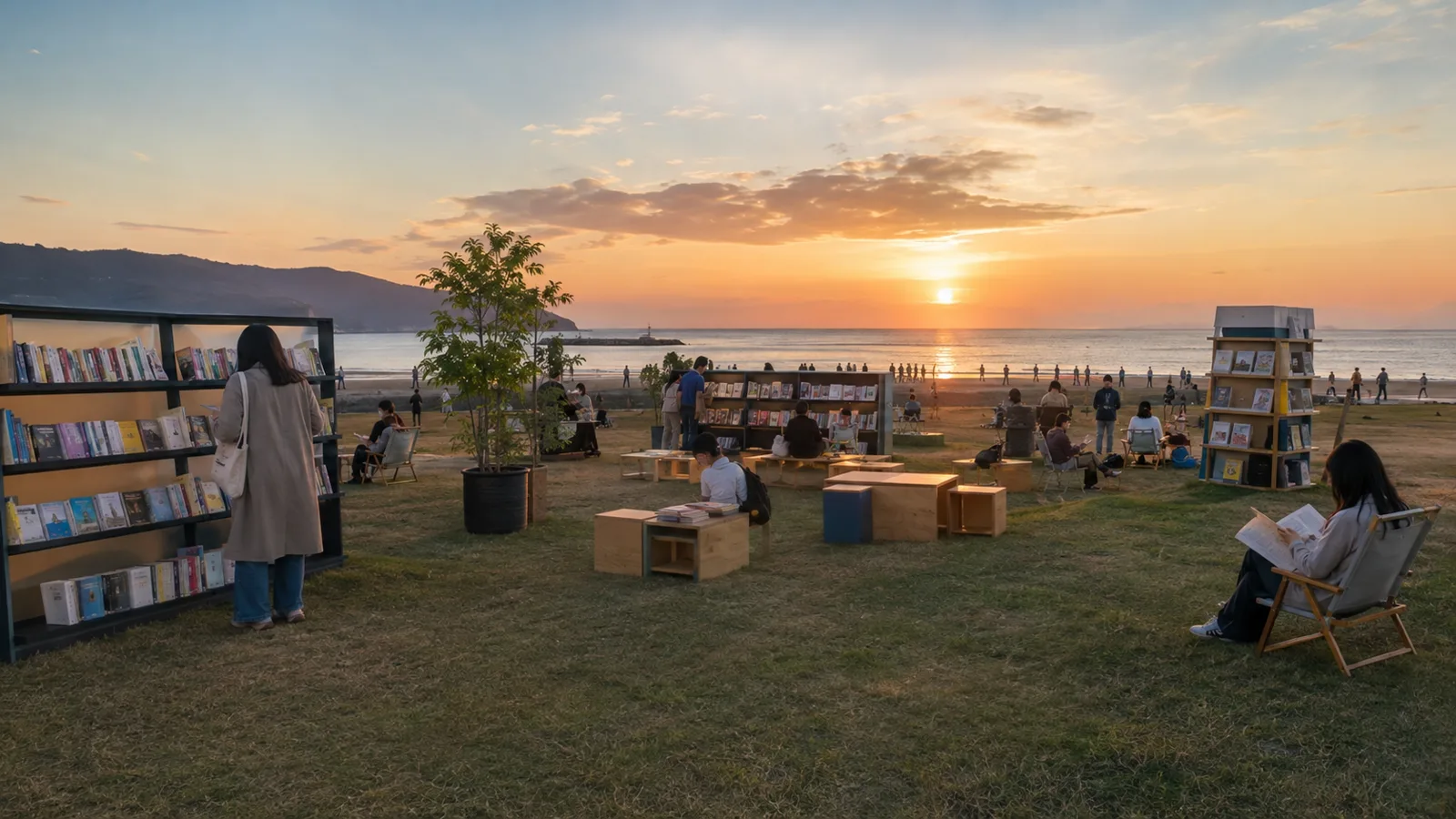
Bibliotheca Busan turns part of Dadaepo Beach Park into an outdoor reading space on autumn weekends. The project brings books and cultural programmes from public libraries, bookshops, publishers and cultural organizations around Busan to the waterfront. For the 2026 autumn run, the useful distinction is easy to miss: the advertised span is September 19 through October 11, but the library operates only on Saturdays and Sundays.
That produces eight operating dates: September 19, 20, 26 and 27, and October 3, 4, 10 and 11. Mondays through Fridays inside the date range are not festival days. General entry is free, and the published age guidance is all ages. The site opens at 15:00 and closes at 21:00, subject to weather or operational changes.

What you actually do here
The confirmed core is simple: browse curated book selections, settle into a reading area and attend book talks or related cultural sessions. KTO divides the current offering into a reading zone, programmes and a community zone called B-Bookspot. The reading-zone list names curation, meongdok meonggeul and book-picnic kits; the programme list includes book talks, a special Science Lounge programme, Focus On, Human Books and another meongdok meonggeul strand. Those names establish the programme categories, not a promise that each one runs on all eight dates.
The picnic-kit element matters because this is a temporary outdoor library, not simply a stage beside a stack of books. The official membership information also lists equipment rental as a member benefit. It does not, however, publish a guaranteed inventory, a same-day rental procedure or the number of kits available at Dadaepo. Bring whatever personal basics you need to sit comfortably rather than building the visit around an unconfirmed loan.
B-Bookspot is the community-facing part of the project. The organizer describes the wider festival as a collaboration with Busan’s public libraries, bookshops, publishers and cultural institutions. In practice, that means the programme can extend beyond passive reading into talks and partner activities. It would still be misleading to call this a conventional commercial book fair: no verified autumn vendor list or sales-booth plan was available at this update.
Hours are 15:00 to 21:00. That puts both daylight and sunset inside one visit, but it also makes the event dependent on outdoor conditions. The organizer explicitly warns that detailed hours and programmes can change because of weather or internal circumstances.
Programme and timetable
The operating window is confirmed, but a complete Dadaepo session grid was not posted when this guide was checked on September 7. The official programme calendar still showed earlier 2026 events at other venues, including Minrak Waterfront Park, rather than a usable autumn schedule for Dadaepo. Do not copy a speaker name or reservation time from those earlier entries into a September or October plan: they are evidence of how the booking system works, not the line-up for this run.
Use the official programme page in two stages. First, filter for the date you intend to visit and confirm that the venue says Dadaepo Beach Park. Second, open the individual entry and check its event time, capacity and application window. The programme database distinguishes a general booking period from a member booking period, so an event appearing on the calendar does not necessarily mean walk-up places will remain.
The event’s passport and stamp mission is separate from an international travel document. KTO describes a Bibliotheca Busan passport that visitors can have issued and use for a stamp mission. The published summary does not give the Dadaepo issue desk, mission route, quantity or completion reward, so treat it as an optional activity to ask about on arrival, not a reason to promise children a prize.
Tickets, fees and membership
There is no general admission charge. No gate ticket is needed according to the current KTO record, and the event is listed for all ages. Free admission does not settle every question about limited-capacity sessions: the official site has a reservation calendar, and membership includes priority booking and member-only book talks.
Membership benefits currently listed by KTO are priority programme reservations, members-only book talks, equipment rental, benefits from B-Book Pass partners and KakaoTalk notifications about schedules and programmes. These are benefits, not proof that membership is compulsory for the reading grounds. The official material checked for this guide does not state a membership fee, nor does it confirm whether every benefit will be available at every Dadaepo session, so no price or blanket promise belongs here.
If one talk is the main reason for travelling, create or check the required account before booking opens and use the event’s own reservation status. If the plan is simply to browse and read, the confirmed fact is much simpler: entry to the festival area is free. The organizer’s published enquiry number is 051-745-7286 to 7288 within Korea.
Getting there without a car
From Seoul Station, take a KTX to Busan Station. Korail’s timetable dated September 1, 2026 shows multiple KTX services on the Seoul–Busan corridor, and the booking search should be used for the actual travel day. Once the local leg and a realistic connection are included, allow roughly 3 hours 15 minutes to 4 hours one way rather than treating Busan Station as the finish.
Busan Station and Dadaepo Beach Station are on the same Metro Line 1, so no subway transfer is needed. Published routing data puts that ride at about 42 minutes. Busan Transportation Corporation confirms that Dadaepo Beach is the Line 1 terminus, while Busan’s tourism portal gives the walk from Exit 2 as about eight minutes. The festival occupies the wider beach-park area rather than one indoor building, so use the official programme for the day’s exact zone.
The subway is the robust choice because it avoids a road transfer and delivers you close to the park. Busan Transportation Corporation publishes Line 1 operating hours extending well beyond the festival’s 21:00 close, but that system-wide window is not the same as a guaranteed departure time from Dadaepo Beach Station. Check the station-specific last train on the travel date if connecting to a late KTX or accommodation elsewhere in the city.
An intercity bus from Seoul is possible, but it does not create a simpler final leg: Busan’s long-distance terminals are not at Dadaepo, and road traffic makes the total less predictable. No dedicated 2026 festival shuttle has been announced in the official sources checked. The direct Line 1 ride from Busan Station is therefore the clearest verified public-transport instruction.
Combining the library with Dadaepo
Dadaepo is more than the temporary reading zones. Busan’s official visitor material identifies the beach and park as a sunset location with lawns and walking space. That context explains the 15:00 start: a visit can move from afternoon reading into the evening without changing venues. It does not guarantee a clear sunset, so check the forecast rather than treating the waterfront view as a scheduled performance.
For the first two weekends, there is one independently scheduled nearby event that can be verified. Busan City lists the 2026 Dadaepo Sunset Fountain of Dreams music show through September 30. On September weekends and holidays, the stated night shows are at 19:30 and 20:30, each for 20 minutes. That overlaps the library’s operating hours on September 19, 20, 26 and 27. The fountain programme ends before the October festival weekends, and either attraction can change operations; confirm both on the day rather than assuming the times will line up perfectly.
Keep this combination modest. The festival zone is spread through the park, the fountain has its own audience, and moving between them can cost part of a booked talk. Choose the library programme first, then fit the fountain around it if the published session time leaves room.
Day trip or overnight
A Seoul day trip is physically possible, but the arithmetic is not attractive. The useful visit starts at 15:00, the festival continues until 21:00, and the trip back begins with the metro ride to Busan Station before the KTX. Leaving early for a reserved return train cuts into the evening portion; staying until closing requires checking the exact Dadaepo subway and Busan-to-Seoul departures before committing.
An overnight is a planning preference rather than a verified requirement, so the frontmatter does not label it mandatory. The Busan Station area simplifies the Seoul rail connection, while western Busan reduces the local trip to Dadaepo. No hotel is named because availability, price and late check-in were not verified.
Food vendors for the autumn library were also not published in the sources checked. Dadaepo is an urban district rather than an isolated site, but that alone does not justify promising meals inside the event. Eat before a fixed talk or check the final venue map for confirmed vendors. The regional specialty shown on this page, Daejeo tomato, is included as a verified Busan product—not as a claim that the festival sells it, and its main season ends before this event.
Honest assessment
Come for reading outdoors with one or two selected programmes, not for a packed checklist of attractions. The sea-facing park is the point. The same openness is the main limitation: wind or rain matters more here than it would at an indoor literary event, and the organizer reserves the right to change the schedule.
There is no verified 2026 attendance forecast, parking plan or traffic-control notice for this event, so any claim about a quiet weekend, easy parking or a particular congestion hour would be guesswork. The nearby fountain can add another audience on September evenings. Public transport removes the parking uncertainty, but it does not remove the need to allow time to find a specific programme zone in a large park.
The practical approach is to arrive while it is still light, locate the reading and talk areas, and keep the official site or Instagram handy for same-day changes. Protect any reserved session from the fountain timetable and from an overly tight dinner plan. From Seoul, a day trip is possible but inefficient; the long local ride after KTX and the 21:00 closing time make an overnight less hurried, though the return decision should be made against live Korail and Busan Metro times.
The strongest case for Bibliotheca Busan is also the narrowest: it gives you a structured reason to spend several hours reading beside Dadaepo rather than merely stopping for a photograph. Visitors who need a dense stage schedule, guaranteed English interpretation or a large book market should wait for the detailed programme before deciding. Those features were not confirmed, and this guide does not turn absence of information into a promise.