
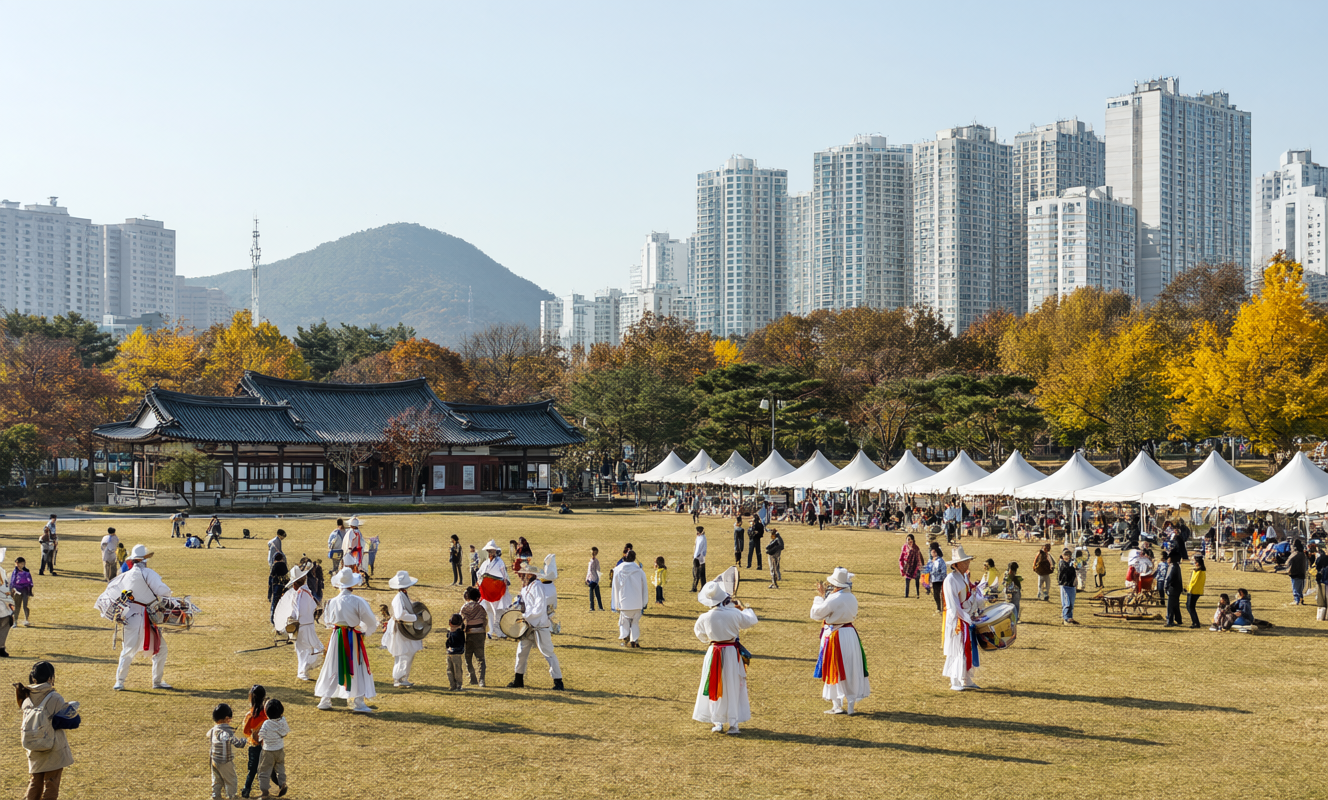
The Busan Folk Arts Festival is a free, two-day weekend event on the big lawn of Busan Citizens Park, run by Busan City and managed by the Busan Intangible Cultural Heritage Federation. Korea Tourism Organization’s listing calls the 2026 event the sixth edition. Its job is to put the city’s registered intangible heritage in front of the public: village-ritual music, a coastal shaman rite, a tightrope act, and a field of craft booths where visitors do the work themselves.
Treat it as a half-day stop rather than a trip in itself. It is a good fit for an October weekend in Busan because it needs no ticket, sits in a flat central park, and is built around things you can watch without understanding Korean.
What you actually do here
The organisers split the grounds into three zones, and the names tell you what each is for.
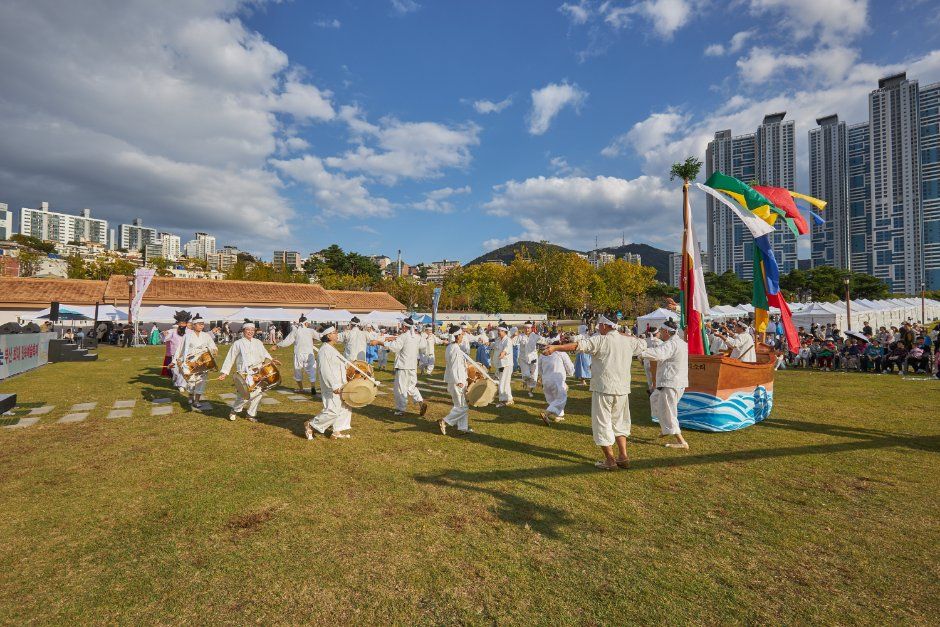
Pungnyu Madang is the performance zone: an opening ceremony, intangible-heritage performances by Busan and visiting groups, a performance by a heritage-training school, special acts and some audience-participation items. The official KTO text lists activities such as a children’s mock civil-service exam, Busan farmers’ music (nongak), a Philippine traditional dance, fusion gugak, Donghae-an Byeolsin-gut (a coastal village ritual with music and dance), Daegu Nalmoe drum dance, Dongnae Jisinbapgi (a “treading the earth-spirit” house-blessing ritual) and a folk-hat sports day. Not all of these have a time on the published stage grid, so see the timetable section below before building a plan around one.
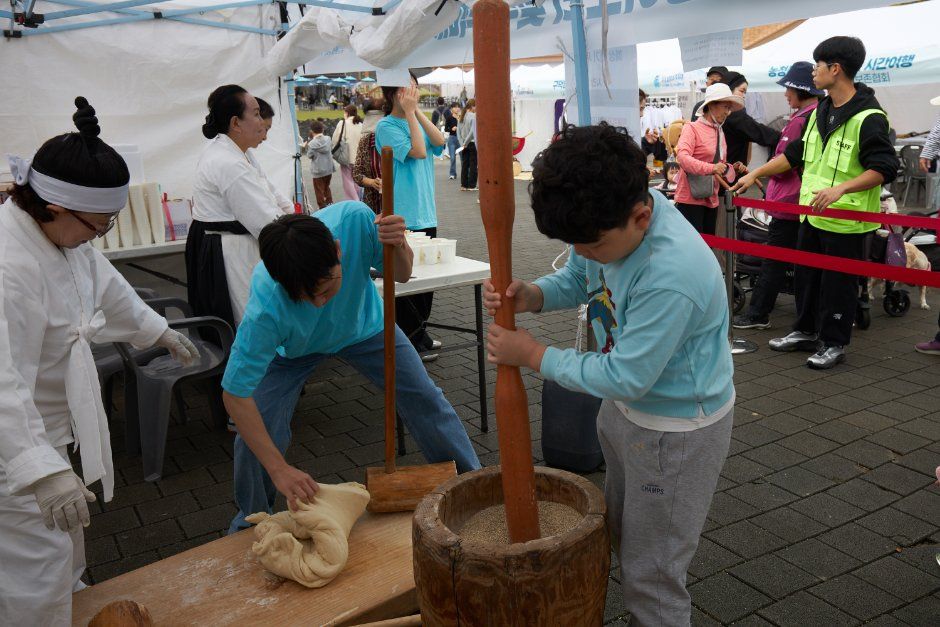
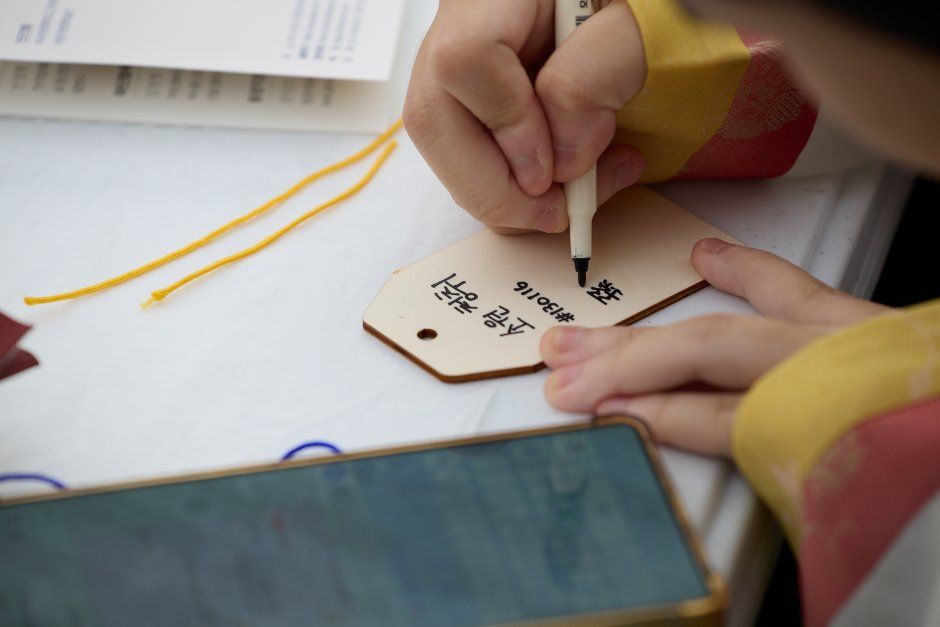
Somssi Madang is the hands-on zone. Heritage practitioners run craft and traditional-culture activities: embroidered phone grips, spinning-wheel demonstrations, flower-shoe making, fan decorating, kite making, wooden key rings, knot bracelets and necklaces, charms, lanterns, and traditional masks. It also lists instrument and costume experiences tied to local heritage items, including Dongnae crane-dance costumes and Suyeong farmers’ instruments. The official programme page names the booth area as the experience booths at Dasom Plaza and gives 11:00-17:00 on both days.
Janchi Madang is the “feast yard”: traditional games such as ring toss, hoop rolling and tug-of-war, a Busan intangible-heritage art fair, a traditional-craft market tied to Hanbok Culture Week, a stamp tour with a wish-writing station, hanbok rental and traditional accessories such as hairpins and hats. Hanbok rental terms were not published, so there is nothing here to quote on price or deposit.
You do not need Korean to enjoy the performances: drums, costume and movement carry them. The explanations on the screens and in the booths are in Korean, so ask a booth worker to demonstrate the first step and copy it.
Programme and timetable
The official programme page gives this grid for the main stage at Dasom Plaza. Everything below is from that page, and the organisers add that schedules may change.
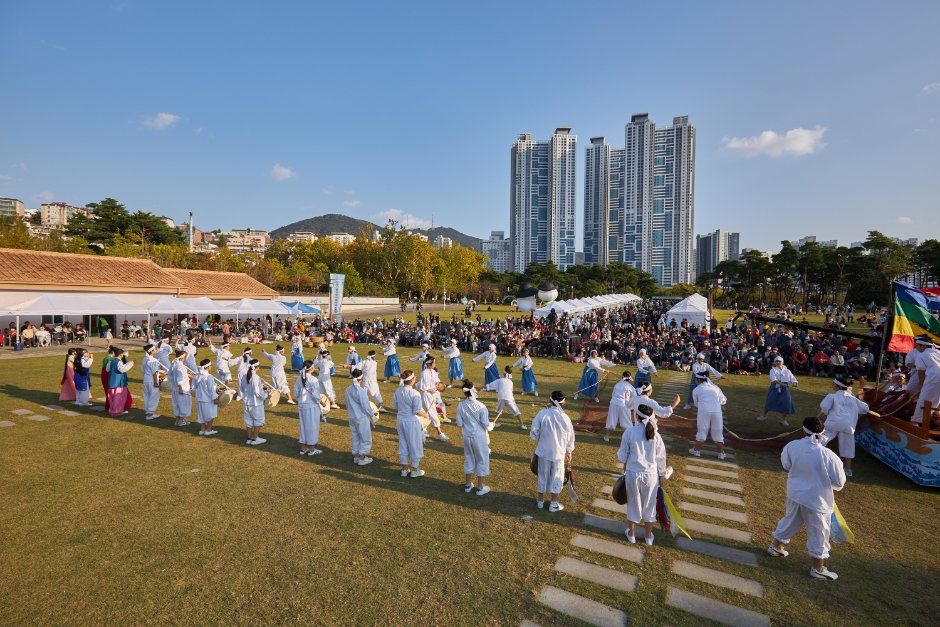
- Saturday, October 24: training-school performance at 13:10 (Gyeongsung University’s Dongnae Yaryu mask-play group); opening ceremony 13:30-14:00; intangible-heritage performances 13:30-17:00; special performances 14:30-17:00, listed as a Philippine traditional performance, fusion gugak and the Busan Arts High School ensemble.
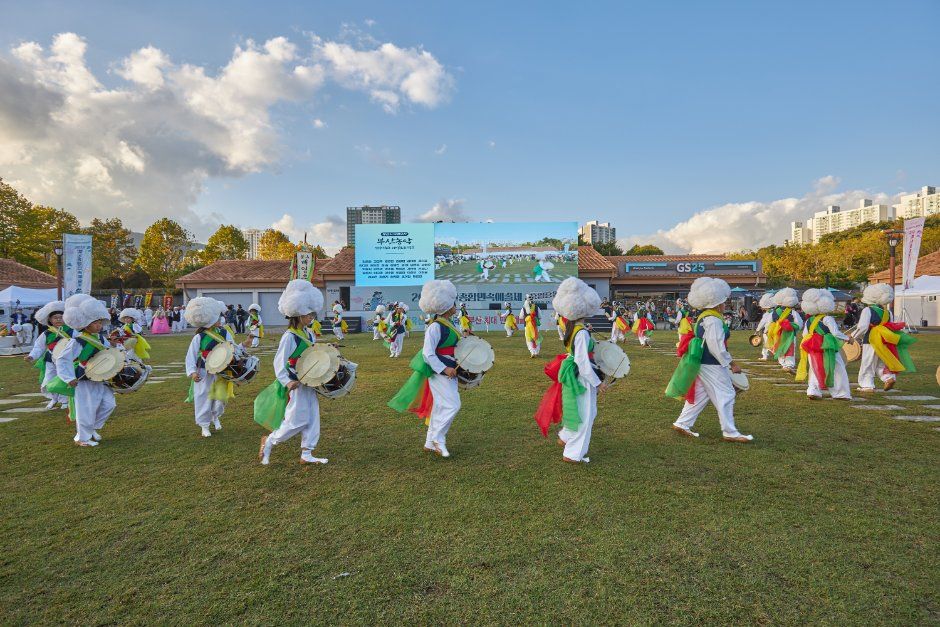
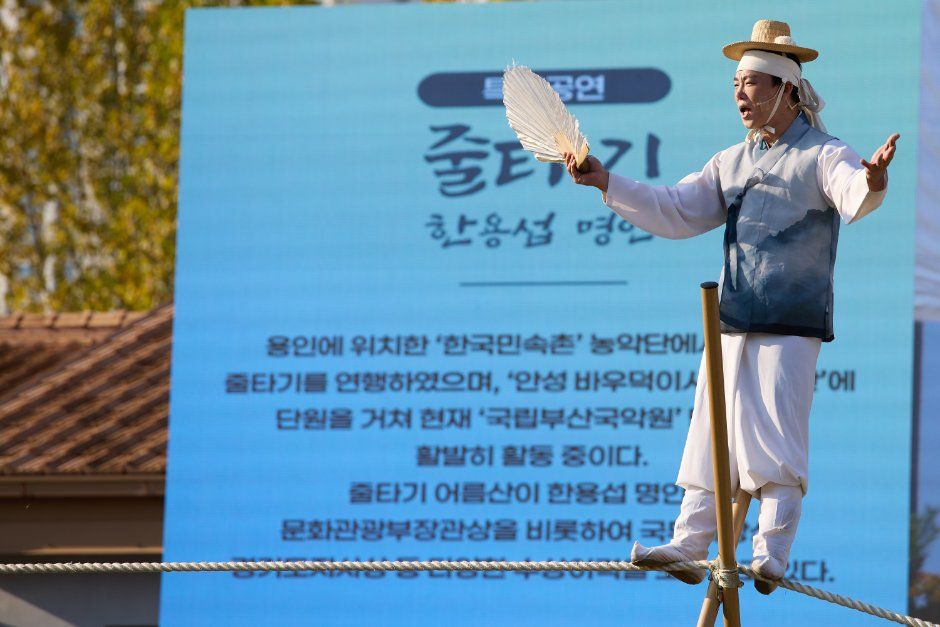
- Sunday, October 25: training-school performance at 14:00 (Baeyoung Elementary School’s Busan Nongak); intangible-heritage performances 13:30-17:00; special performance 14:30-17:00, listed as jultagi, Korean tightrope walking.
- Both days: experience booths 11:00-17:00.
The heritage performers named for the main-stage block are Busan Nongak, Donghae-an Byeolsin-gut, Dongnae Jisinbapgi, Suyeong Jisinbapgi, Dadaepo Huri-sori (a fishermen’s net-hauling song) and Nalmoe Buk-chum, a drum dance from Daegu. The page does not say which group plays on which day, so the grid above is the day-level detail that is actually known.
The gap is mornings. The festival opens to visitors at 11:00 but the stage grid starts after 13:00, so the first two hours are booth time. If a specific performance is your reason to come, check the official site or its Instagram on the day before you travel, because the performers and times were not fixed to the minute.
Tickets, fees and booking
Entry costs nothing. What remains open are the add-ons. The official site shows a “Program Reservation” menu and an Eventus channel for advance registration of hands-on programmes, but neither showed the list of programmes, slots or fees when this guide was checked, so this guide does not say which activities require booking. The organiser line is 051-714-1508, the number KTO lists for both host and inquiries.
Do not read “free admission” as “free everything”. Craft materials, rentals and market stalls often charge, and none of those prices have been published.
Getting there without a car
The simplest route from Seoul is KTX from Seoul Station to Busan Station, which takes about 2 hours 15 minutes on the fastest trains and up to about 2 hours 45 minutes on slower ones. From Busan Station, take Metro Line 1 to Bujeon Station; route-planner listings give roughly 12-17 minutes for the ride. Visit Busan states the walk from Bujeon Exit 1 to Busan Citizens Park as about 10 minutes, and Dasom Plaza is inside the park, so allow a little extra. City buses 33, 44, 63 and 179 stop at the park, about six minutes’ walk from the bus stop according to Visit Busan.
If you are already in Busan, the same Line 1 route applies from anywhere on that line. The address is 73 Simin Gongwon-ro, Busanjin-gu.
Parking, shuttles and traffic control
The park’s own parking page lists a 414-space underground car park open 05:00 to midnight, plus a 93-space south temporary lot and a 64-space east temporary lot, both weekends and holidays only from 10:00 to 19:00. Rates are billed per 10 minutes (200 won weekdays, 300 won weekends), up to 10,000 won a day, with card payment. No festival-specific shuttle or traffic-control plan was found. With only a few hundred spaces serving a whole park on an October weekend, take the subway.
Day trip or overnight
A Seoul day trip works. With KTX in about two and a half hours each way plus the Line 1 transfer, you can reach the park around mid-morning, spend the afternoon on the stage block and still head back after 17:00. This guide has not checked the last-train time for your date, so look it up before booking a return. Staying overnight in Busan only makes sense if you want to combine the festival with other Busan sights, and none of those were researched for this article.
Food on site and nearby
The official site’s menu lists a “Traditional Food Experience” among the hands-on programmes, and the KTO programme text mentions traditional food experiences in the Somssi Madang zone. Which dishes, how they are served and what they cost was not published, so this guide does not promise a meal. Bring a plan for lunch outside the park.
For regional context, Busan’s best-documented farm product is the Daejeo tomato from Gangseo-gu, which carries a protected geographical-indication name. Its season is roughly February to May, so it belongs in this guide as background rather than as something to eat at an October festival.
Honest assessment
This is a modest, well-organised cultural event, not a spectacle. Its strengths are that it costs nothing, sits next to a subway line, and lets you see several registered heritage traditions in one afternoon without a long journey. The performances are concentrated into a clear block, 13:30 to 17:00, so you will not need to scan a sprawling site.
The weaknesses are practical. The grounds close at 17:00, so it is useless if you only have an evening. English support is planned but unspecified, and the on-site explanations are Korean. Prices for the hands-on parts, hanbok rental terms, the booking list and a rain plan were all unpublished at writing time, so the details that matter most for planning craft time are the ones you cannot verify in advance. Since the event is held outdoors on a lawn in late October, check the weather and the official channels on the morning you go.
If you are in Busan that weekend and want an easy first taste of Korean intangible heritage, it is worth two to three hours. If you are deciding whether to travel to Busan for it, the festival alone is a thin reason; pair it with other plans.