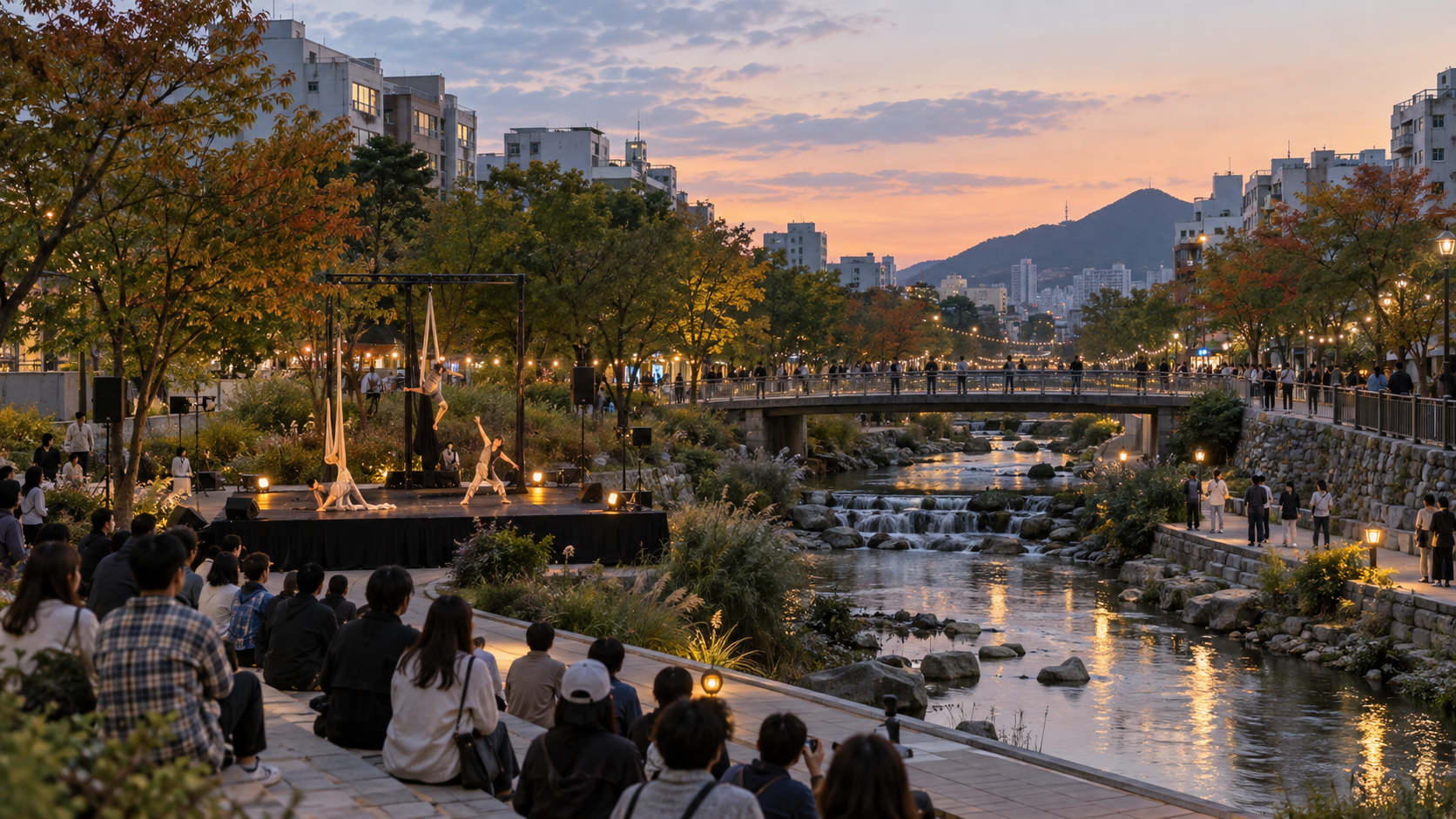
The Busan International Performing Arts Festival is a free, open-air street performing-arts festival held along Oncheoncheon (온천천), the city stream that runs through Geumjeong-gu, and the university street beside it. For 2026 it runs September 18-20, a Friday to Sunday, with operating hours listed as 13:00 to 20:00. It is organised by the Geumjeong Cultural Foundation, and admission is free.
One point of confusion is worth clearing up first. The English name here is nearly identical to BIPAF, the older Busan International Performing Arts Festival that concentrates on theatre. This is a different event: it uses the organiser acronym B.P.A.F, it is run by a district cultural foundation rather than the theatre body, and it happens on the street beside a stream rather than in theatres. If you are matching a poster to this guide, check the organiser (Geumjeong Cultural Foundation) and the venue (Oncheoncheon and the Busan University area).
The 2026 edition carries the theme “MOSAIC: diverse pieces, one picture.” The organiser lists about 28 performing-arts works in total — a mix of internationally invited pieces, domestic official-participation works and domestic invited works — with artists from six countries named in the local coverage: Italy, Chile, Brazil, Indonesia, Malaysia and Taiwan. The festival grew out of the foundation’s earlier street-art programme on the same stream, and it has kept that character: performances happen in the open, close to a walking crowd, rather than on a single ticketed main stage.
What you actually do here
This is a walking festival, not a seated one. The performances are spread across four named zones strung along the stream and the university street, so the core activity is moving between them and watching short outdoor pieces — street theatre, dance, movement and circus-style acts — at close range. The organiser divides the ground into four areas: Zone A, the “gathering yard” (어울마당); Zone B, a culture-sharing space (문화나눔터); Zone C, the Busan University “street of youth” (부산대 젊음의 거리); and Zone D, the railway underpass (굴다리). Because the zones sit along a linear stream corridor, you can reasonably cover them on foot in an afternoon and evening.
Alongside the invited and competition performances, the 2026 programme lists several participatory and supporting strands. Dancing Generation is a citizen-participation dance piece scheduled for the opening; the foundation says roughly 40 participants — a mix of local and foreign residents — prepared it over about two months of workshops, which makes it one of the more community-rooted items rather than a touring show. The Geumjeong Art Market is a community-run market running alongside the stages, and the organiser recruited participants for it in advance. Two exhibitions, “Art Link: Geumjeong” and “CITY_POP,” and a touring mobile-performance strand are also listed in the programme. These are the kinds of elements you encounter between scheduled stage acts rather than sit and wait for.
Because so much of it is street work, you do not need Korean to get value from a visit — movement, costume and circus read on their own. That said, the detailed running order matters if a particular country’s company or a specific competition slot is your reason for coming. The foundation publishes the day-by-day schedule on its own site and channels, and that is the document to check shortly before you travel; a general “28 works over three days” does not tell you which act is on which stage at which hour.
Getting there without a car
From Seoul, the practical route is rail plus subway. Take a KTX from Seoul Station to Busan Station — the fastest services run about 2 hours 15 minutes and typical ones around 2 hours 40 minutes, with the exact time depending on how many stops the train makes, so check your specific service in Korail. Busan Station is the end of the line for the KTX, not the festival, so budget a local leg after it.
The local leg is unusually simple. Busan Station and the festival are both on Busan Metro Line 1, so you ride straight north to Pusan National University Station (부산대역) with no line change. The station sits right on Oncheoncheon in Jangjeon-dong — its own address, 48 Jangjeon-oncheoncheon-ro, is effectively the festival’s registered venue address — so you arrive at the ground rather than needing a further transfer. Use Exit 3 for the university street area, where the cafés, pubs and the “street of youth” zone are. If you are already staying elsewhere in Busan, the same Line 1 ride applies; only your starting station changes.
A taxi from Busan Station is an alternative if you are carrying luggage or travelling in a group, but for a single visitor the subway is faster and avoids the city’s evening traffic. Because the festival is strung along a stream and a busy university district, arriving by public transport and walking the corridor is the way the event is designed to be seen.
Tickets, times and what “free” means
There is no admission ticket. The Korea Tourism Organization lists the festival as free, and the organiser describes the performances and programmes as open to the public at no charge. That is genuine rather than nominal here: because the acts happen on the street and along the stream path, you can watch the core programme without buying anything or reserving a seat.
Free admission is not the same as everything being free. The Geumjeong Art Market sells goods, and some hands-on activities may charge for materials. Those are individual transactions at the stall, not a festival-wide fee, and no reliable 2026 price list for them was available at the time of writing, so treat them as pay-as-you-go rather than budgeting a figure in advance.
The operating window is 13:00 to 20:00. That shapes the whole visit: this is an afternoon-into-early-evening festival, and it closes before the late night. Anchor moments such as the opening ceremony and the Dancing Generation piece fall on the first day, Friday September 18. For the exact start times of specific performances, competitions or the market on each day, use the foundation’s published schedule close to your visit rather than assuming a fixed grid, because street-festival running orders are commonly finalised late.
Food and a local specialty
The festival itself is a street event, and food on site is likely to be market stalls and whatever the art market and nearby university district offer rather than a formal food programme. The Pusan National University area around Exit 3 is a dense student neighbourhood of cafés and cheap restaurants, which makes eating before or between performances easy without planning.
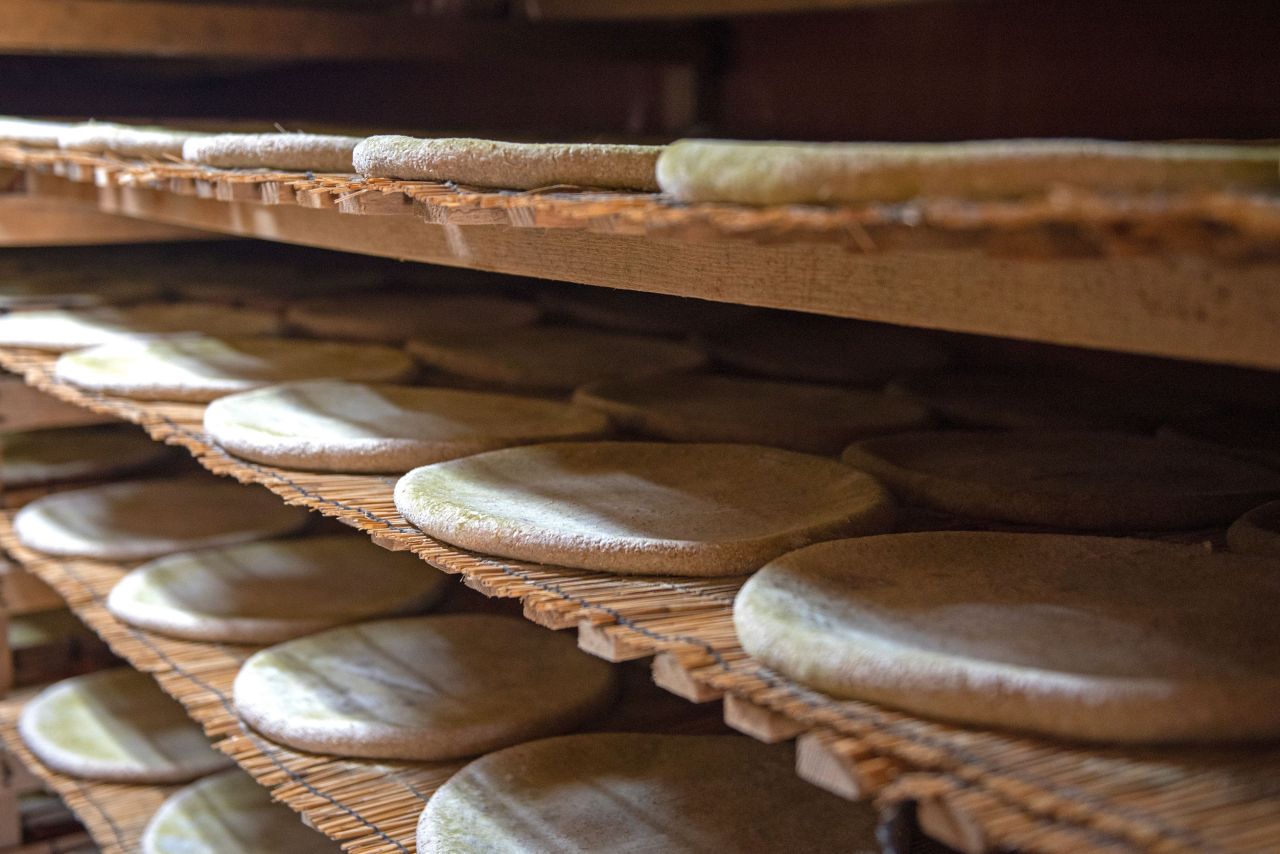
For something specific to the district rather than the festival, Geumjeong-gu’s best-known food-and-drink specialty is Geumjeongsanseong makgeolli (금정산성막걸리). Busan’s cultural-heritage records and the City of Busan describe it as Korea’s first officially designated folk liquor, recognised in 1979, brewed up in Sansong Village at the foot of Geumjeongsan using hand-formed, foot-trodden nuruk fermentation starter — the drying discs shown in the photo here. It is produced at the fortress village well away from the stream, so this is a district recommendation to seek out, not a claim that it will be poured at a festival stall. If you are pairing the trip with the makgeolli, treat the brewery village as a separate outing.
Honest assessment
The strength of this festival is its format. It is free, it is easy to reach — a single Line 1 ride drops you at the ground — and its street setting along a stream means you can see a lot of short international and Korean pieces at close range in one relaxed afternoon and evening. The community strands, especially the resident-made Dancing Generation piece and the local art market, give it a genuine neighbourhood texture that a purely touring festival would not have. For a traveller already in Busan, or one who likes outdoor performance over ticketed theatre, it is a low-commitment, high-flexibility way to spend a September day.
The weaknesses are the flip side of the same format. “Oncheoncheon and Busan University Road” describes a corridor, not a single plaza, so without the daily schedule you can walk past the one piece you most wanted to see. The 13:00-20:00 window and the free, come-and-go nature mean there is no guaranteed seat and no late-night programme; anyone hoping for a single big headline show, or a quiet evening, will be better served elsewhere. And the near-identical English name shared with BIPAF is a real trap — confirm the organiser and venue before you build a plan around it.
The fair way to use it: go in the late afternoon, walk the four zones from the university street toward the underpass, catch a couple of scheduled performances you picked from the published grid, and let the market and street acts fill the gaps. Check the foundation’s own schedule shortly before travelling for the specific times, and treat everything beyond the free performances — market goods, activities, the fortress-village makgeolli — as separate, optional add-ons.