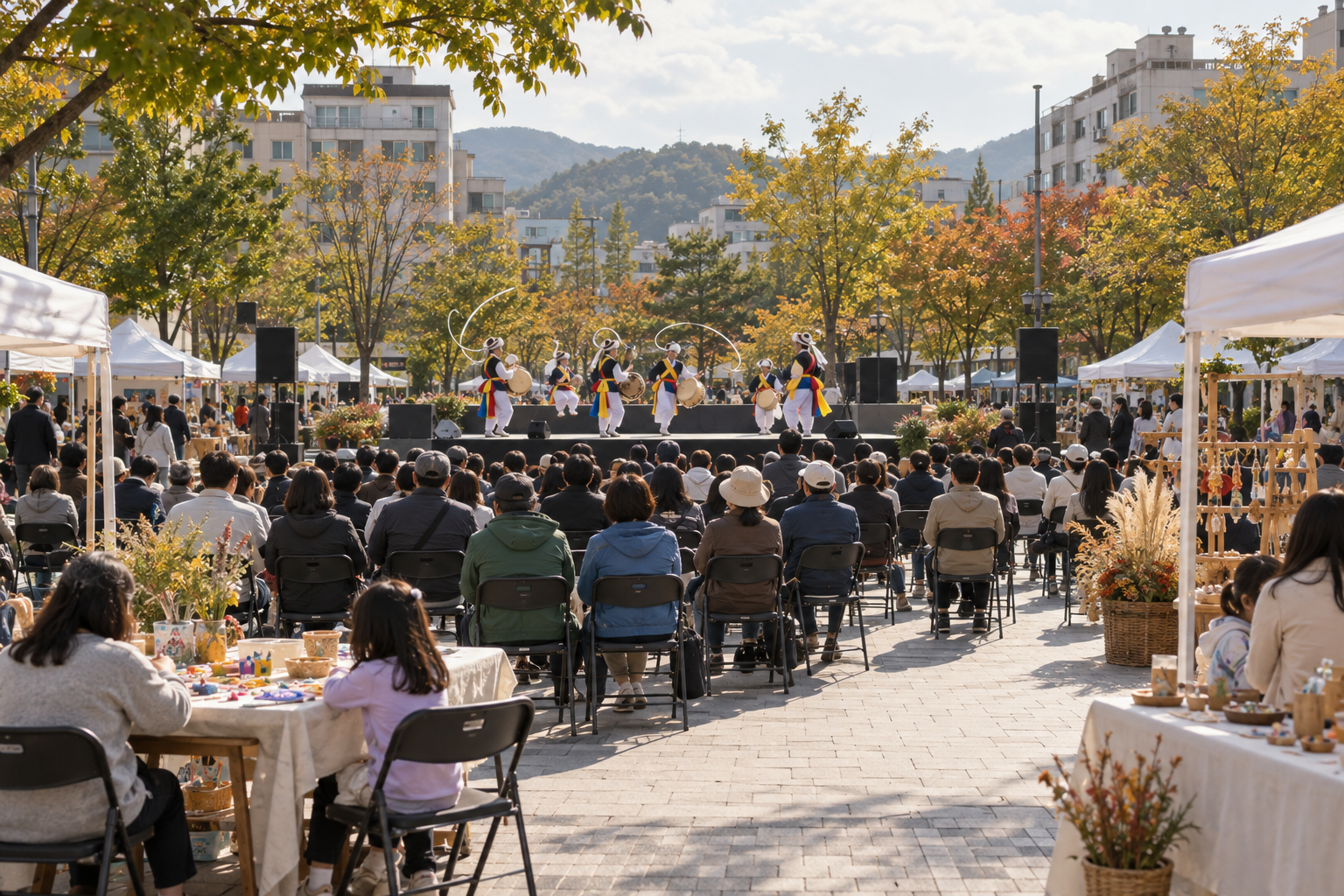
Byeolmangseong Fortress Art Festival is a two-day civic arts event in Ansan, a city on the coast southwest of Seoul. It is named after Byeolmangseong (별망성), a hill fortress in Danwon-gu designated Gyeonggi Provincial Monument No. 73 in 1977. The festival began in 1987 and commemorates the patriotic defence spirit tied to the fortress, whose garrison is remembered in local history for repelling foreign invaders on this stretch of coast. In 2026 it reaches its 40th edition.
One point matters before you plan anything: the festival is not held at the fortress. Since recent years it has run at Seonbu Square (선부광장), a public plaza in the residential Seonbu-dong area of Danwon-gu, several kilometres from the monument itself. The plaza is the venue; the fortress is the namesake and the reason the event exists. If you come hoping to walk the historic ruins as part of the programme, you will be in the wrong place.
The confirmed 2026 dates are September 19-20, a Saturday and Sunday. This is worth stating carefully, because the dates move. A national annual-plan document listed provisional dates of September 12-13, the 2025 edition ran September 20-21, and the 2024 edition was held September 7-8. The September 19-20 dates come from the organiser’s own announcement in August 2026, which is the most reliable source available for this year.
What you actually do here
This is a neighbourhood culture festival, not a large tourist attraction. The core of it is a stage programme that mixes traditional Korean performance with municipal ensembles and lighter modern acts, wrapped around an art competition, hands-on booths and food stalls in the square. You watch performances, walk between exhibition and experience tents, and eat — that is the shape of the visit.
The organiser, the Ansan Arts and Culture Council (안산예총), frames it deliberately as an open event for any resident rather than a showcase for artists and officials only. In practice that means the emphasis is on participation and access: the programme is spread across a single accessible plaza, the anchor performances are free to watch, and the tone is civic rather than commercial. It is the kind of festival a local family drops into for an afternoon, and that is the right way for a visitor to treat it too.
Because the whole thing sits in one square with a subway station underneath it, there is very little logistics overhead. You are not managing shuttle buses, satellite car parks or a long walking circuit between distant venues. That simplicity is genuinely the festival’s strongest practical feature, and it shapes the honest recommendation below.
Programme for 2026
The organiser’s announcement names several fixed elements for the 40th edition. The opening ceremony leads with a Dokkaebi Dance (도깨비춤) opening performance — dokkaebi are the goblin-like figures of Korean folklore — followed by a run of stage sets. Confirmed among them are an “Opera Journey” programme, a performance by the Ansan City Korean Traditional Music Orchestra and one by the Ansan City Choir. The mix of a municipal traditional-music orchestra and a civic choir alongside folk-rooted dance is the clearest signal of what the festival is: a city’s own cultural institutions performing for its residents.
Beyond the main stage, the announced programme includes an art competition (a live drawing and painting event), a set of hands-on experience booths, a screening of the classic Korean silent film “Arirang,” and food stalls. The silent-film screening is a small but distinctive touch and fits the festival’s traditional-and-modern framing.
What is not published is a timed schedule. No start and finish times for the individual sets were given in the material available at the time of writing, and there is no confirmed detail on which programme runs on the Saturday versus the Sunday. If a specific performance is your reason for going, look for the day-of schedule on site or on Ansan City’s festival page rather than assuming an order. This guide deliberately does not invent a timetable.
Tickets and cost
There is no admission ticket. The festival takes place in an open public plaza with no gate, so entry is free in the plain sense that there is nothing to pay and nothing to book to walk in and watch the stage.
Free entry is not the same as everything being free. The announced programme includes hands-on experience booths and food stalls, and those are ordinarily operated separately by vendors and participating groups. No 2026 price list for any booth, workshop or food item was published, so this guide does not quote figures. Bring a normal payment option and treat any paid activity as a small extra rather than a planned cost.
Getting there without a car
This is the easiest transport situation of almost any festival on this site. Seonbu Station on the Seohae Line is built directly underneath Seonbu Square, and all five of its exits open into the plaza. There is no transfer, taxi or walk between the station and the grounds — you come up the stairs into the venue.
From central Seoul, the route is a single transfer onto the Seohae Line. The line runs north to south through the western capital region, so you can join it at Sosa (transfer from Subway Line 1), at Gimpo Airport (transfer from Lines 5 and 9 and the airport railway), or from the north via Daegok (Line 3). Alternatively, take Subway Line 4 south to Choji and ride one stop north to Seonbu, since Choji is the next station down the Seohae Line. Typical door-to-door journeys from central Seoul run roughly one to one-and-a-half hours depending on where you start and how the transfer falls; check a live route planner for your exact origin and travel time, since this guide does not promise a single figure.
The practical upshot is that this festival works cleanly as a public-transport trip. You do not need to plan around parking or road closures, and the return is just as simple — the same station under the same square.
Local specialty: Daebu Island grapes
If you want a food association with Ansan that is verifiable rather than invented, it is not a festival stall but the city’s grapes. Daebu Island (Daebu-do), which belongs to Ansan’s Danwon-gu, is the city’s best-known agricultural area, known for table grapes — largely Campbell Early — and for local grape wine. Ansan has pursued a designated grape-and-wine special industrial district for the island, and Daebu-do runs its own grape festival in September, which is how firmly the fruit is tied to the city’s identity.
This is a regional specialty of Ansan, not a promise about the arts festival. Seonbu Square is in the urban part of the city, well away from the island’s vineyards, and there is no confirmation that Daebu grapes are sold at the event. Treat them as the thing to seek out if you are exploring Ansan more widely, especially the Daebu-do coast, rather than as something the festival itself provides.
Day trip or overnight
For a visitor based in Seoul, this is a day trip and nothing more. The travel time is about an hour each way by train, the venue is a single plaza, and the festival runs for two days with no confirmed evening headline that would justify staying the night. A half-day is a realistic amount of time to watch a stage set or two, walk the booths and eat.
There is no strong case for an overnight built around this festival alone. If you are already spending time in Ansan for other reasons — the Daebu-do coast, the city’s street-arts scene at other times of year, or a longer western-coast trip — then the festival slots in as one afternoon. On its own, it does not carry an overnight stay, and this guide does not recommend a specific hotel because none was verified.
Honest assessment
Byeolmangseong Fortress Art Festival is a genuine civic culture festival with a clear identity: a city performing its own traditions and institutions for its own residents, on a weekend in September, in a plaza anyone can reach. Its strengths are exactly that authenticity and its unbeatable access — a subway station inside the venue, free admission, and no logistics to manage. For someone already in the Seoul area who wants an unforced look at ordinary Korean civic culture rather than a polished tourist event, that is a real and pleasant offer.
Its weaknesses are the flip side of the same facts. It is small and short — two days, one square — and it is built for a Korean-speaking local audience, with no confirmed English support and a programme (a municipal orchestra, a civic choir, a silent-film screening) that rewards some cultural familiarity. The published information is also thin: confirmed dates, venue and a programme list, but no timetable and no prices. None of that makes it a bad festival; it makes it a modest one that does not pretend otherwise.
The fair way to judge it is by effort. Because getting there is so easy and costs so little, the bar it has to clear is low, and it clears it: a couple of hours of performances and booths in a convenient plaza is a reasonable way to spend part of an autumn weekend. Do not cross the country for it, do not expect the fortress on site, and do check the day-of schedule when you arrive — but if you are nearby, it is worth the short ride.