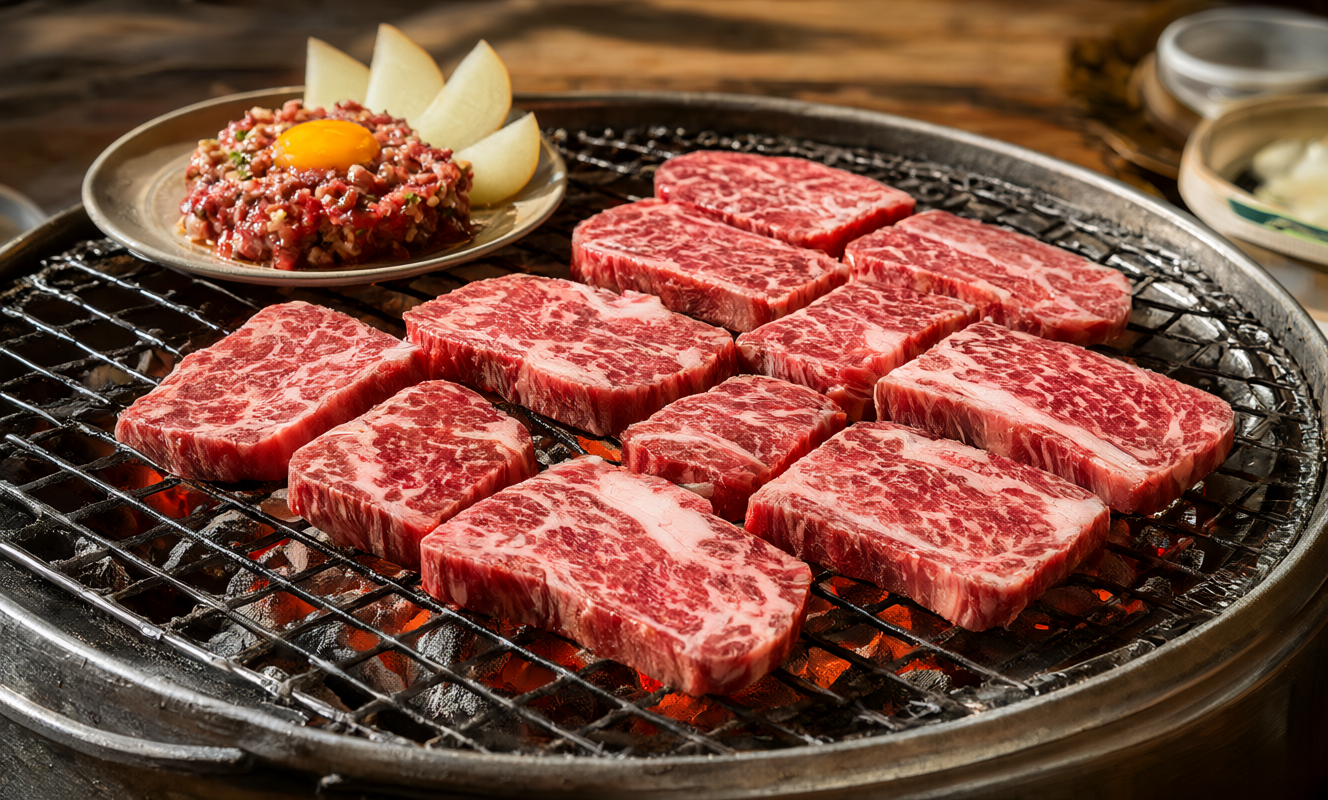
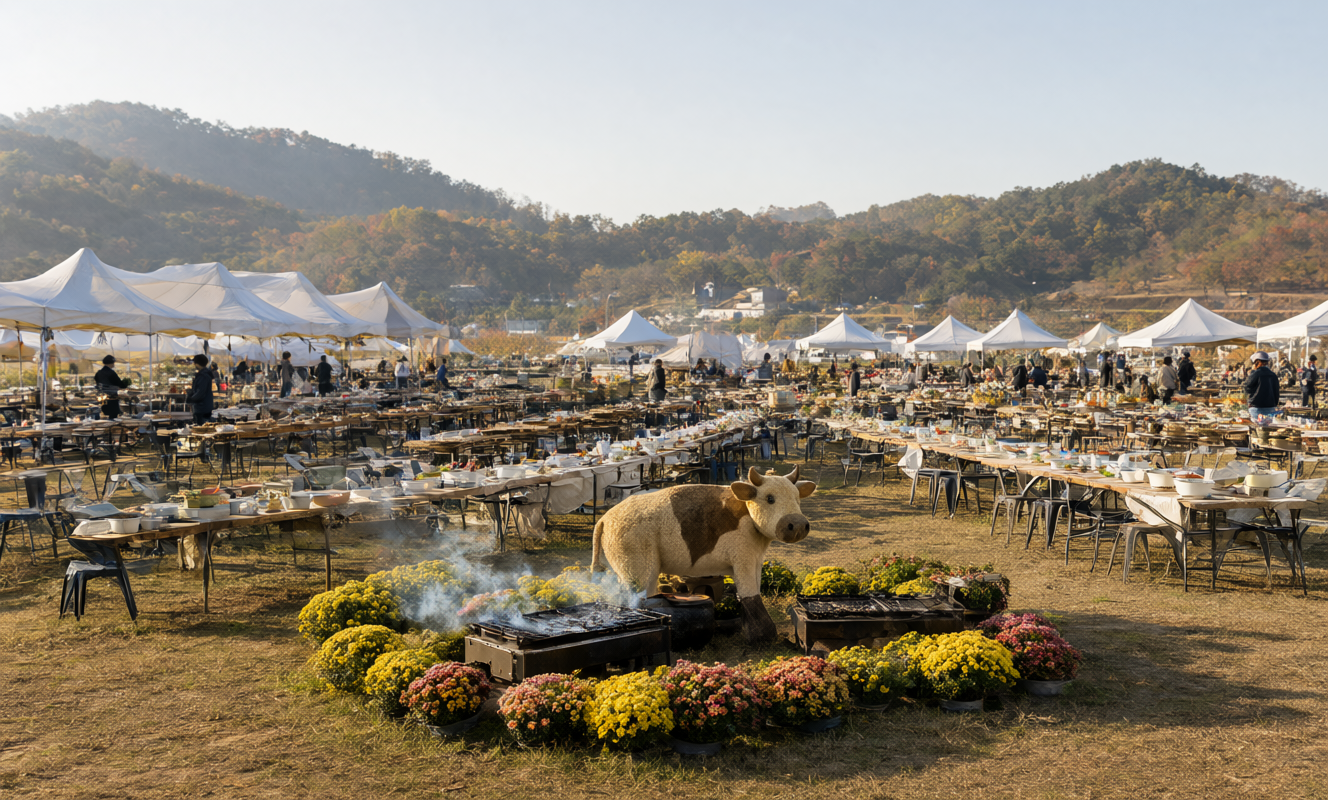
The Cheolma Hanwoo Bulgogi Festival is a beef market that has grown into a five-day event. It takes place in Cheolma-myeon, a rural township in the hills of Gijang County, on the northern edge of Busan. The 2026 edition is listed as the 16th, and it is organised by a local promotion committee rather than a national body. The Ministry of Culture’s regional-festival plan classes it as a local-specialty festival, and that is a fair description: you come to eat hanwoo, Korean native beef, near the place where it is traded.
For 2026, Gijang County’s notice gives October 21-25 (Wednesday to Sunday) with the opening ceremony on Thursday, October 22 at 17:00. The daily hours are 11:00 to 20:30, and the county marks 20:30 as last order. The site is the Cheolma Urban Agriculture Park area at 797-23 Gaejwa-ro. One caution: the Ministry of Culture’s earlier plan listed October 22-26, and the county’s own notice, posted on September 29, moved it a day earlier. A dozen press reports from October 19 all agree with the county.
What you actually do here
The core activity is eating. According to the county’s release, there is a space to buy and taste hanwoo at below-market prices, alongside a direct-sales market for Cheolma-area farm produce. The signature programme is a giant raw-beef bibimbap made every day. A “surprise” hanwoo auction is also listed.
Around the food there is a light programme. Guest singers named in the county release are Shin Seung-tae, Kim Yong-bin, Chun-gil and Yeom Yu-ri, and one outlet adds two more names, but no day-by-day running order was published. There are a citizens’ singing contest, performances by local artists and a grasshopper-catching experience tied to the farm setting. The county also lists an autumn flower exhibition with the Gijang Flower Crop Association and a photo zone built around flowers and a large hanwoo sculpture.
Expect an outdoor, rural, food-market layout. The Michelin Guide’s Korea feature says more than 300,000 people attend over the festival’s four to five days and that last year’s edition went through the equivalent of around 100 head of cattle. Treat that as a rough scale and not a promise about any given day.
Programme and timetable
The only fixed times are the daily 11:00 start, the 20:30 last order and the opening ceremony on October 22 at 17:00. Nothing in the county notice or the coverage reviewed gives a time for the bibimbap-making, the auction, the singing contest or any named singer. The county’s notice carries a programme sheet as an image attachment, but its contents could not be read, so this guide does not reproduce a timetable.
If you are coming for a particular singer, ask the committee on 051-721-4245 which day they perform before planning the trip. The practical reading of the confirmed information is to arrive for lunch or an early dinner, eat well before 20:30 and treat any performance as a bonus.
Tickets, fees and booking
No entry ticket appears in the county notice or in any of the 2026 articles reviewed. The programme is built around buying food and beef on the spot, so free entry is the reasonable expectation, but it is not stated in writing, and this guide marks it as unconfirmed. There is no booking system for the food market in any source found.
Prices are the unknown that matters most. No 2026 price list was published. As a reference point only, the committee’s prices for the 2025 edition were reported at 10,000 to 12,000 won per 100 g for sirloin and striploin and 20,000 won for 250 g of raw beef, about 5,000 won under typical market price, with other cuts 20 to 40% cheaper than market. A 2026 headline from News1 mentions a 30% hanwoo discount, but the conditions were not in the coverage available, so do not budget around it. Look for the price boards on arrival and ask how cuts are weighed before ordering.
Getting there without a car
From Seoul, the KTX to Busan Station is the straightforward leg and takes roughly 2 h 15 m for the fastest trains and up to about 3 h 25 m for slower ones. From Busan Station take Metro Line 1 north to its terminus at Nopo Station, where Busan’s long-distance bus terminal sits beside the station.
The final stretch from Nopo to Cheolma-myeon is where this guide stops being able to promise anything. A town bus route out of the Nopo terminal area is listed as serving Cheolma-myeon, but at intervals of around an hour, and no source confirmed a stop at the festival grounds or any extra service during the festival. No shuttle was announced. Use a live Korean map app on the day, set the destination to Cheolma Urban Agriculture Park (this page’s Naver Map link opens it directly), and have a taxi as the fallback.
Parking, shuttles and traffic control
No 2026 parking map, shuttle timetable or road-closure notice turned up. A 2025 press report said a large parking lot had been prepared for that edition, which says nothing certain about this year. Older posts also give the street address as 789 instead of 797-23, so check the number you navigate to against the 2026 county notice. If you drive on an evening or weekend, expect slow traffic on the approach roads and ask the committee about parking before you leave.
Day trip or overnight
A Seoul day trip is possible on paper: the festival opens at 11:00 and orders run to 20:30. In practice you add a KTX, a metro ride and a local leg each way, and the weakest link in that chain is the last one. This guide does not state a last train because that depends on the date, so check the return in Korail before you buy the outbound ticket. If you want a relaxed meal with the rest of Busan, it makes more sense to stay in the city and treat Cheolma as an afternoon-to-evening excursion. No accommodation was checked for this guide.
Food on site and nearby
This festival is the food. The confirmed items are hanwoo sold below market price, the daily giant raw-beef bibimbap, and a farm-produce market. No stall list, menu, vegetarian option or payment method was published, so do not assume card machines at every booth and carry some cash. The festival is not suited to anyone avoiding raw or red meat.
For the local background, the Michelin Guide’s Korea feature describes Cheolma-myeon as a hub with roughly 40 to 50 butcher-restaurants and hanwoo shops, which is the reason a beef festival exists here. It also notes that Cheolma hanwoo is a trade and a standard of selection more than a farm location, and that the cattle are not necessarily raised in Cheolma. Outside the festival dates, those shops are where the same beef is sold year-round.
Honest assessment
The strength of this festival is its single-mindedness. It does one thing, selling and serving local beef at lower-than-restaurant prices in a rural field, and the daily raw-beef bibimbap and the auction give it some theatre without turning it into a stage show. If you like Korean beef, that clarity is the appeal.
The weaknesses are practical. The programme is thin on published times, the final leg from Nopo is unverified, no shuttle or parking information exists for 2026, and entry and prices are unconfirmed in writing. Dates have moved between June, late October and now October 21-25 over the past few years, so ignore older blog posts. It is not a first-timer’s Korea festival, and it is a poor choice for vegetarians or anyone who dislikes queuing for food. For a beef lover already in Busan, it is worth the trip out.