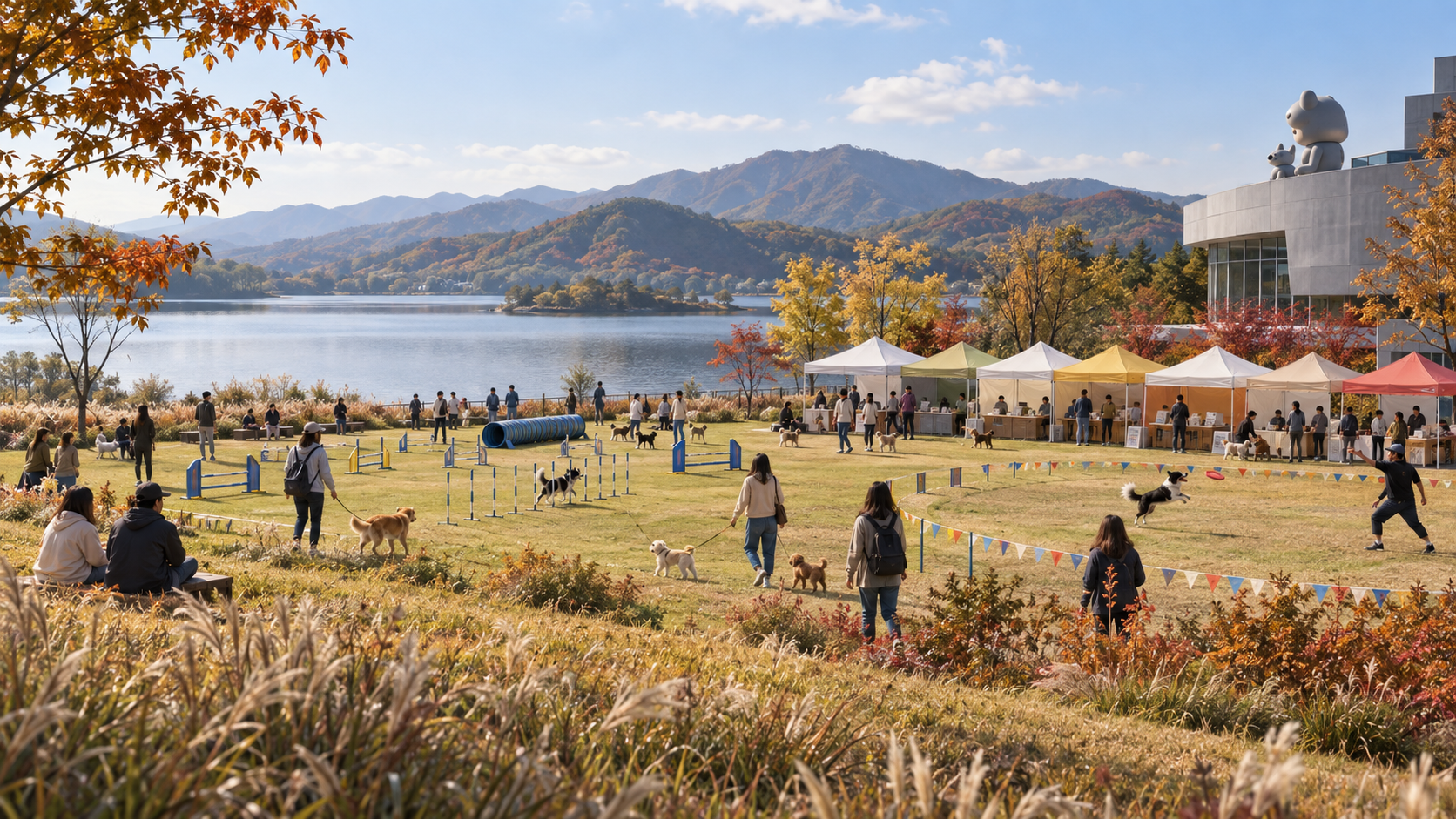
The 2026 Chuncheon Pet Festival is a three-day outdoor event on the Animation Museum grounds beside Uiam Lake. The official English name, Chuncheon Pet Festival, comes from the Korea Tourism Organization’s English record; it is not a translation created for this guide. Chuncheon City identifies 2026 as the sixth edition, following the festival’s start in 2021. Press reports say the city extended it this year from two days to three.
Checked on opening day, October 9: we found no postponement, cancellation or date change. Korean press reports published October 6-8 and the organiser’s own pages agree on October 9-11. This update also corrects an earlier error in this guide: the lakeside dog walk is a Sunday-morning event, not a Saturday-and-Sunday one.
There is an important date correction. The Ministry of Culture’s annual plan placed the event on October 2-4, but the organiser’s current overview and its September 23 visitor notice now give October 9-11, 2026, with daily operation from 10:00 to 19:00. Chuncheon City’s tourism calendar independently shows the same revised dates. Use the later official announcement, not the early planning sheet.
The site is not in central Chuncheon. It is in Seo-myeon, west of the city centre, at the Animation Museum complex. The lake setting works for the festival’s walking programme, but it also creates a last-mile transport step after the train. Visitors coming from Seoul should plan the train and local bus as two separate journeys.
What you actually do here
The programme has three main layers. The first is spectator dog sport. The official page lists a Skyhoundz international flying-disc competition and a Korea Kennel Association agility national-team promotion event under the Dog Sports Championship. Press reports put the two headline events on specific days: the Skyhoundz international qualifier on Saturday and the agility national-team promotion event on Sunday, with 300 teams in the dog-sport competition overall. On Friday the competition ground is opened early so spectators can watch athletes practise. The organiser does not publish start times for individual heats, so treat the day as the plan and the hour as unknown.
The second layer is participation with your own dog. Beginner agility runs on Saturday and Sunday for ten teams per day. Dog yoga is scheduled for Saturday with a 30-team limit. The festival’s three-event “pet Olympics” on Friday uses stay, recall and scent-detection tasks and accepts 50 teams through advance and on-site registration. These are small capacities relative to an open festival, so use the application links on the official website rather than travelling on the assumption that a place will be available.
The lakeside dog walk is one of the larger participatory programmes. The organiser’s programme page lists it on Sunday, October 11 only, with 300 teams, and press reports place it on Sunday morning along Uiam Lake. The organiser describes it as connected with a dog-food donation. That confirms the setting, day and listed capacity, but not the exact start time, route length or donation mechanism; none of those is added here. An earlier version of this guide wrongly gave two walk days.
The third layer works without entering a competition. A pet-industry expo operates around the grounds throughout the festival. A training talk, a breed-introduction presentation on Sunday and a Saturday recreation session are listed as open to visitors. The festival also stages its anniversary ceremony on Saturday and screens selected entries from its AI short-form video competition (press reports cite 79 submissions). Two outdoor films are scheduled at 5 p.m.: a cat-themed film on Friday and a second pet film on Saturday (press lists only the Korean titles). Press descriptions of the expo cover living, food, tech, cats and exotic animals, plus AI, healthcare and veterinary products. The quiz programme on Sunday asks 50 registered participants to answer 30 pet-knowledge questions.
This is therefore possible to visit without bringing an animal. Spectator sport, booths, talks and stage programmes do not require you to arrive with a dog. Still, the practical emphasis is unmistakable: most of the limited-capacity sessions are designed around dogs and handlers. The current programme does not justify promising comparable activities for cats or other companion animals.
Programme and registration
Friday is the specialist day. The invited seminar with international dog-sport competitor and coach Andrea Morrissette is scheduled for October 9 at the main stage and competition area, and the three-event pet games also take place that day. Both have registration links on the official site; the seminar is advance-registration only, while the games allow advance and on-site applications within the stated 50-team total. The competition ground opens early for spectators, and a cat-themed outdoor film screens at 5 p.m.
Saturday carries the widest mix of scheduled activities. Dog yoga, the open recreation session, the first day of beginner agility and the festival anniversary ceremony all appear on October 10. The AI short-form awards and screening are also set for Saturday, along with the Skyhoundz international qualifier and a second 5 p.m. outdoor film. Because the organiser has published dates but not a complete hour-by-hour grid for every item, do not build a sequence that assumes these programmes cannot overlap.
Sunday starts with the Uiam Lake dog walk in the morning and also has the second beginner-agility session, the agility national-team promotion event, the 50-person pet-knowledge quiz and the breed presentation. The industry expo and dog-training talk are listed as operating throughout the festival rather than on one named day.
Registration matters more than ticketing here. The official site’s application menu links separately to the walk, amateur agility, dog yoga, invited seminar, quiz and pet games. Capacity is explicit for several of them, but closing dates and wait-list rules are not consistently stated on the programme overview. Open each form before travel and treat a closed form as unavailable; an open festival ground does not imply an open activity place.
Tickets, fees and what remains unconfirmed
The organiser publishes no gate ticket, booking step or admission charge for general entry, and the standing KTO festival record describes admission as free. This guide therefore records free general admission. It does not extend that claim to shopping, food or every optional service. The industry expo is partly a retail setting, and no reliable 2026 price list for goods or incidental activities was available when checked.
Advance registration should not be confused with a paid ticket. The official pages identify who may register and the team limits, but do not publish a participation fee for the listed sessions. With no explicit 2026 fee notice, this guide leaves those individual costs unstated rather than carrying forward a previous year’s information.
The same restraint applies to practical pet rules. The reviewed pages do not give a complete, field-tested list for vaccination documents, animal size, carriers, muzzles, prohibited zones or waste-bag provision. Bring the equipment and records normally needed to manage your animal responsibly, but check the organiser’s final notice or call the operations office at 070-4103-4711 for a rule that could determine entry. Language support and card acceptance are also left unverified.
Getting there without a car
ITX-Cheongchun is the most straightforward Seoul connection. Chuncheon City’s rail information gives 65 minutes from Cheongnyangni to Chuncheon and 85 minutes from Yongsan. The Animation Museum’s own guide gives about 1 hour 10 minutes from Yongsan, a small timetable-dependent difference that supports planning on roughly an hour to a little over an hour for the intercity leg. Reserve the actual service shown by Korail rather than treating either rounded figure as a guaranteed journey time.
From Chuncheon Station, follow the festival’s stated bus route. Walk about ten minutes to the Chuncheon Nonghyup stop and take Seo-myeon 3, 4 or 5 to Animation Museum Entrance. The museum’s own transport page independently lists Seo-myeon 3 on the same alignment, while the festival adds routes 4 and 5. Check the live Chuncheon bus service before departure: the official festival directions give route numbers but no guaranteed frequency or dedicated shuttle.
An intercity bus from Seoul is possible, but it does not remove the local transfer. The Animation Museum lists about 1 hour 10 minutes from Dong Seoul Terminal to Chuncheon, while the National Chuncheon Museum’s public-transport guide independently gives the same scheduled duration and about 1 hour 30 minutes from Seoul Express Bus Terminal. Road traffic can change those figures. After reaching Chuncheon Bus Terminal, you still need a city-bus or taxi connection to Seo-myeon.
Day trip or overnight
A day trip is realistic because the festival closes at 19:00. Chuncheon City’s current rail page lists the last Saturday and holiday ITX-Cheongchun departure from Chuncheon toward Yongsan at 22:13, leaving a useful buffer on paper. Do not spend that buffer twice: you must first get from the museum area back to the station, and local bus waiting time is not included in the 65-minute train figure.
An overnight stay is a preference rather than a necessity for this programme. It can make sense if you want separate competition and hands-on days, but no published event runs late enough to require it. This guide does not recommend a hotel or quote room availability because neither was independently checked.
Food nearby
The 2026 festival pages do not provide a dependable food-vendor list, menu, dietary guide or price board. Do not assume a full meal service simply because an industry expo is present. If food access matters, eat before the last bus-dependent part of the day or verify on-site vendors with the organiser.
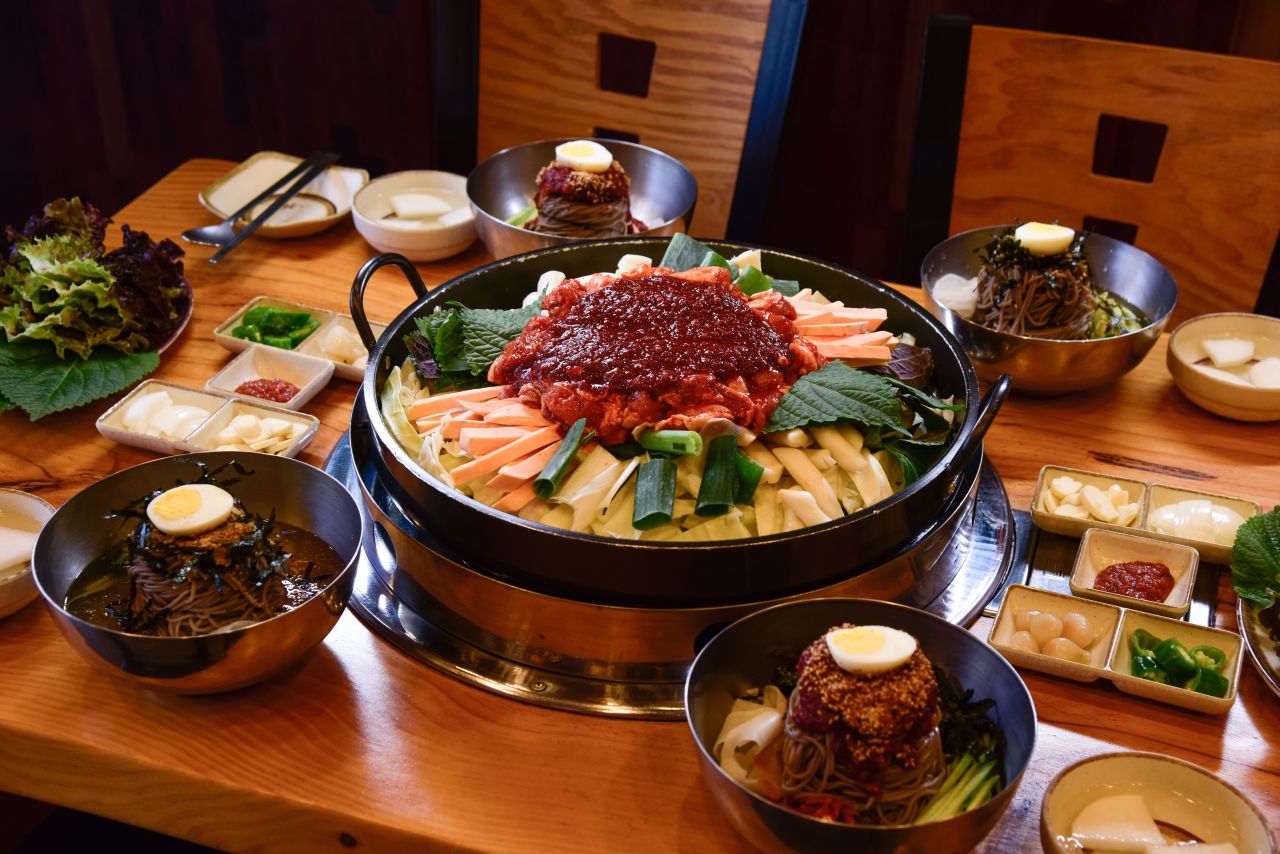
For a documented Chuncheon meal, dakgalbi is the clearest local option. Chuncheon’s tourism portal calls the city’s Myeongdong Dakgalbi Alley a place to eat Chuncheon’s representative dakgalbi and lists multiple specialist restaurants. The usual pan-cooked format combines seasoned chicken and vegetables; the KTO photograph attached to this page also shows makguksu served alongside it. This is regional context, not a claim that dakgalbi is sold on the festival grounds.
Honest assessment
The strongest reason to come is the combination of serious dog sport and low-barrier participation. You can watch professional agility and flying-disc competition, then register a beginner dog for a small-group session or join a lakeside walk. The published capacities make the smaller activities concrete rather than vague promotional promises.
The main weakness is incomplete logistical detail. On opening day the organiser had published routes, programme dates and registration links, but no festival shuttle timetable, parking plan, road-control notice, rain plan or hour-by-hour stage grid was visible in the organiser’s pages or in the Korean press coverage checked for this guide. Drivers should not interpret that absence as proof of unrestricted museum parking, and public-transport users should not expect a special shuttle. Recheck the official notice board immediately before travel.
The festival is also narrower than its English title may suggest. It addresses companion-animal culture broadly in talks, booths and its video competition, yet the live participation schedule is primarily about dogs. That is a good match for a handler interested in training or dog sport, and a reasonable spectator outing for a family. It is a weaker trip for someone seeking extensive programming for cats or small animals, or for a visitor who wants a detailed English timetable in advance.
Plan around one or two named activities, not a promise to “see everything.” Friday favours dog-sport enthusiasts, Saturday has the broadest mix, and Sunday suits the morning walk, the agility national-team event, quiz and breed presentation. With the correct October 9-11 dates, an ITX reservation and a checked local bus connection, this is a workable Seoul day trip rather than an event that requires a car or an overnight stay.