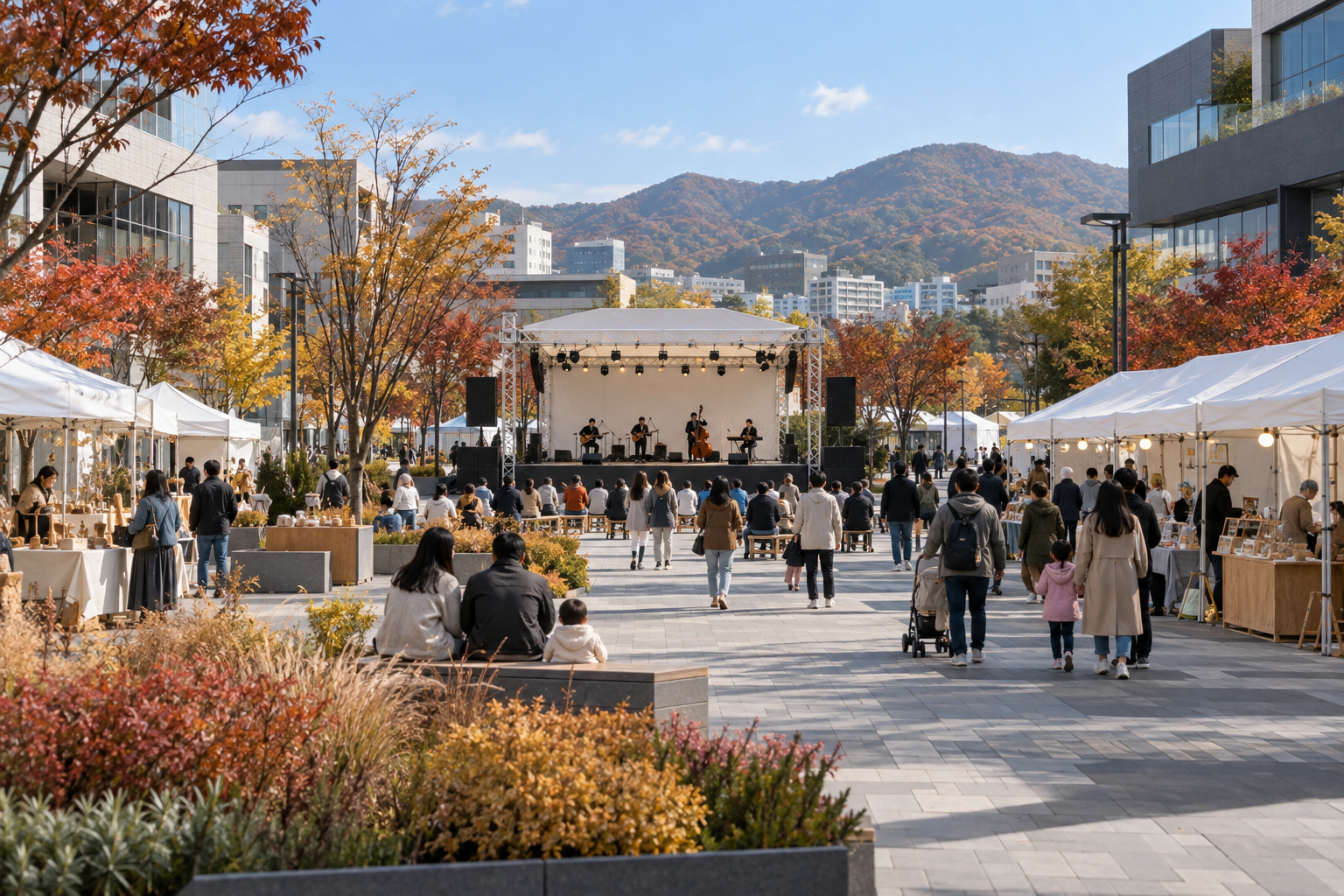
Hyeoksin FESTA is a three-day community event in Wonju Innovation City, the planned district in Bangok-dong that houses the Korea Tourism Organization and other relocated public bodies. The official English wording is not a translation created for this article: Hyeoksin FESTA appears on Wonju City’s official 2025 poster. The current 2026 notice uses only the Korean name, but the earlier city artwork establishes how the event itself has written the name in Roman letters.
The most important planning fact is a date change. The Ministry of Culture’s annual regional-festival plan listed September 10-12 at Hyeoksin Miraenae Square. Wonju City notice 2026-2415, posted on September 1 with a detailed operating document attached, instead places the event on October 15-17, from 11:00 to 21:00, around Miraenae Street at Bangok-dong 1902. The newer local notice is the operational source, so this guide uses October and the street-area description. Do not travel on the ministry plan’s earlier dates.
What you actually do here
The confirmed structure is straightforward: browse temporary stalls, use a play area, watch cultural and arts performances, and join experience programmes. Wonju’s attached document is a call for operators rather than the final visitor leaflet, but it is specific about the planned mix. The city is recruiting 24 food stalls and six sales, experience or publicity stalls. Those numbers describe the recruitment target and may change, as the document itself warns; they should not be read as a guaranteed final stall count.
This is not an innovation-industry exhibition despite the name. “Hyeoksin” here refers to the innovation-city district and the event’s community role. The Ministry classifies it as a resident-harmony festival, and Wonju’s 2026 planning describes food, retail, play, performance and participation rather than product launches or a business conference. Visitors looking for local life in a newer part of Wonju are a better match than visitors expecting a technology expo.
The play area is confirmed only at category level. The city document calls it a playground but does not publish equipment, age limits, supervision rules or a separate charge. Likewise, “experience programmes” is too broad to promise a particular craft. Wait for the public programme or inspect the activity board on arrival before telling children that a specific workshop will be available.
Programme and timetable
The reliable timetable currently has one line: the event operates 11:00-21:00 on October 15, 16 and 17. Cultural and arts performances are confirmed, but no public day-by-day grid or named performer list was available on September 10. There is therefore no evidence for recommending Friday evening over Saturday afternoon, or for promising a headline act at a particular time.
The 2025 programme helps explain the format but should not be copied into a 2026 itinerary. Last year’s official city notice named relay busking, performances by local arts groups and public-institution clubs, food and experience stalls, and public-institution publicity booths. It also described small participation events. None of those named 2025 teams or activities is carried forward here unless the 2026 document confirms the category. The useful conclusion is only that the event has previously worked as a dispersed street programme, not that the same schedule will return.
If a performance is your main reason to go, delay the final choice of day until Wonju publishes the visitor leaflet. If your aim is simply to browse, eat and see what is happening, the full operating window is enough to make a loose plan. The site is a street area rather than a theatre, so allow time to walk before assuming you have seen every component.
Tickets, fees and payment
Wonju’s current document does not list a gate ticket or general admission charge. It treats the site as an open street event populated by temporary booths. That supports free general entry, but it does not mean food, retail products or every hands-on activity costs nothing. No visitor-facing menu, activity price or reservation system had been published when this guide was checked.
Payment is one area where the operating rules are unusually useful. Businesses applying to sell must be registered and able to use a card reader. The rules also state that food sales must accept credit cards, display prices and country-of-origin information, and not charge more than the prices declared in the application. That is firmer evidence than assuming card use from normal Korean shopping practice. It still does not confirm that every non-sales activity takes cards, so keep the claim limited to participating vendors.
The city charges vendors no booth-entry fee, but that is an operator condition, not a visitor bargain and not evidence that goods will be cheap. Published prices are still pending. Look at the displayed menu or product price before ordering, and treat any old coupon or reusable-cup offer found in 2025 coverage as expired unless it is announced again for 2026.
Getting there without a car
From Seoul, rail is the most predictable first leg. KTX services run from Cheongnyangni Station to Wonju Station, and Wonju City’s rail-opening information gives about 46 minutes for the trip. Some Central Line trains now extend to Seoul Station, but Cheongnyangni has the broader service pattern; search the exact date in Korail and use the departure printed on your ticket.
Wonju Station is not at the festival entrance. The city’s traffic information lists routes 18, 19, 30, 34-1 and 90 at the station, but a normal route list does not prove which is best for Miraenae Street on an event day. Use a live Korean map or Wonju bus information after arrival, or take a taxi to Miraenae Street, 1902 Bangok-dong. This guide does not give a station-to-site bus number or travel time because no festival transport notice confirms one.
There is a second route that may be simpler: a direct express bus between Seoul Express Bus Terminal and Wonju Innovation City. Wonju City says the separated direct route began operating in July 2026, with 11-12 one-way services Monday through Thursday and 13-16 Friday through Sunday. The announcement confirms service frequency and the innovation-city destination, but it does not supply enough visitor detail to promise the exact alighting stop for Miraenae Street. Check the stop name and scheduled duration in the booking screen before paying.
Using the ordinary Seoul-Wonju express bus terminal is also possible, but it adds another cross-city transfer from the terminal area to Bangok-dong. For this particular venue, compare the direct innovation-city bus against KTX plus taxi rather than defaulting to central Wonju Terminal.
Parking, shuttles and traffic
No 2026 visitor parking map, temporary road-control plan or festival shuttle schedule had been published by September 10. The address describes a street area, and stalls and activities need installation space, but that alone does not prove which road will close or where drivers will be directed. Do not navigate to the middle of Miraenae Street and assume normal curb access.
Check the official notice again shortly before October 15 and use Wonju’s traffic-information service for live conditions. If the city names a remote lot or shuttle later, verify its operating dates and last departure rather than relying on a screenshot from the previous year. The 2025 festival occupied a broader corridor between commercial and public-institution sites; the 2026 recruitment document instead names Miraenae Street, another reason not to recycle last year’s map.
Crowd levels are not quantified. The event is designed for residents and the operating window extends through the evening, but there is no published attendance forecast that supports calling a particular hour crowded. Leave margin around any performance you select once the schedule appears, especially if you must make a reserved train or bus back to Seoul.
Day trip or overnight
A day trip from Seoul is workable on the confirmed facts. The KTX leg is under an hour, and the event closes at 21:00 rather than after midnight. The unknowns are the two local transfers and the exact return service, so book the return only after adding realistic time from Miraenae Street to Wonju Station. A direct innovation-city express bus can reduce transfers if its live timetable fits.
There is no verified reason to stay overnight solely for a late finale: no finale has been announced, and the published operating window ends at 21:00 each day. An overnight stay may still suit a wider Wonju trip, but this guide does not recommend a hotel or claim festival-period availability because those were not independently checked.
Food and a Wonju specialty
Food will be a substantial part of the site if recruitment reaches its target: 24 of the planned 30 booths are food booths. The document confirms sales rules, hygiene requirements, price displays and card acceptance, but not a menu. It would be unsafe to promise vegetarian dishes, local specialties, alcohol, seating or a particular price range before the final vendor list appears.
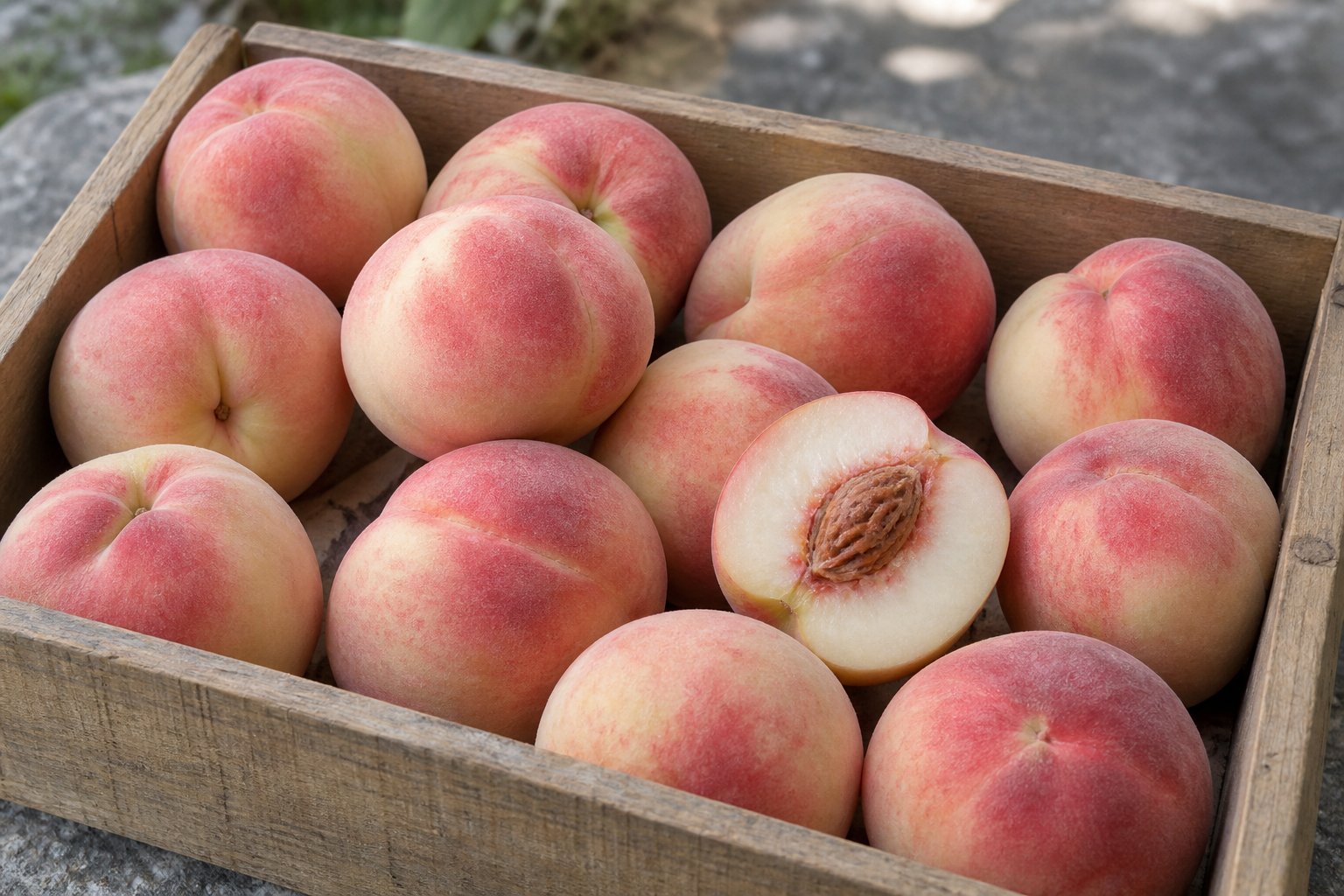
Away from the temporary menu, Chiaksan peaches are a documented Wonju specialty. Wonju Agricultural Technology Center lists them among the city’s agricultural products and says orchards are concentrated on well-drained slopes around Chiaksan with plentiful sunlight. Peach season and stall participation were not verified for the October festival, so this is something to recognise as a Wonju product—not a claim that fresh peaches will be waiting at Hyeoksin FESTA.
Honest assessment
Hyeoksin FESTA makes most sense as a neighbourhood event that visitors can fold into a Wonju trip. Its confirmed ingredients—food booths, small retail and experience booths, a playground and cultural performances—offer variety without requiring advance study. The direct express bus to the innovation city also makes the district less awkward from Seoul than it used to be.
Its weakness is that the public-facing detail is still thin. The city has published what operators need to know, not what visitors most need: there is no daily stage grid, participant list, parking plan or activity price sheet. The event is also young, with the annual plan recording an initial 2024 edition, so there is limited evidence for treating any past programme as a fixed tradition.
The date revision is the clearest warning against planning from aggregators. Even a national annual plan can be overtaken by a later municipal decision. Use October 15-17 and 11:00-21:00 now, then check the Wonju City page again for the final leaflet. Go for an informal look at how the innovation-city community uses its central streets; wait for more detail if one named performance or activity must justify the journey.