
Autumn · Gyeongsangnam-do · Field listing
Jinju Namgang Lantern Festival 2026
The essentials first: whether it is open, what it costs, how hard it is to reach and what to expect if you do not speak Korean.
When
Oct 3 — 18ConfirmedConfirmed dates
Where
Jinjuseong Fortress and the Namgang River, JinjuGyeongsangnam-do
Admission
FREEGeneral admission to the 2026 festival is free. Wish-lantern hanging, floating a lantern, crossing the temporary pontoon bridge and the cruise-boat experience are listed as activities, but reliable 2026 prices had not been published when this guide was updated.
From Seoul
About 3 h 30 m by direct KTXTake a direct KTX from Seoul Station to Jinju Station, then use a taxi or a city bus connection to Jinjuseong Fortress. Check the live local route planner because festival diversions and the 2026 shuttle plan were not yet published.
Hours
13:00-23:00; lanterns lit 18:00-24:00
Organiser
Jinju Culture and Arts Foundation, 055-761-9111 or 055-755-9111
Is this one for you?
Who it suits. This suits visitors who are happy to spend an evening walking both banks of the river and the fortress grounds to see lanterns from several angles. It is a weaker choice if you want a single seated performance, or if you cannot stay out late, since the lanterns are only lit after dark and the walk covers a lot of ground. Anyone who dislikes crowds should also weigh that this is a well-known festival on a compact riverside site.
When to go. Come in the second half of the day and stay into the night. Arriving while it is still light makes the fortress and the river layout much easier to read, and then the lanterns are listed as illuminated from the evening onward, so the display is really an after-dark event. Budget enough time to cover more than one bank rather than stopping at the first cluster near an entrance.
LOCAL WEATHER
Weather near the festival
Korea Meteorological Administration forecast
Need something we do not list — a stall menu, a parking gate, a last bus? The Korea Travel Helpline answers in English around the clock: dial 1330 inside Korea, or +82-2-1330 from abroad.
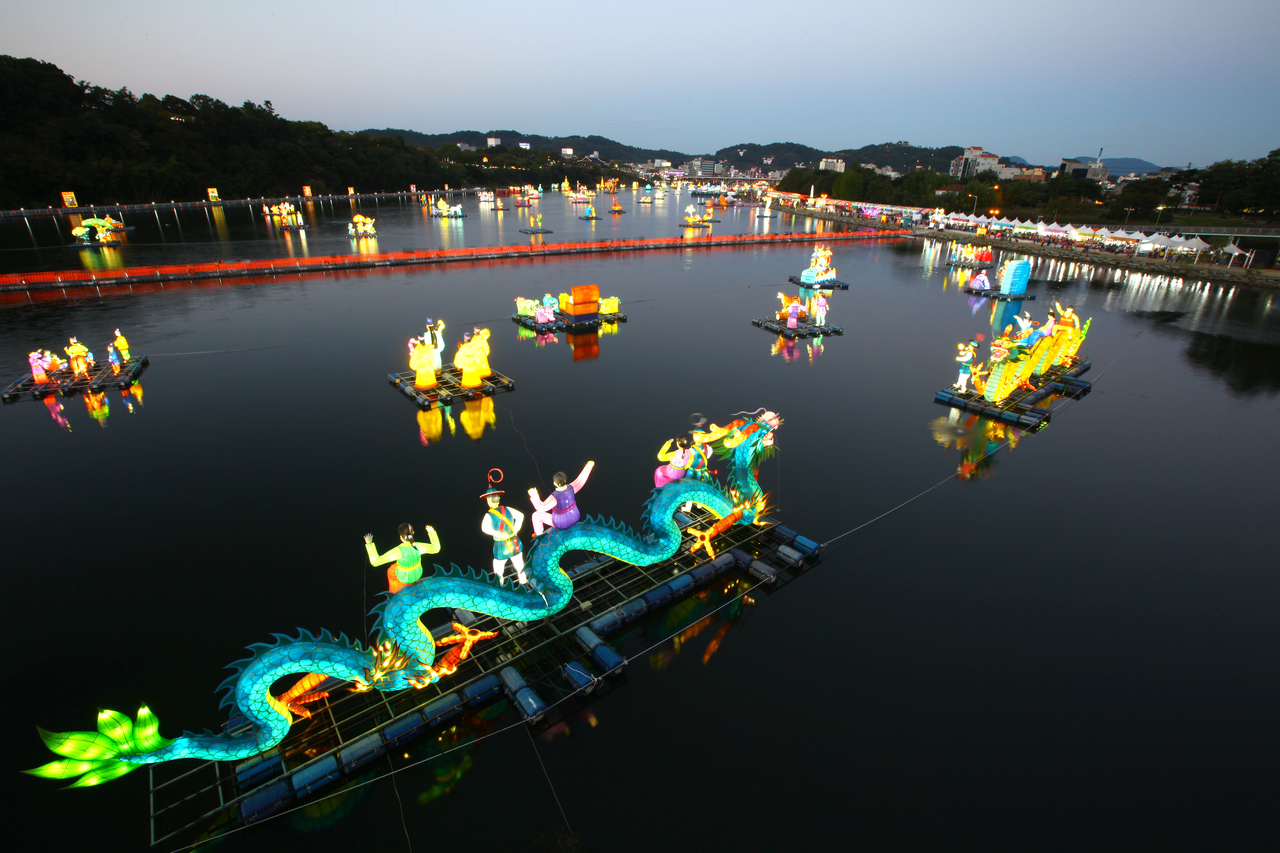
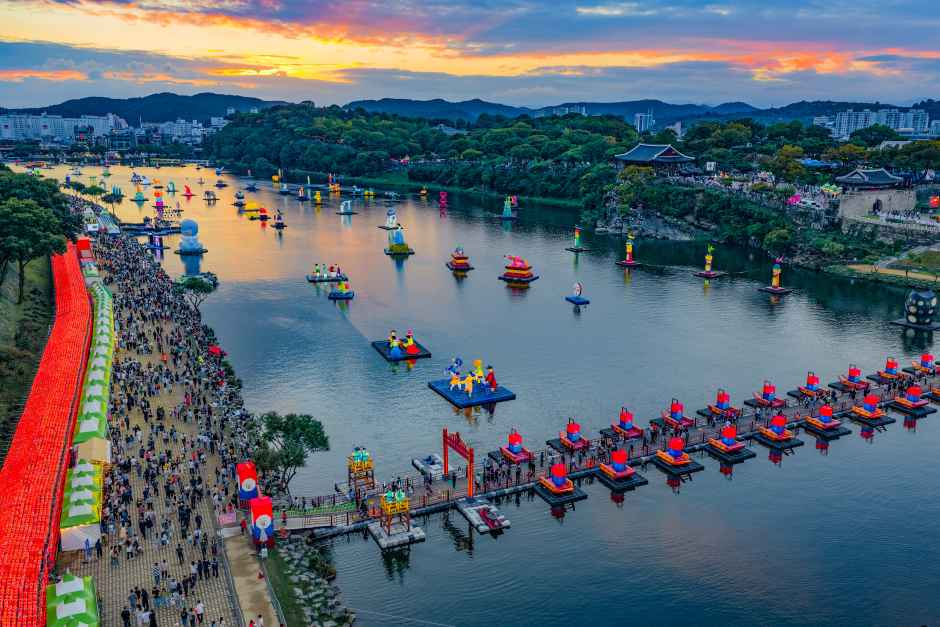
Jinju’s lantern festival occupies both banks of the Namgang and the grounds of Jinjuseong, the fortress above the river. Its origin story is local history rather than a decorative theme added later. During the 1592 Battle of Jinjuseong, part of the Imjin War, lanterns on the river were used for military signalling and communication with people outside the fortress. Jinju residents later maintained a lantern competition within the Gaechon Arts Festival, which began in 1949; the lantern event became an independent festival in 2000.
For 2026, the confirmed dates are October 3-18. KTO lists the site as Jinjuseong and the Namgang area, at 626 Namgang-ro in Bonseong-dong, and general admission as free. The important timing distinction is that booths and the temporary bridge operate 13:00-23:00, while the lanterns are listed as illuminated 18:00-24:00. This is fundamentally an evening visit, even though arriving in daylight makes the fortress and river layout much easier to understand.
What you actually do here
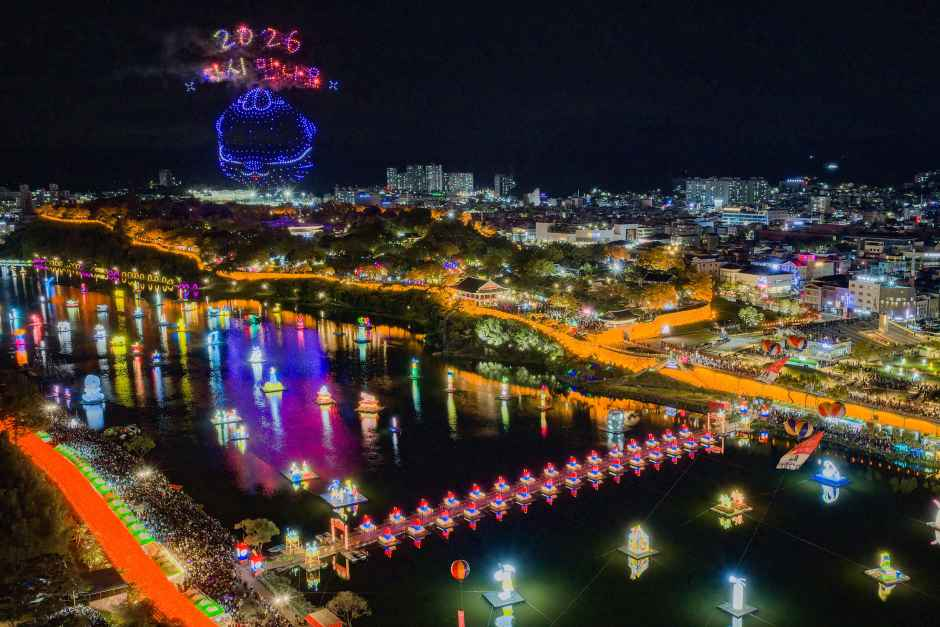
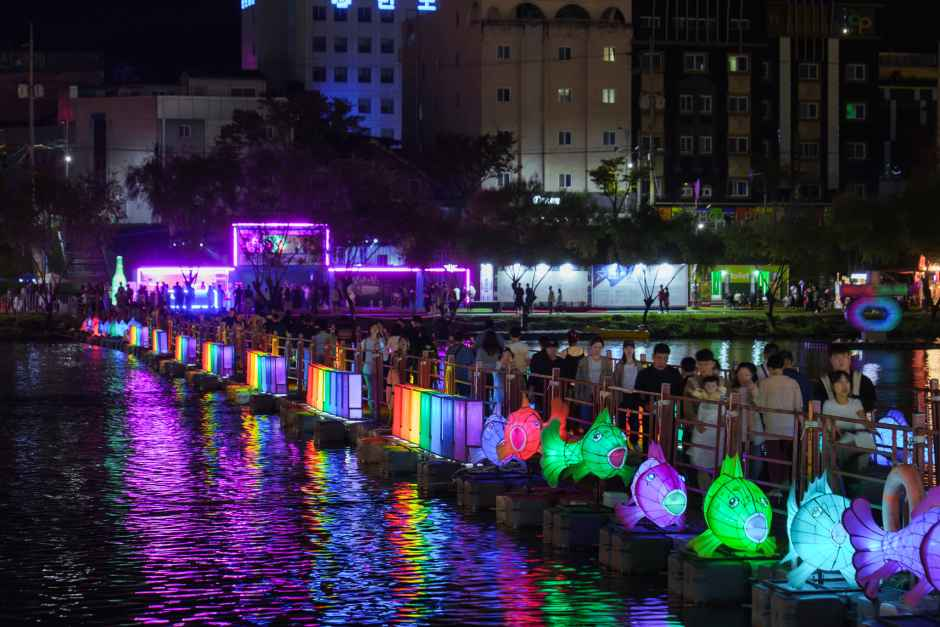
The central activity is a long walk rather than one seated performance. Lantern installations stand on the water, along the riverbank and inside Jinjuseong. From the fortress side you see the floating pieces against the opposite embankment; from the riverside paths you get closer views and different angles back toward the walls. Allow time to cover more than one bank instead of treating the first bright cluster near an entrance as the entire show.
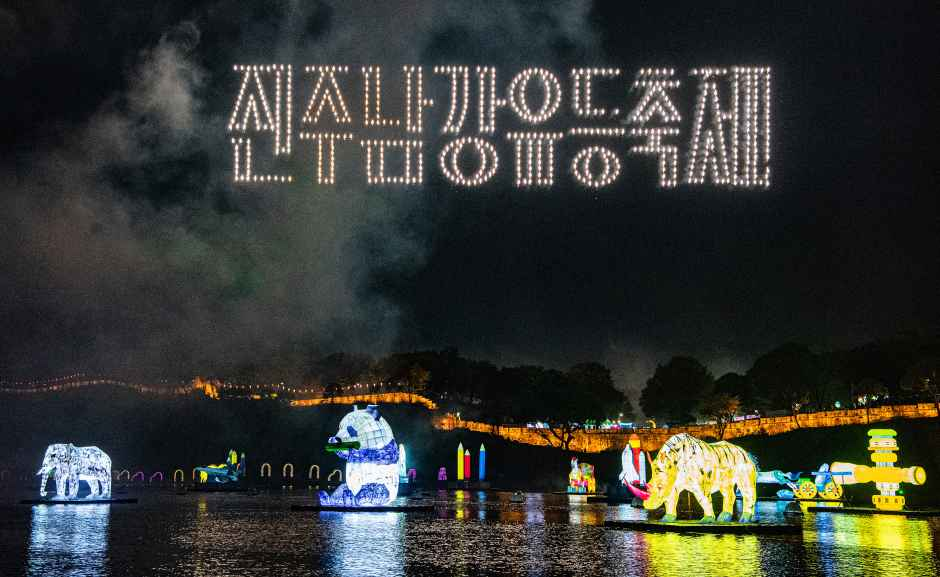
The 2026 KTO programme confirms four principal elements: floating lantern displays, land-based lantern displays, a drone light show and fireworks over the river. It also lists a night parade. The drone and fireworks are specific events, not continuous attractions, and their dependable 2026 dates and viewing instructions had not been published when this article was checked. Several pages on the official site still carry 2025 labels and dates inside a 2026 layout, so copying those dates into a 2026 itinerary would be unsafe.
Visitors can take part as well as watch. Confirmed activity categories include hanging a wish lantern, floating a lantern on the river, crossing a temporary pontoon bridge and taking a cruise-boat experience. These activities should not be read as included in free admission. KTO confirms free entry but does not yet give a reliable 2026 price for each optional programme. Check the price displayed at the booth and the final festival leaflet rather than planning around figures from an earlier year.
Programme and timetable
The overall operating window begins at 13:00, but there is limited reason to arrive that early solely for illuminated displays. A practical sequence is to use late afternoon for Jinjuseong, move down toward the river before 18:00, and then walk the installations after lighting. The final hour also needs care: booths and the pontoon bridge close at 23:00, one hour before the published midnight end of lantern illumination. Do any paid activity or cross-river shortcut before the booth closing time.
KTO also identifies two accompanying festivals from October 9-18: the Gaechon Arts Festival and the Korea Drama Festival. That creates a useful distinction within the 16-day lantern-festival run. A visit from October 3-8 is focused on the lantern event itself; from October 9 onward, more programmes coexist in Jinju. It does not follow that every accompanying event takes place at the lantern grounds, so check each event’s venue before building a tightly timed route.
The official 2026 daily grid remains the missing planning document. The safest approach for anyone travelling specifically for fireworks, the drone show, a parade or a named singer is to wait for the date-by-date schedule on the official site or its notice board. KTO confirms the programme types but not enough detail to promise a particular performance on a particular night. This article deliberately leaves out the 2025 fireworks and drone dates that remain searchable online.
Tickets, fees and booking
There is no general admission ticket for 2026. You can enter the riverside festival area without paying, and KTO describes the event simply as free. That makes it possible to see the principal lantern displays without committing to a package or advance reservation.
Free entry is not the same as every activity being free. Wish lanterns, lantern floating, the pontoon crossing and cruise boats are separately operated experiences. Their 2026 prices, booking method, capacity and cancellation rules were not available in a form reliable enough to publish on September 7. If one is essential to your visit, contact the organiser at 055-761-9111 or 055-755-9111 rather than relying on an old blog or a previous festival’s price board.
The same caution applies to the drone show and fireworks. They are listed components of the festival, but there is no separate ticket information in the current KTO record and no verified 2026 reserved-viewing product. General riverbank viewing should not be confused with any later announcement of controlled or reserved areas.
Getting there without a car
Direct KTX services run from Seoul Station to Jinju Station. Current schedules place the trip at roughly three and a half hours; individual services vary with their stops, so use the specific train shown by Korail for your travel date. The station is southeast of the historic centre, not beside Jinjuseong. Budget a second local leg after the intercity train.
A taxi is the simplest station-to-fortress transfer when time matters. City buses also connect the station area with central Jinju, but routes and stops can be altered during a large riverside event. Use Jinju’s live bus information or a Korean map app on the day and set Jinjuseong or the festival address—not merely “Jinju”—as the destination. The earlier version of this guide said there was no direct city bus; that claim was not supported well enough and has been removed.
Intercity bus is the alternative from Seoul Nambu Terminal to Jinju’s intercity terminal. Current timetable listings put the scheduled ride at about three and a half to four hours before road delays. The advantage is arrival closer to central Jinju than the rail station; the disadvantage is exposure to expressway and festival traffic. Verify the live departure and arrival terminal when booking, because Jinju has more than one long-distance bus terminal.
Parking, shuttles and traffic control
This is one area where last year’s details can create a bad plan. The festival site currently names large satellite parking areas such as the innovation-city area, Mulchoeul Park and Jinju Stadium, but its pages also visibly retain 2025 programme content. A dated 2026 parking map, road-closure notice and shuttle timetable were not available when checked. Those details should be treated as pending, not copied forward.
If driving, open the official Traffic Information page again shortly before departure and follow the published satellite-lot assignment. Do not navigate straight to Jinjuseong and expect curbside parking: the event spans roads and paths around the old centre, and any temporary controls will matter more than a normal map listing. A shuttle is useful only if its 2026 stop, operating dates and final departure have been confirmed; this guide does not promise the previous year’s hours.
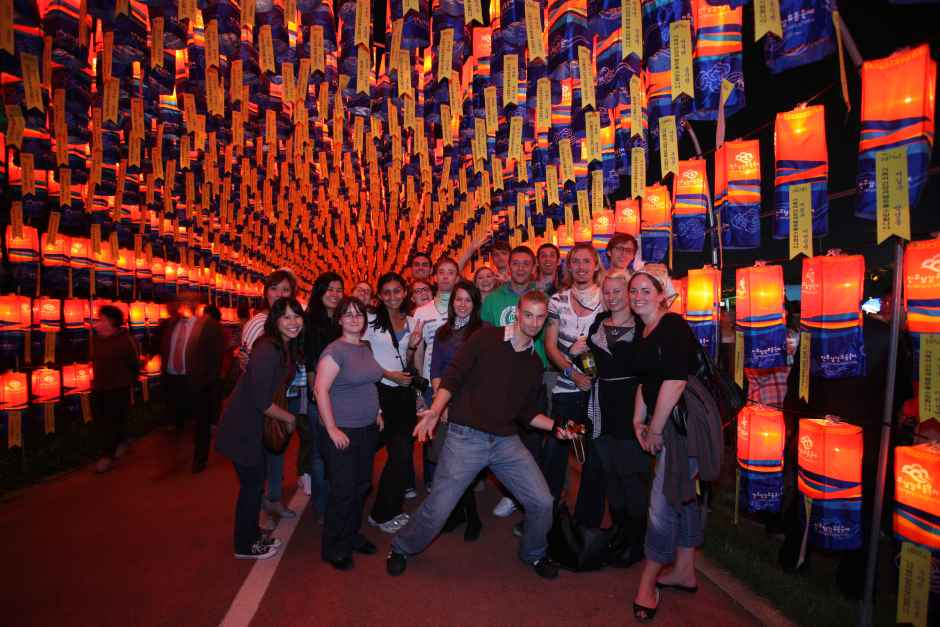
Crowding is structurally concentrated after 18:00 because that is when the lights come on. Fireworks and drone-show nights will also concentrate people into limited river-viewing areas, although no evidence yet supports naming one 2026 night as the busiest. Keep children away from the edge of a moving crowd, agree on a meeting point before crossing the river, and avoid making a tight onward connection immediately after a headline event.
Day trip or overnight
A Seoul day trip is technically possible but poorly matched to the festival’s hours. Seven hours or more of round-trip rail travel, two local transfers and lantern lighting beginning at 18:00 leave a narrow evening window. This guide does not state a last train because the correct answer depends on the travel date and any timetable changes. Search the exact return in Korail before buying the outbound ticket.
One night in central Jinju is the more workable structure if the lanterns, drone show or fireworks are the main reason for coming. Choose the area based on walking access to Jinjuseong and the Namgang rather than proximity to Jinju Station; the station still requires a transfer. Availability and prices were not independently verified, so no individual hotel is recommended here. Book early if your dates overlap the accompanying festivals from October 9-18, when more than one event is drawing visitors to the city.
Food on site and nearby
KTO warns that the food information in its current listing still describes the 2025 festival and is being updated for 2026. That means this guide cannot responsibly name a 2026 stall, menu, price, vegetarian option or payment method. Eat before the most crowded evening period if a reliable meal matters, and treat whatever is operating on site as a convenience rather than a confirmed food programme.
For a documented local dish away from temporary stalls, Jinju City’s tourism office identifies Jinju bibimbap as a traditional local food and uses the name chilbo-hwaban, referring to its flower-like arrangement. The version represented in KTO’s Jinju photo-gallery record includes seasoned vegetables and raw beef over rice. Ask before ordering if raw beef is unsuitable for you. This is a regional specialty recommendation, not a claim that it will be sold inside the festival.
Honest assessment
The festival’s strength is the relationship between the lanterns, water and fortress. The view changes as you move, reflections add a second layer to the installations, and the historical setting gives the display more context than a generic urban light show. You do not need a paid activity to understand the event, which makes the free admission meaningful rather than nominal.
Its practical weakness is scale combined with incomplete advance detail. “Jinjuseong and the Namgang” describes a broad area, not one compact plaza, and the most searched-for events—fireworks, drones and parades—need a final daily timetable. The official website’s mixture of 2025 and 2026 material is another reason to check page labels closely. Use the KTO-confirmed dates and operating hours now, then retrieve the final leaflet for event-specific planning.
Arrive before lighting if photography matters, complete bridge or boat activities before their 23:00 closing time, and leave margin after any headline show. Rain can reduce visibility and make riverside walking less comfortable, but no verified 2026 rain policy was published, so check same-day notices rather than assuming cancellation or continuation. The festival is worth an overnight visit for travellers who want a full circuit after dark; it is a much harder proposition as a rushed return trip from Seoul.
Local specialties to try

Jinju bibimbap (진주비빔밥)
Jinju City's tourism office identifies this composed rice dish as a local food and also calls it chilbo-hwaban, or a flower-like bowl. A common local version is topped with seasoned vegetables and raw beef; it is a city specialty, not a promise about what temporary festival stalls will serve.
Questions worth asking
When should I arrive to see the lanterns properly?
The festival grounds and booths operate from 13:00 to 23:00, while the official site gives 18:00-24:00 as the lantern lighting period. Arrive before 18:00 if you want to see Jinjuseong in daylight and be beside the river when the display changes after dark.
Is the 2026 Jinju Lantern Festival free?
General admission is free. Several participatory activities are separate, including wish-lantern hanging, floating a lantern, the pontoon bridge and cruise boats, but the official 2026 price list was not available at this update.
Are the 2026 fireworks and drone-show dates confirmed?
The Korea Tourism Organization confirms that both a drone light show and fireworks on the river are in the 2026 programme, but a dependable date-by-date 2026 timetable had not been published on September 7. Do not use the 2025 dates still visible on parts of the official website.
Can I do this as a day trip from Seoul?
The direct KTX takes about three and a half hours each way, and the lanterns are lit from 18:00. A same-day trip leaves little useful evening time once the transfer between Jinju Station and the river is included. Check your exact return train before deciding; this guide does not assume a particular last departure.
Where should I park, and is there a festival shuttle?
The official site names satellite parking areas used in its current transport material, but the dated 2026 lot-by-lot plan, shuttle stops and service intervals had not yet been published. Use the festival's transport notice immediately before travel rather than navigating to an old parking list.
Before you goFestival Etiquette in Korea: What Visitors Get WrongBooking KTX Trains and Intercity Buses as a Foreign VisitorGetting Out of Incheon Airport and On to a FestivalKorean Festivals With Children: Toilets, Strollers and TimingStaying Online in Korea: SIM, eSIM and the Apps That MatterEating at a Korean Festival Without Speaking KoreanRain, Typhoons and Cancelled Festivals: How to Plan Around ThemHow to Pay for Things in KoreaT-money and Transit Cards in KoreaWhat to Wear to a Korean Festival, Season by Season
LAST UPDATED · Sep 7, 2026