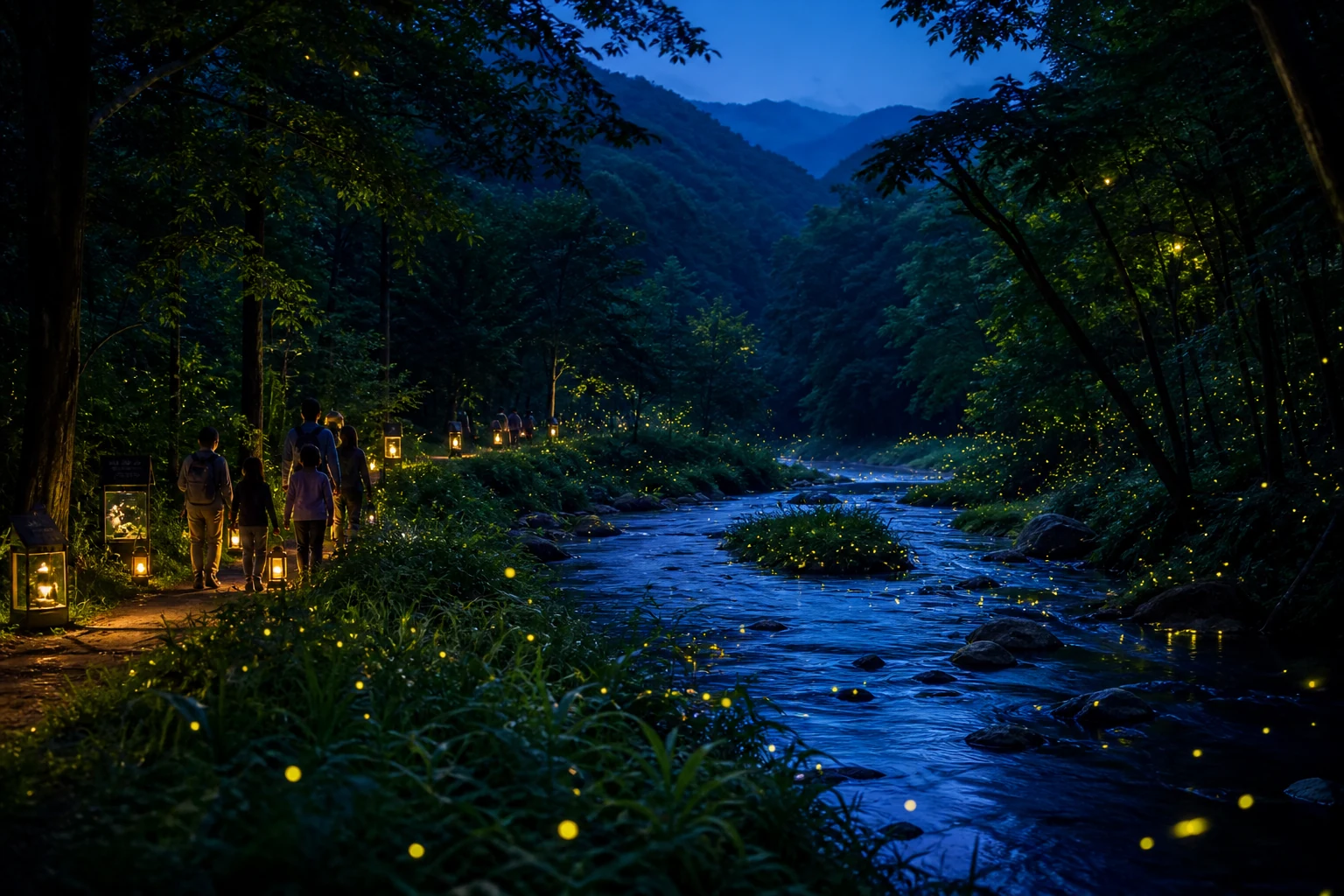
Muju’s festival is built around a specific nighttime experience: leaving the town-center grounds by bus to look for fireflies in their natural habitat. The rest of the event fills the day with an indoor firefly theme hall, ecology activities, performances and evening light programs along the Namdaecheon area. The confirmed 2026 festival runs September 4-12, the main grounds operate 10:00-22:30, and general entry is free.
The festival closes on September 12, but the signature habitat excursion continues through September 20, except September 14 and 15. Someone interested only in the guided trip therefore has post-festival dates; someone wanting stages, food booths, parades and the complete town-center program should stay within the nine festival days.

What you actually do here
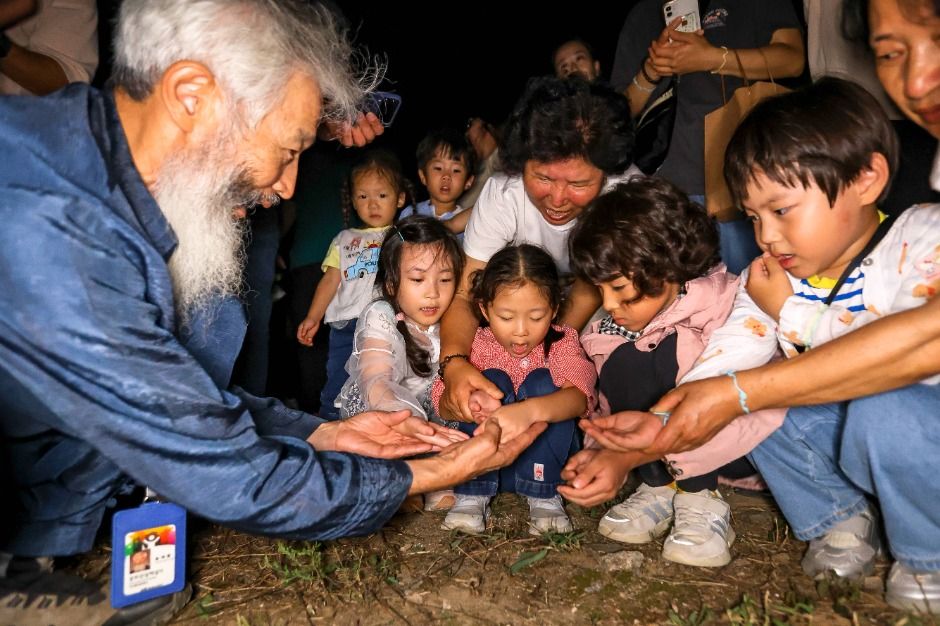
The signature program is the Firefly Mystery Exploration. Its published sequence starts with check-in at 18:40, reaches the habitat at 19:20, leaves it at 20:05 and returns at 21:00. A place costs 20,000 won per person and the standard program must be booked online through the festival website. The organiser sends final confirmation by text because the schedule can shift with sunset, so treat those times as a planning frame and arrive early.
This is wildlife observation, not a staged light display. The organiser warns that weather and natural conditions can cancel the program or restrict sightings. It recommends long trousers and athletic shoes, prohibits LED shoes, and does not allow pets. Wheelchairs and other mobility aids are restricted on the habitat excursion because of its environment; that limitation is specific to the exploration, not a description of the central festival grounds.
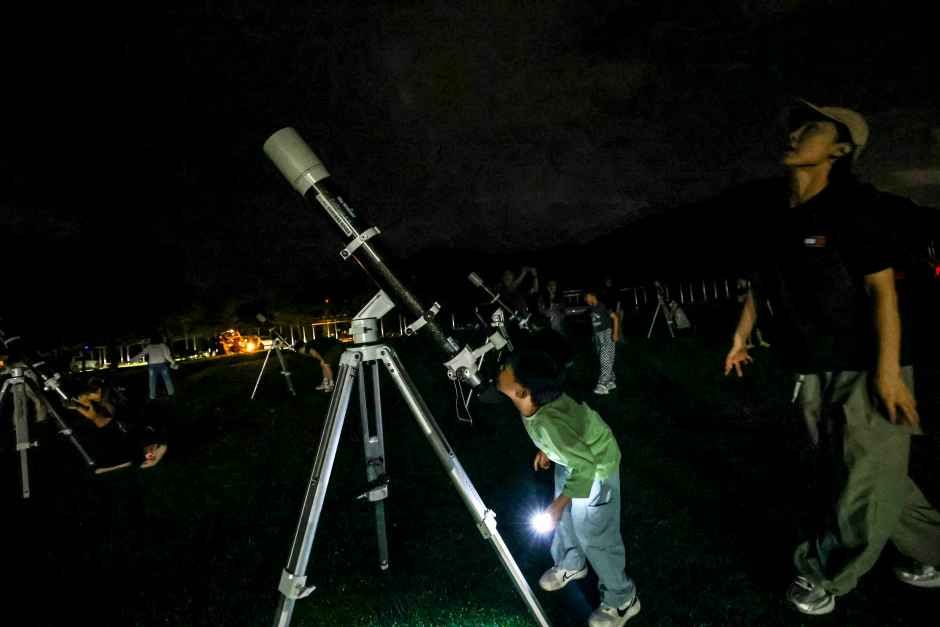
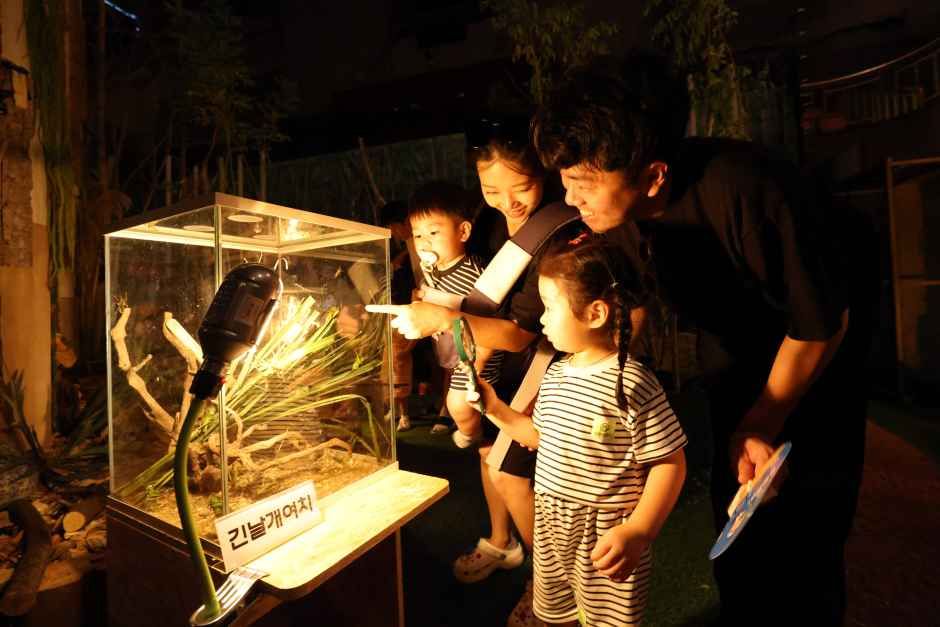
If you do not book the habitat trip, there is still a daytime and early-evening festival: the Firefly Theme Hall, children’s ecology activities, performances, a parade and light displays are spread around central Muju-eup. Check the daily timetable rather than assuming every program runs every day. General admission is free, but the Korea Tourism Organization lists some activities as paid separately.
Programme and timetable
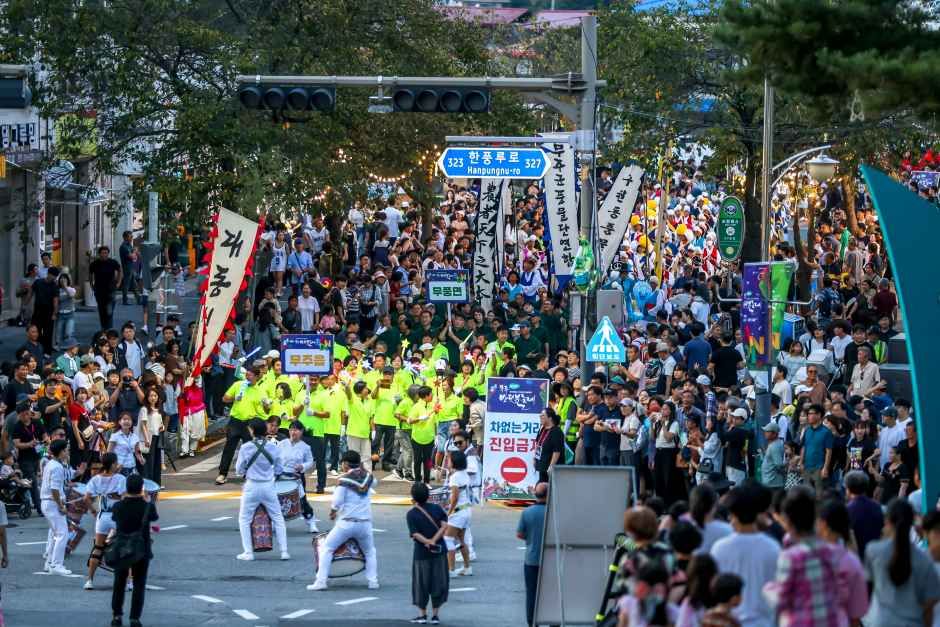
The daily grid changes between weekdays and weekends. The opening weekend carries the densest schedule, including children’s bubble shows, Namdaecheon Life Plus, taekwondo performances, a parade and stage events. On September 5, the opening procession starts from Muju County Office at 19:00, the ceremony follows at the Global Grand Stage, and the riverside light program is listed from 20:20 to 21:50.
The closing Saturday, September 12, has another concentrated sequence: children’s programming and taekwondo in the afternoon, Namdaecheon Life Plus and the Global Parade from 16:00, the closing ceremony at 19:00, and closing fireworks by Namdaecheon from 19:30 to 21:00. The official timetable warns that operations may change. Recheck the live schedule if fireworks, a concert or one named performance is the reason for travelling.
Weekdays are leaner but not empty. The September 7-10 grid lists the ecology overnight program, taekwondo performances, local arts events, wine busking and the evening EDM party on several dates. September 11 adds an international firefly environmental symposium and the 2026 children’s song festival. Some rows on the official grid are visually dense and easy to misread; choose by date first, then verify the time and numbered zone on the official page.
Tickets, fees and booking
There is no gate ticket for the central grounds. Korea Tourism Organization records general admission as free with some paid programs. The Firefly Mystery Exploration costs 20,000 won per person. The same price applies to adults and children; children under 36 months may participate free with documentary proof but cannot occupy a separate seat.
For the standard program, reservations are first-come, first-served through the festival website and there is no on-site registration. The fee includes a local return: each paid participant receives a 10,000-won Muju Love gift certificate, distributed from the departure operations room from 16:00 that day. Treat this as spending credit in Muju, not as a cash discount on the initial booking.
Cancellation terms become strict close to the visit. The official rule is a full refund at least seven days before the session, 70% at five or six days, 50% at three or four days, and no refund from two days before through the event day. Reservations cannot be transferred or resold. Enter a working mobile number and read the final operational message before travelling.
There is one important exception for international visitors during the September 4-12 festival. One foreign-visitor bus accepts same-day registration without advance booking at the general information booth beside the thatched booth near Global Art Zone. Registration operates 10:00-17:00, requires a passport or comparable proof, and is limited by remaining places and conditions that day. The organiser says foreign-language guidance is provided for this bus but does not name the languages, so this guide does not promise a particular language.
Getting there without a car
Take a direct intercity bus from Seoul Nambu Bus Terminal to Muju Public Bus Terminal. Published journey times vary by service and direction, so allow roughly two and a half to three hours. Muju County’s tourism information and current timetable data both list only a small number of direct services each day; check and reserve the exact trip before leaving Seoul.
The main venue at Muju Arts and Culture Center is about a five-minute walk from Muju Public Bus Terminal. That makes the town-center part of the festival straightforward without a car. The habitat visit is different: participants check in at the designated exploration zone and travel on the program bus, so use the meeting point attached to the reservation rather than trying to reach the habitat independently.
The regular return bus is the constraint. Current timetable data puts the last Muju-to-Seoul departure at 17:45, before the firefly trip begins. The festival operates paid, reservation-only Kakao T shuttles on September 4–6 and 11–12, with same-night return after the exploration; routes have limited inventory and may close early. Otherwise, book a night in Muju.
Shuttles, parking and local circulation
The paid Kakao T shuttle is the same-night alternative on September 4, 5, 6, 11 and 12. Routes cost 22,000-45,000 won, depending on origin, and must be bought in advance through Kakao T; there is no purchase at the boarding point. Inventory is limited, departure confirmation comes by text two to five days beforehand, and passengers should arrive 15 minutes early. The Muju drop-off is Jinnam Park P2, and the return operates after the firefly excursion.
A separate festival circulation bus links the town grounds with outlying parking and visitor areas. Its route runs from the National Sports Center near the festival through Bandi Land/P1, Taekwondowon, Muju Deogyusan Resort and Gucheondong Tourist Information Center. The organiser estimates 20 minutes from the grounds to Bandi Land, another 10 to Taekwondowon, 30 to the resort and 15 to Gucheondong. It publishes departures from the festival side between 13:00 and 22:30, plus a 09:30 direct service to Taekwondowon. Follow the dated stop table rather than assuming a hotel-door shuttle.
Drivers should use the official temporary-parking map rather than navigating to the Arts and Culture Center itself. The organiser has published a 2026 map, but its lot details are embedded as an image and are not transcribed here without reliable verification. The official shuttle page warns of festival-day traffic. Whether arriving by car or coach, leave margin before a fixed exploration check-in.
Food on site and nearby
The organiser has published a 2026 food-booth price list. Food booths operate 11:00-23:00. The Global Food Zone covers full meals and snacks: examples include jajangmyeon at 6,000 won, pork or rice dishes around 10,000 won, donkatsu at 13,000-15,000 won, and two-person jokbal or bossam at 25,000-27,000 won. A cafe booth lists many drinks at 3,000-5,000 won. These are selected examples, not a complete menu or a guarantee against sell-outs.
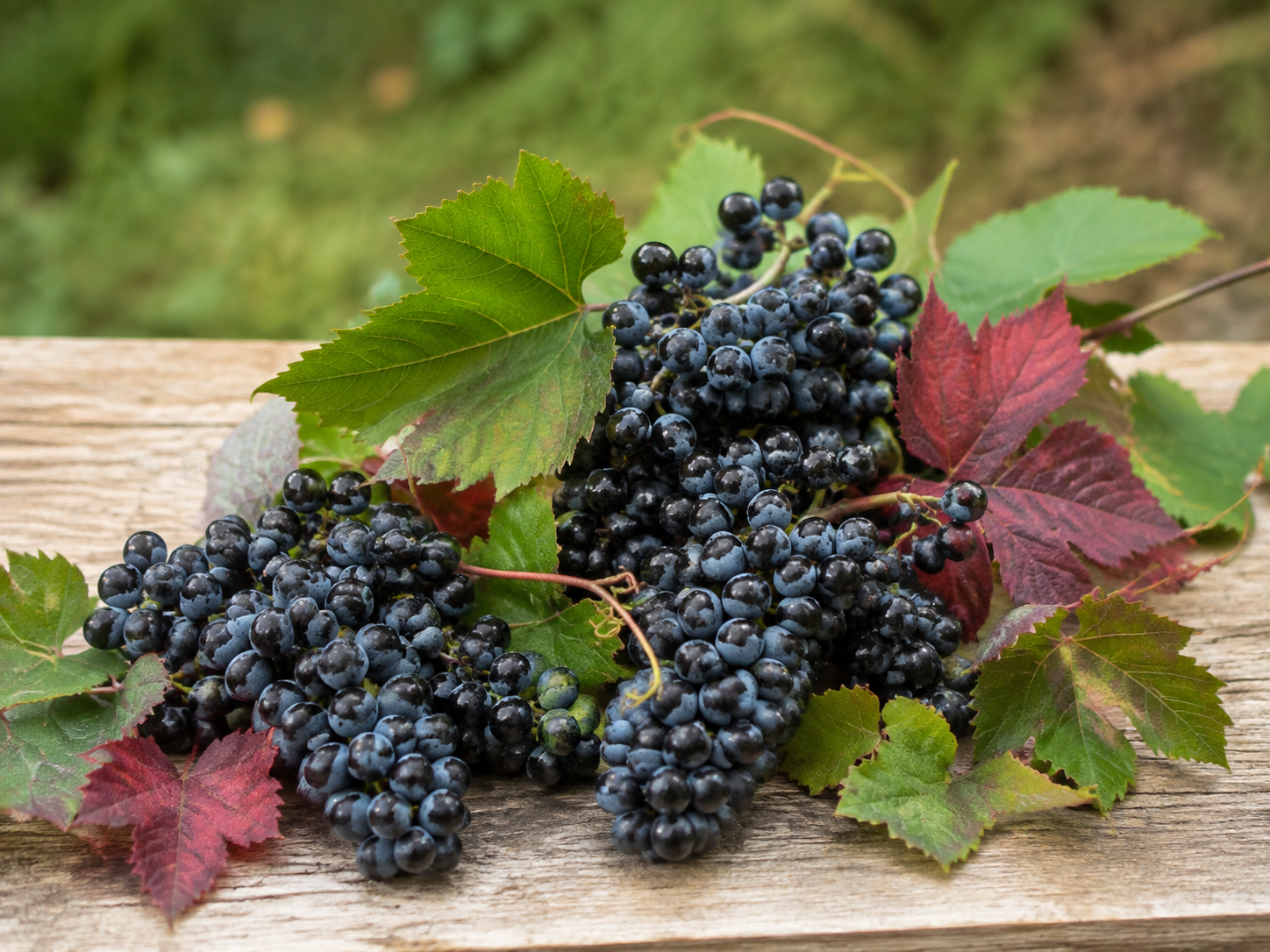
For a genuinely local product rather than generic festival food, Muju County identifies mountain grapes (meoru) as a regional specialty. County tourism material describes local wineries making mountain-grape wine from fruit grown around Deogyusan, and the festival timetable includes wine busking. That does not establish which winery or bottle is sold at a particular temporary booth. Look for a producer name and posted price rather than assuming every dark-red drink is a Muju product.
The site also provides practical support: an information booth and lost-child point are in the Global Food Zone, water stations are listed in several major zones, and an ATM is listed at the Firefly Theme Hall. Card acceptance has not been field-checked, so carrying a cash backup is sensible without claiming that stalls are cash-only.
Day trip or overnight
A daytime visit from Seoul is possible: take an early direct bus, walk from the terminal, use the theme halls and ecology activities, eat on site, and leave before the final regular return. That version misses the defining habitat excursion and most of the later light program.
For the full event, stay overnight unless a reserved Kakao T shuttle matches your date and origin. This conclusion is based on two verified times—the 21:00 exploration return and 17:45 final regular bus—not on a general assumption that Muju is too far for a day trip. Accommodation around central Muju reduces transfers; the official circulation bus also makes Bandi Land, Taekwondowon, the resort and Gucheondong more workable on its operating timetable. No particular hotel is recommended because availability and festival-date prices were not verified.
Honest assessment
This is not a festival to approach as a casual evening walk-in if seeing fireflies is the reason for coming. For most visitors, the defining habitat program has fixed capacity, a fee and advance booking. International visitors have a useful same-day route, but it is only one bus, requires proof of eligibility and depends on remaining capacity. Secure the standard reservation when possible rather than treating the exception as guaranteed entry.
Transport is manageable but not flexible. The bus terminal is close to the main grounds, yet the sparse intercity schedule and early final bus to Seoul remove much of the margin for error. The organizer also warns of traffic congestion during the festival and recommends its reserved shuttle. On busy dates, arrive early enough to complete the 18:40 check-in without relying on a last-minute road transfer.
The payoff is focus: the habitat excursion, theme hall and ecology programs all serve the same subject instead of treating fireflies as decoration. The trade-off is that a wild animal sighting depends on darkness, weather and habitat conditions. Paying and travelling do not guarantee a dense display, and the organiser says so.
Finally, separate the illuminated riverside production from the wildlife encounter. Fireworks, media art, EDM and bright stage lighting belong to the public festival; the habitat excursion has footwear rules and limits on artificial light. Read the organiser’s final text rather than relying on an old screenshot, and treat the free town-center program as separate from the controlled wildlife excursion.