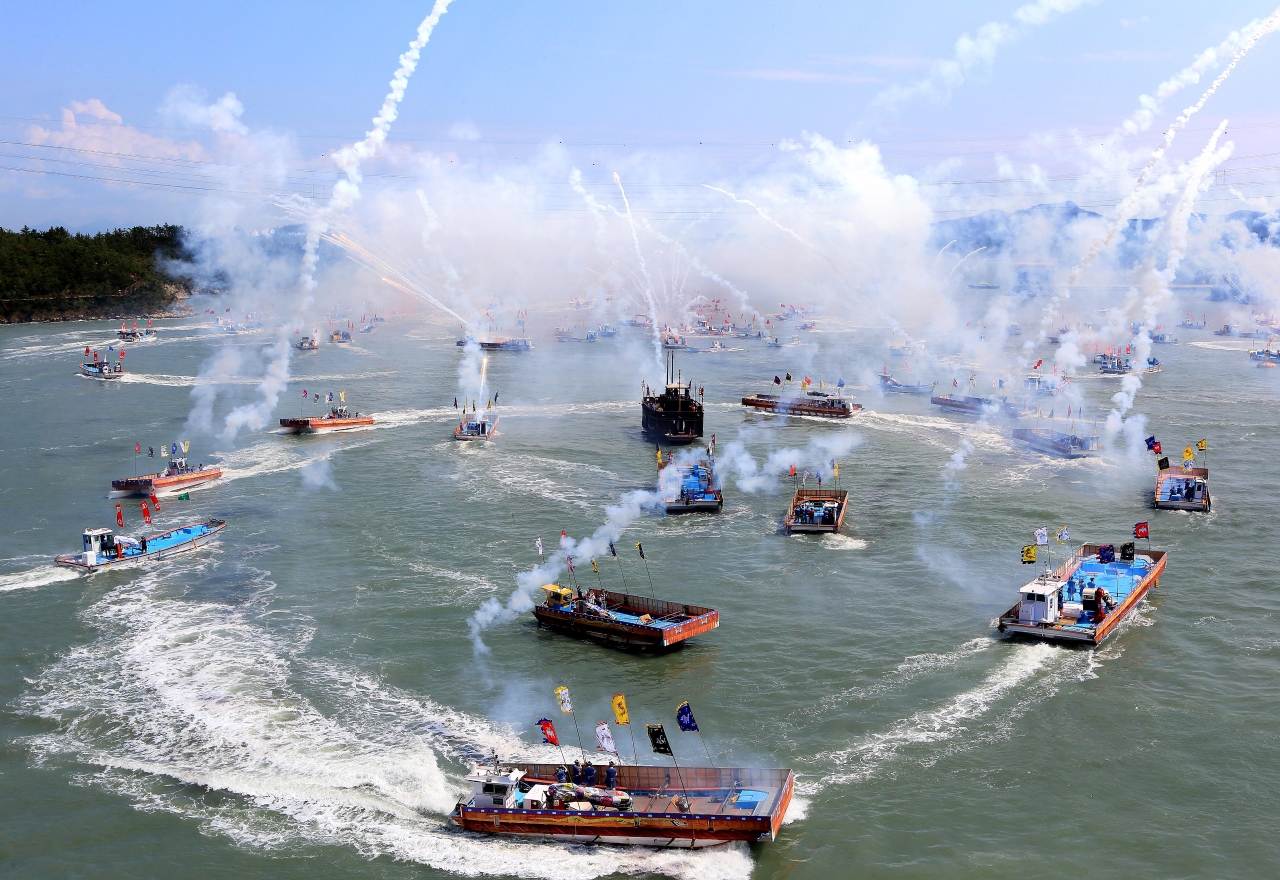
The Great Battle of Myeongryang Festival is held on the Uldolmok strait, the narrow, fast-running channel between Jindo island and the Haenam peninsula in the far southwest of the country. This is the water where, in 1597, Admiral Yi Sun-sin fought the Battle of Myeongnyang, using the strait’s violent tidal currents to defeat a far larger Japanese fleet with only thirteen ships. The festival commemorates that battle and the part local Jeolla fishing communities played in it. Jeollanam-do, Jindo County and Haenam County have run it jointly every autumn since 2008.
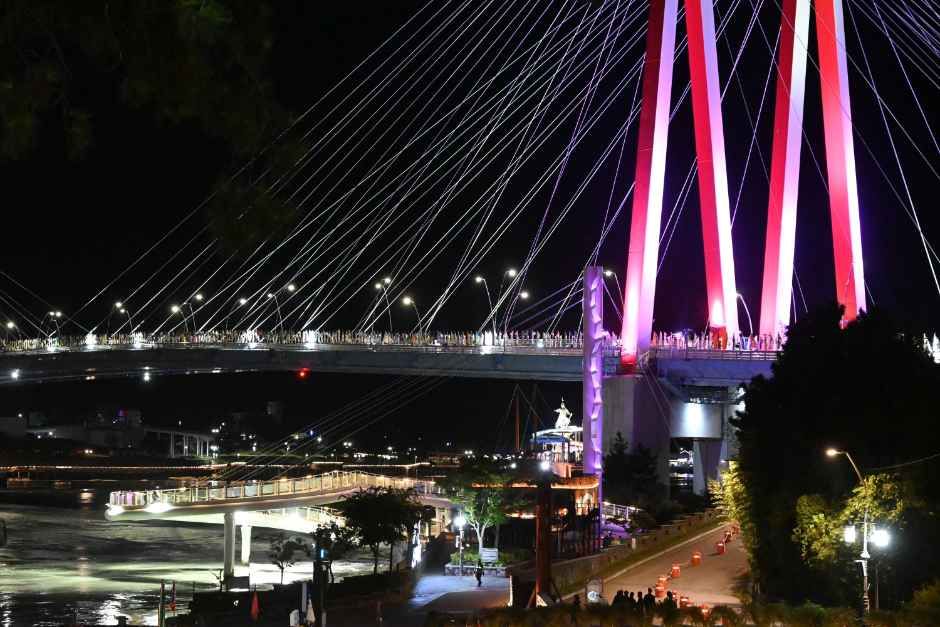
For 2026 the confirmed dates are September 11-13. The Korea Tourism Organization lists admission as free and operating hours as 11:00-21:30, with the final day, September 13, ending earlier at 18:00. The single most important planning fact is geographic: the event is not on one compact site. It runs on both banks of the strait — the Nokjin Tourist Area on the Jindo side, which holds the main stage and the opening ceremony, and the Usuyeong Tourist Complex on the Haenam side — connected by the Jindo Bridge over the water.
What you actually do here
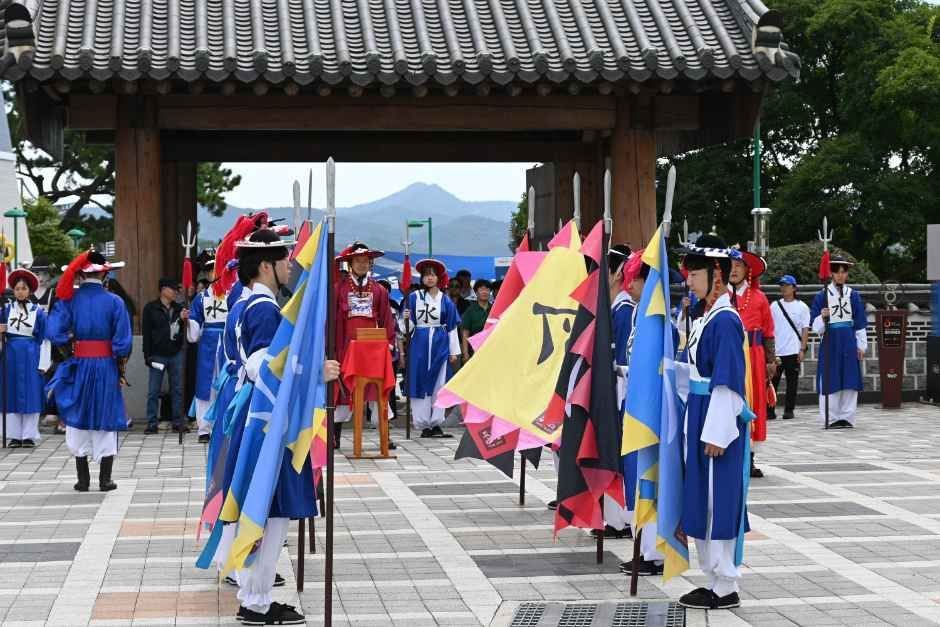
The daytime and the evening are two different visits. During the day the programme leans on exhibitions and participation: a changing-of-the-guard ceremony by costumed Joseon-navy performers, a Joseon-navy lantern display, exhibitions of Myeongnyang battle records, a stamp rally, and AR and MR experiences that let you step into the naval battle on a screen. Hands-on booths let visitors try on a commander’s uniform, take part in a navy garrison experience, and make traditional Korean instruments.
None of this needs spoken Korean to follow, because the material is visual — costumes, flags, ships and reenactment. That is an observation about the format, not a promise that English signage or interpretation will be provided; neither was field-checked for this guide. Bring a payment method in case a workshop is charged, since the Korea Tourism Organization separates general free admission from some paid experiences and no reliable 2026 price list was available.
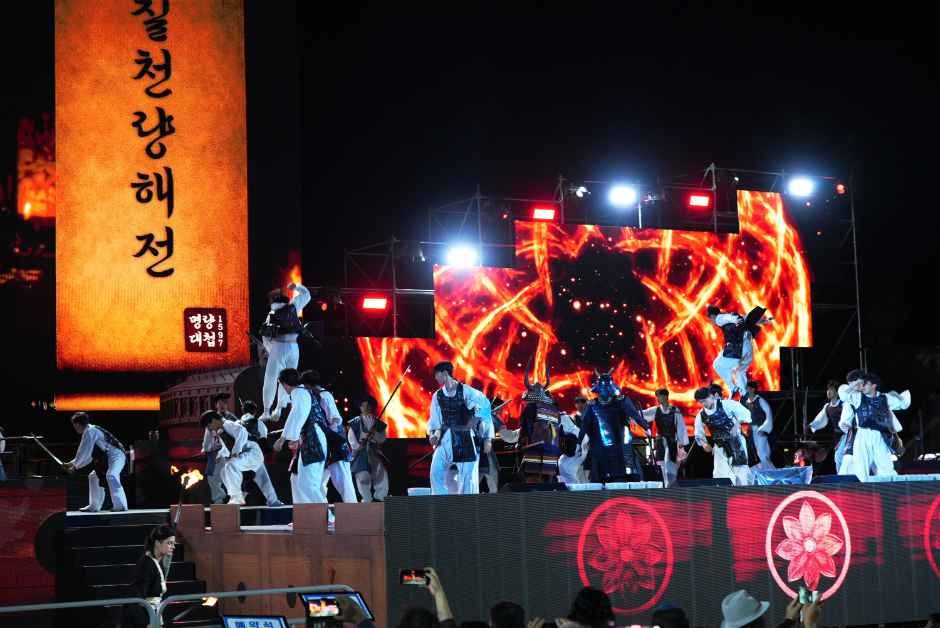
The reenactment and the evening main stage
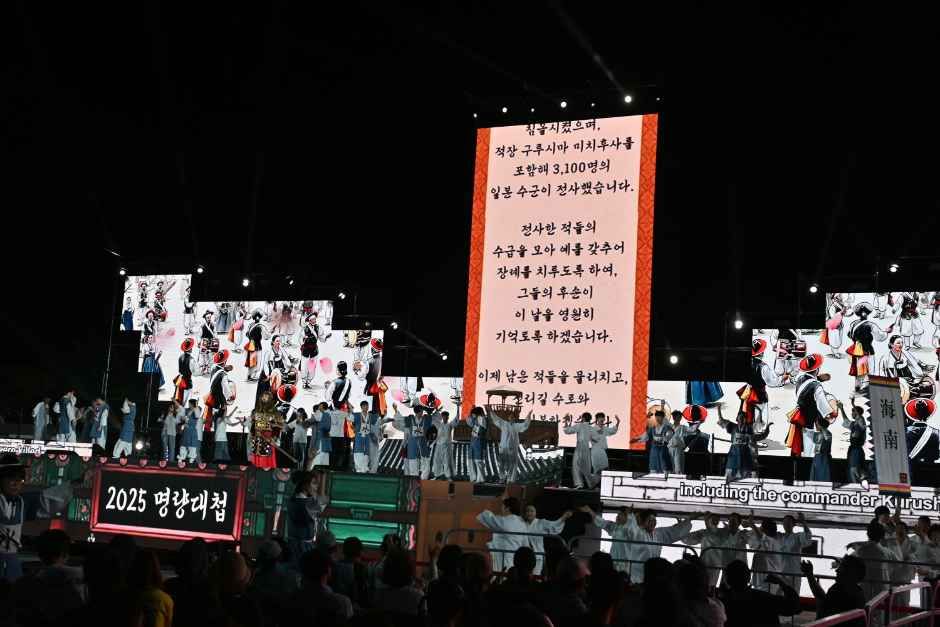
The centrepiece is the theme performance staged at 19:30 on September 11 and 12 at the Jindo Nokjin main stage. Reporting describes it as a four-act production that runs from the outbreak of the Imjin War, through the rebuilding of the Korean navy and the assembly of panokseon warships, to the victory at Myeongnyang. It combines live performers with large-scale projection and lighting, an ICT-heavy staging rather than a straight historical pageant.
Around the reenactment, the official programme lists a digital multimedia sea battle, a naval and coast-guard ship parade on the water, a drone light show and a “whirlpool” fireworks display named after the strait’s spinning currents. These are scheduled set-pieces, not continuous attractions, and the complete 2026 daily grid — the document that would tell you exactly when each one runs — had not been published in full when this guide was written. If a specific show is your reason for coming, check the official schedule page shortly before you travel.
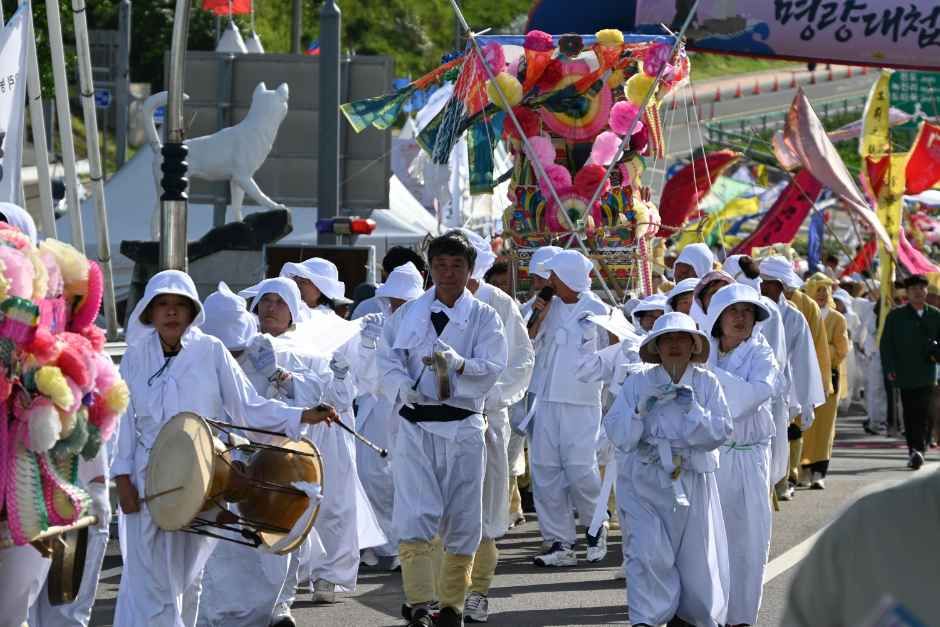
The opening parade across the Jindo Bridge
The festival opens on September 11 with a ceremony at 19:00 on the Jindo side. Its most striking element is the departure parade: reporting puts roughly 1,200 participants setting out from the Haenam bank and crossing the Jindo Bridge on foot to reach the main stage. That crossing is both the symbolic and the physical link between the two halves of the festival, and it is worth positioning yourself near the bridge or the Nokjin stage in advance if you want to see the procession arrive.
Because the parade moves across the strait, the two tourist areas are best treated as one event with a bridge in the middle rather than as a choice between them. Where you base yourself affects what you see easily: the Jindo Nokjin side carries the main stage and the ceremonies, while the Haenam Usuyeong side is the historic naval base and the starting point of the crossing.
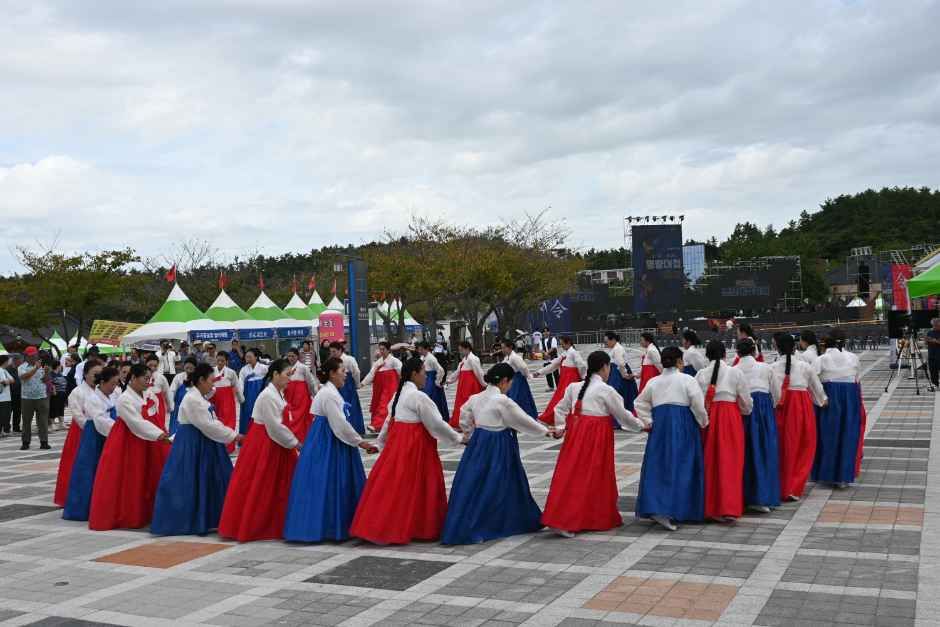
Traditional performances and hands-on programmes
Beyond the reenactment, the festival carries a strong regional folk programme. The Haenam side is home to Usuyeong ganggangsullae, the circle dance inscribed on UNESCO’s Representative List of the Intangible Cultural Heritage of Humanity, and the festival stages it alongside a changing-of-the-guard, a youth gugak (traditional music) programme and other local performances. The Jindo side brings the island’s own traditions: Jindo Arirang, Jindo buk-nori drum dance, the Jindo ssitgim-gut shamanic rite, and a manga procession, a traditional funeral-song march.
The last day, September 13, is lighter and closes earlier at 18:00, with a trot-singing session and the peace manga procession among the listed items. If traditional Korean performance rather than the battle spectacle is what draws you, the daytime and the final day are where to concentrate, but confirm times against the official grid because the published details were still filling in.
Getting there without a car
This is the hardest part of the trip and the reason an overnight stay makes sense. There is no train station at Uldolmok. The two realistic public-transport routes are: take a KTX from Yongsan to Mokpo (about 2 hours 50 minutes) and continue by local bus or taxi toward Haenam and the Usuyeong side; or take an express bus from Seoul Central City to Jindo (about 4 hours 40 minutes, with services through the day) and continue to the Nokjin side. Either way you finish with a local leg, and exact 2026 local-bus times for that leg were not something this guide could verify — use a live Korean map app on the day and set Nokjin Tourist Area or Usuyeong Tourist Complex, not simply “Jindo”, as your destination.
For those driving or arriving by intercity bus, the festival posted a 2026 shuttle notice: Route 1 runs between Seorim Park in Haenam-eup and the grounds, and Route 2 runs as needed between the designated parking areas and the grounds. Treat the shuttle and parking plan as the current official transport information, but read the exact operating hours from the notice board close to your travel date rather than assuming them.
Honest assessment
The festival’s real strength is its setting. Very few historical reenactments happen on the actual site of the event they depict, and the tidal strait under the Jindo Bridge gives the sea battle, the ship parade and the fireworks a backdrop that a stadium show cannot match. The combination of a large ICT-driven reenactment, a genuine UNESCO-listed folk dance and free admission is a strong offer for anyone interested in Korean naval history or in evening spectacle.
The weaknesses are practical. The event is split across two counties on opposite banks, so “the festival” is really two clusters joined by a bridge, and the headline reenactment is an after-dark event that a rushed day trip cannot reach comfortably. Getting there is a long journey with no station nearby and a local transfer at the end. The final published details — the full daily timetable, the concert line-up, per-programme prices — were still incomplete when this guide was written, and news reports and the official site did not fully agree on the concert acts.
The fair plan is an overnight: arrive in daylight for the exhibitions, ganggangsullae and hands-on booths, watch the crossing and the evening reenactment with the fireworks, and avoid booking a same-night return that forces you to leave before the main stage even begins. Confirm the daily grid and the shuttle times on the official site before you go, and set your map destination to the correct bank.