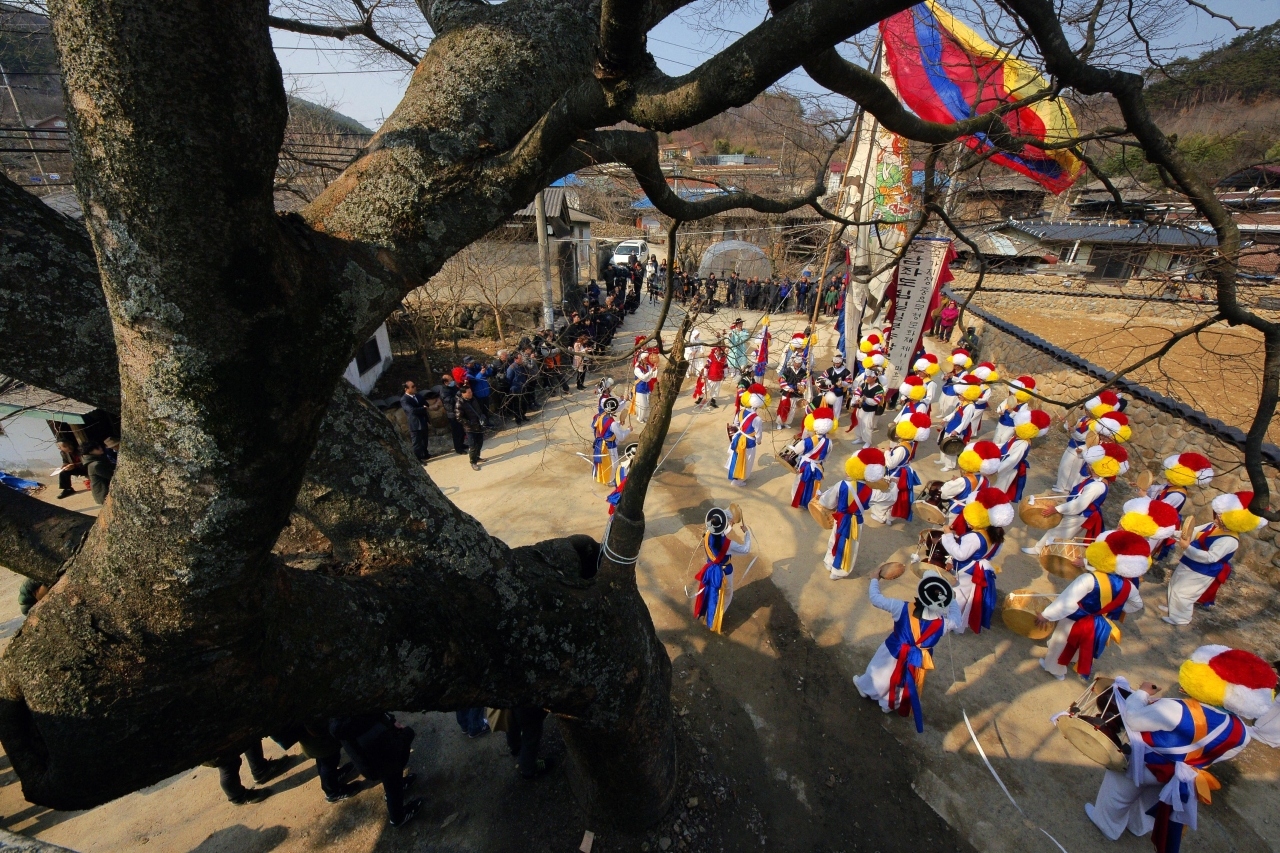
The Pilbong Maeul Gut Festival is a village gut — a communal ritual expressed through music and dance — held at Pilbong Cultural Village in Gangjin-myeon, deep in the hills of Imsil County in Jeollabuk-do. It is built around Imsil Pilbong Nongak, a form of Korean farmers’ percussion music that is a National Intangible Cultural Heritage of Korea; nongak as a whole was inscribed on UNESCO’s Representative List of the Intangible Cultural Heritage of Humanity in 2014. This is not a tradition imported into a festival theme — the festival takes place in the village where the music is preserved and handed down.
For 2026 this is the 31st edition, and the confirmed dates are September 17–20 (four days), with the opening ceremony held on September 18 and the festival running through Sunday, September 20. The festival began in 1996 to honour the late master Yang Sun-yong, who was central to Pilbong Nongak becoming nationally known, and it is run by the Imsil Pilbong Nongak Preservation Society (063-643-1902). The venue is Pilbong Cultural Village (필봉문화촌), and both general admission and parking are free.
One practical point matters before anything else: this is a remote festival. The cultural village sits in Gangjin-myeon, outside Imsil town, and Imsil itself is roughly four hours from Seoul by the only reasonable rail option. Plan the journey as carefully as the programme.
What you actually do here
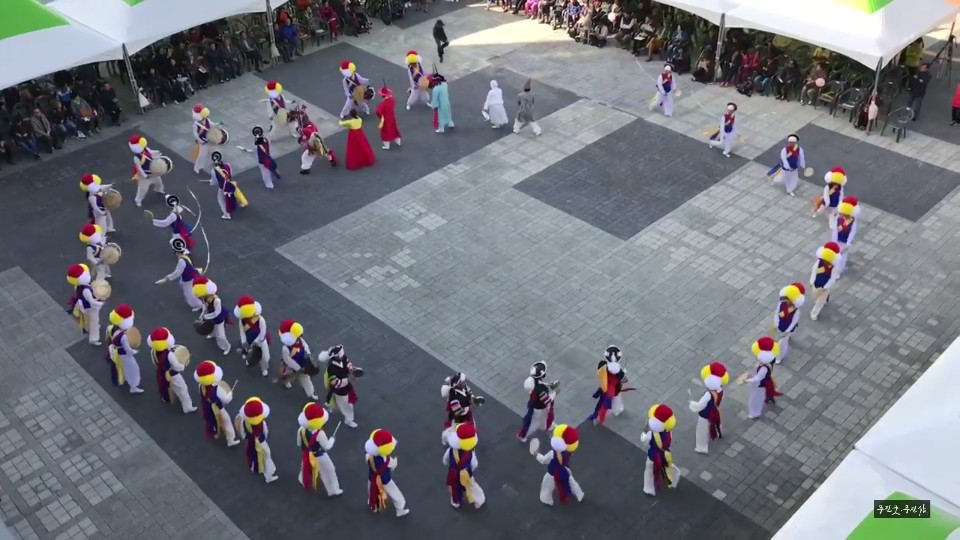
The core of the visit is watching, and sometimes joining, live percussion-and-dance performance. Pilbong Nongak belongs to the jwado (left-region) style of nongak from the Honam area, driven by gongs and drums, and a village gut of this kind is meant to be experienced as a whole rather than as a single seated act. Expect processional and circle formations, the small hand-gong lead of the sangsoe, and the building, repeating rhythmic cycles that give this music its momentum.
The 2026 programme, as described by the organiser and Korean coverage, runs on several parallel tracks. There are performances of the UNESCO-listed nongak and other national intangible-heritage arts; there are overseas traditional-arts troupes and an international-exchange strand; and there are newly created yeonhui theatre pieces that reinterpret the tradition. Alongside the stage programme sit a competition with individual and group divisions, an academic seminar on how traditional performing arts are transmitted and what they mean today, and an exhibition documenting the people who have carried Pilbong Nongak and the life of the village.
There is also a hands-on side. Pilbong Cultural Village is a working teaching centre, and the festival includes intangible-heritage experience programmes aimed at a range of ages — the kind of thing where you can pick up a drum rather than only watch one. If joining in is the point of your trip, that is genuinely available here.
Programme and what is confirmed for 2026
Be clear about what is fixed and what is not. The dates, the venue, the free admission and the broad programme categories above are confirmed. What the organiser has not published is an hour-by-hour daily grid; the Imsil County listing simply describes the festival as running “all day.” That means you can rely on the four-day window but should not build a rigid timetable around a specific performance without checking first.
The single element that is clearly anchored to a day is the finale. On the last day, the festival closes with a Daedong hapgut (대동합굿) — a large communal performance that deliberately merges the preservation society’s members, the visiting participants and the audience into one moving body of players. It is the participatory high point and the clearest expression of what a “village gut” is trying to do: dissolve the line between performer and spectator.
Because the running order can stay fluid close to the event — the competition alone brings in entrants whose slots firm up late — the reliable way to plan is the organiser’s own channels: the official site at pilbong.co.kr and the festival’s YouTube channel, @pilbongGOOD, which the cultural village points visitors to for current notices. Check those shortly before travelling rather than trusting a second-hand schedule.
Tickets, fees and hands-on programmes
Entry is free, and so is parking. That is unusually simple, and it means you can see the main performances without a ticket, a package or an advance booking.
Free entry is not the same as everything being free. Pilbong Cultural Village runs structured experience programmes with published per-person prices — for example, learning pungmul or sogo drumming, nanta, traditional song, mask dance and ganggangsullae at around 9,000 won for students and 10,000 won for adults, and Korean paper craft at around 16,000–17,000 won. Those are the village’s standard year-round rates, and a festival-specific 2026 price list for the intangible-heritage experiences was not published, so treat the numbers as a guide to the order of cost and confirm the actual festival programme fees at the site. Bring a payment method rather than budgeting around an unconfirmed figure.
Getting there without a car
This is the part that decides whether the trip works. There is no KTX service to Imsil. The direct rail option is a Mugunghwa train — or an ITX service on the trains that stop at Imsil — on the Jeolla Line from Yongsan Station to Imsil Station. A representative Mugunghwa run is about 3 hours 57 minutes, and only a limited number of daily trains stop at Imsil, so book the specific service for your date rather than assuming frequent departures.
Imsil Station is not the venue. The festival is in Gangjin-myeon, and the last leg is a genuine rural transfer: from the Imsil bus terminal area you can take a local bus heading toward the Sangpil stop and then walk a few hundred metres to the cultural village, or take a taxi for the final stretch. Local buses here are infrequent, so check the return departure before you commit to a bus, and consider a taxi if your timing is tight.
An alternative is to take a KTX to Jeonju — the fast trains serve Jeonju rather than Imsil — and then continue by regional bus toward Imsil and Gangjin-myeon. That can shorten the mainline leg but adds its own transfer, so it is not obviously simpler than the direct Jeolla-Line train. Either way, budget for a slow final approach into the hills.
Day trip or overnight
A same-day return from Seoul is technically possible but tight: roughly four hours each way, plus the local transfer at the far end, leaves a narrow window on the ground and depends on catching a specific return train. If your only goal is to catch a few daytime performances, it can be done, but it is a long day for a short visit.
Staying over is the more comfortable structure, especially if you want the closing Daedong hapgut or plan to do any hands-on programme. Pilbong Cultural Village runs a hanok-stay building, Chwirakwon, on the site itself, which puts you a short walk from the performances, and there is additional lodging in Imsil town. This guide does not name a specific room or quote availability because neither was verified — contact the cultural village or book directly.
Food and the local specialty
The organiser did not publish a confirmed 2026 food-vendor plan, so this guide cannot promise a particular stall, dish or price on site. Expect some food to be available at a festival of this length, but do not plan a meal around an unconfirmed menu.
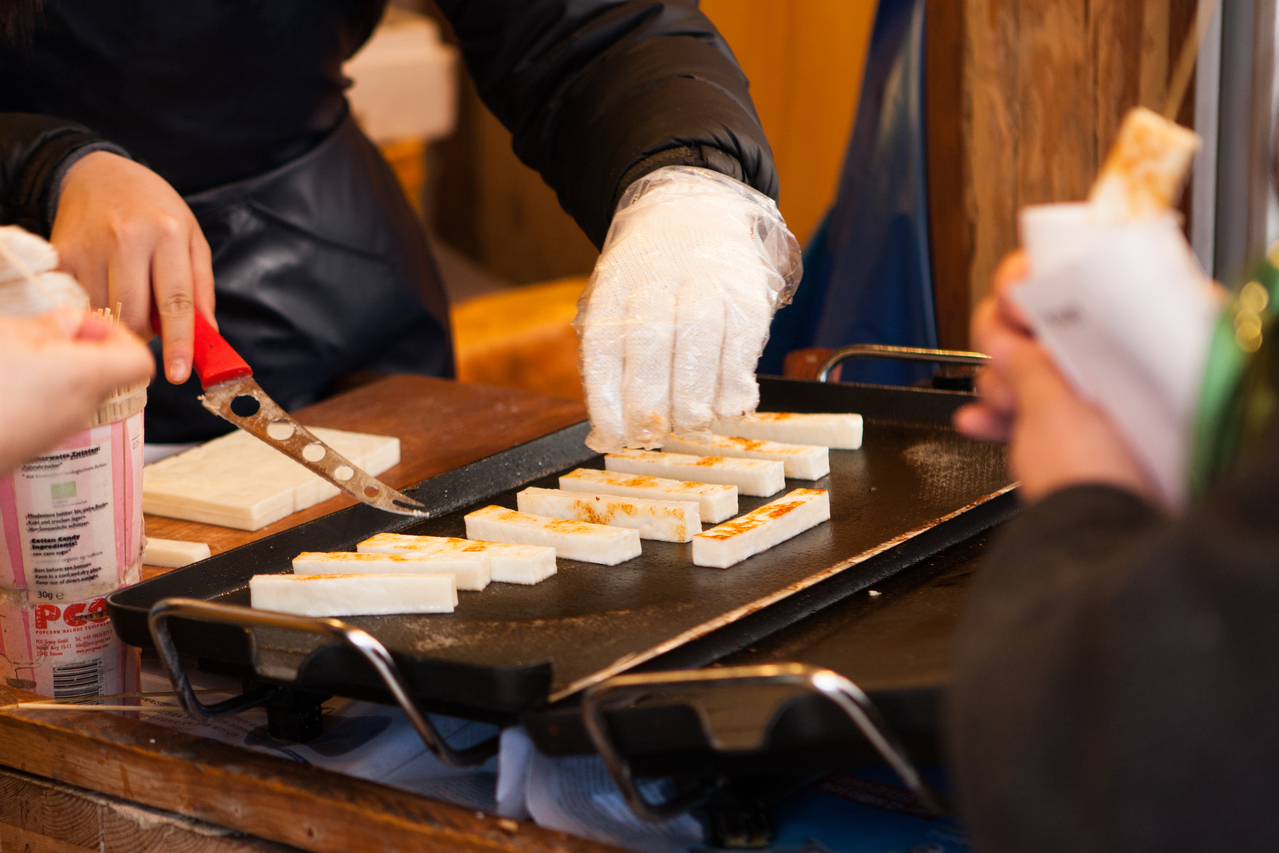
For a documented local product, the region has an unusually specific claim to fame: Imsil cheese. Imsil is where cheese was first produced in Korea. A Belgian priest, Ji Jeong-hwan — known in Korean by that name, born Didier t’Serstevens — began dairy farming and cheese-making in Imsil in the late 1960s to give the poor upland community a livelihood, and the operation was later handed over to a residents’ cooperative. Imsil County lists cheese as its representative local product and markets itself as the home of Korean cheese; grilled Imsil cheese is a common street-food form, as shown in the photo here. It is a county specialty worth seeking out in the area, not a claim about what the festival stalls will sell.
Honest assessment
The strength of this festival is authenticity of place. You are watching a UNESCO-listed folk tradition in the village that preserves it, run by the people who carry it, with a genuine ritual structure rather than a stage show assembled for tourists. Free admission and free parking make that access unusually straightforward, the international-exchange performances add range, and the closing communal gut offers something most festivals only gesture at — a finale you can physically join.
The weaknesses are all about logistics and information. It is far: about four hours from Seoul on trains that do not run frequently, followed by a rural transfer that a first-time visitor should not underestimate. The organiser publishes no fixed daily grid in advance, so precise timing has to be confirmed close to the date through pilbong.co.kr or the @pilbongGOOD channel. And there is no confirmed English support, so it rewards travellers comfortable navigating a small Korean-language event on their own.
The fair way to judge it is by intent. If you want convenience, English hand-holding and big-festival scale, this is not the trip. If you want to stand in a hill village and watch — or join — a living percussion tradition where it belongs, and you are willing to plan the travel properly, it is a rare and worthwhile one. Confirm the schedule, sort out the last-mile transport, and give it the overnight it really wants.