
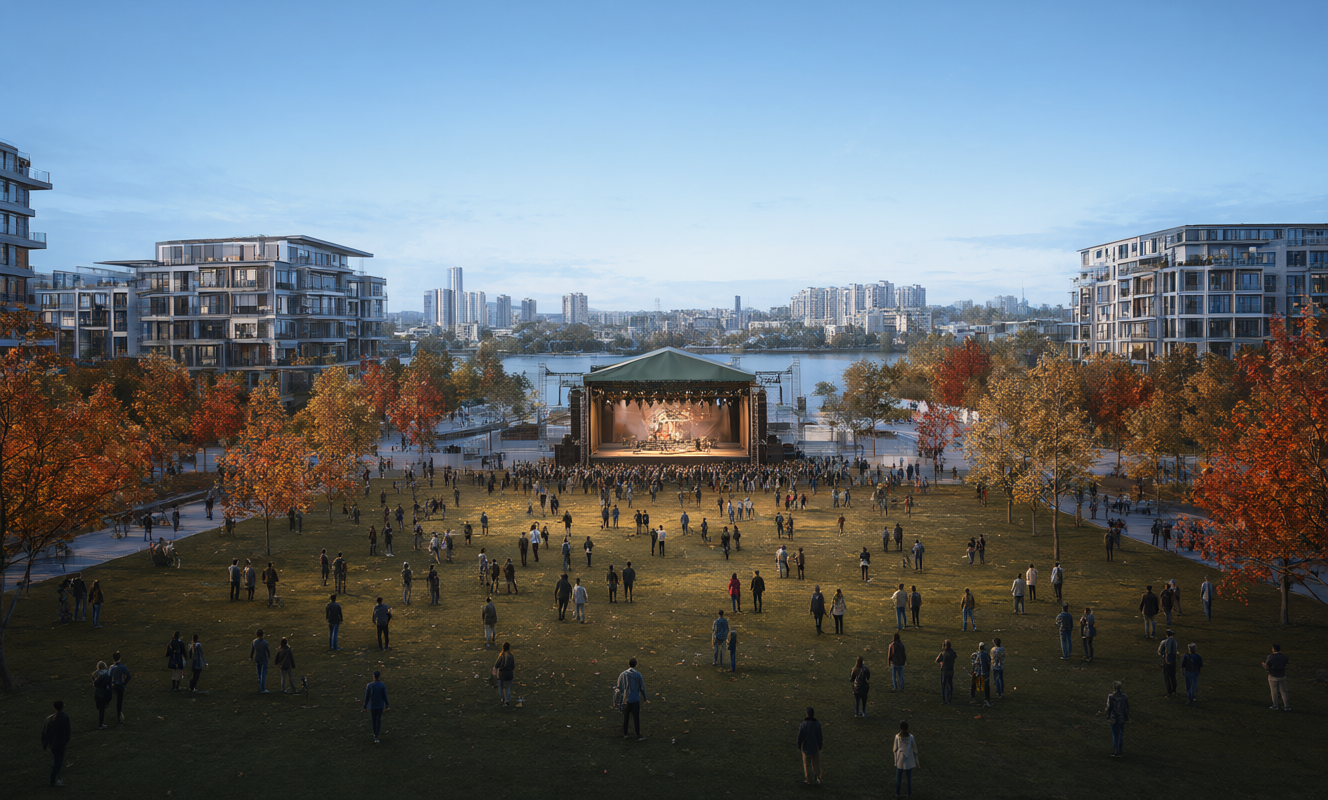
The Sejong Bohemian Music Festival is a three-day, ticketed outdoor music event in Sejong Central Park, in the planned administrative city of Sejong. The Ministry of Culture’s festival plan records it as first held in 2022 and run every year since. The 2026 edition runs 30 October to 1 November, a Friday to Sunday, and the festival’s own posters use the English name “2026 Sejong Bohemian Music Festival”. Sejong City, the Korea Creative Content Agency and the Sejong Culture and Tourism Foundation host it, and the Sejong Music Creation Center runs it.
This is not a traditional or free local festival. It is a ticketed rock and indie line-up with a big crowd, one main stage and food and drink on site, so treat it like a small concert festival rather than a street fair. The venue is the Urban Festival Grounds at Jungang-gongwon-ro 60.
What you actually do here
You stand or sit in front of a single stage and watch back-to-back sets. According to the organiser’s timetable, there are 18 slots across the three days, each lasting 30 to 60 minutes. Friday runs from 18:30 with Oysters, then Chorokbulkkot Sonyeondan (초록불꽃소년단), KARDI and NELL, whose set is 21:10 to 22:10. Saturday starts at 14:30 with Lee Pa-ran (이파란) and Shin In-ryu (신인류), continues through WAH WAH WAH, Nolidogam (놀이도감), Kim Hyun-chul and Touched, and ends with Silica Gel at 20:10. Sunday opens with Grizzly at 14:30, followed by Sanbo (산보), KIRARA, The Solutions, Baek Hyun-jin and Peppertones, and Jaurim closes from 20:00 to 21:00.
Where the poster prints an English name it is used above; for the others the Hangul is given with a romanisation, which is this guide’s own. Korean news coverage notes that Saturday has been called a “Silica Gel day” because the band’s side projects also play that day.
Between sets there is an event zone with festival-culture activities, a photo zone, a Hangul-themed shop, merchandise, camping gear sales, a food and drink area and a bar. These come from the organiser’s space-guide poster, which warns the layout may change.
Programme and timetable
| Day | Gates | First act | Last act |
|---|---|---|---|
| Fri 30 Oct | 17:30 | Oysters 18:30 | NELL 21:10-22:10 |
| Sat 31 Oct | 13:30 | Lee Pa-ran 14:30 | Silica Gel 20:10-21:10 |
| Sun 1 Nov | 13:30 | Grizzly 14:30 | Jaurim 20:00-21:00 |
The official ticket page gives slightly wider windows (Friday 18:30 to 22:00 and weekend 14:30 to 21:30), which are the booking-page hours; the timetable image above is the more precise guide. The weekend gate time of 13:30 is taken from a poster line that sits between the Saturday and Sunday columns, so confirm it on the day. Ticket exchange desks open at 16:30 on Friday and 12:30 on the weekend, one hour before gates.
Tickets, fees and booking
Advance tickets went on sale on 12 August at 14:00 and sales run to 31 October. The prices are in the front matter above. Pre-ordered tickets are mobile tickets: you show the mobile ticket at the ticket booth, receive a wristband, and then queue or go in. You must keep the wristband on to be inside; one without a valid wristband in the venue is asked to leave. Proxy queuing, swapping wristbands in line and overnight queues are prohibited, and the organiser may slow or limit entry if a zone fills.
The FAQ says cancellations carry a fee that depends on the cancellation date, same-day cancellations are not allowed and the Sejong resident discount cannot be combined with other discounts. On-site sales open only after the ticket booth opens, and the booth’s hours were still “to be announced” on the poster.
Other costs are small but real. A storage point inside the event zone charges 3,000 won to store a bag, 10,000 won for a carrier or large luggage and 1,000 won per re-store, and it runs from gate opening until 30 minutes after the last set. Alcohol is sold on site.
Getting there without a car
The official arrival poster says parking is difficult on the day and recommends public transport. It gives these routes, all ending at the Sejong Arts High School stop beside the park:
- From Osong Station (KTX): bus B3, get off at Hansol-dong, then change to bus 204.
- From Jochiwon Station: bus 801 to Nareutjae Village complexes 1 and 2, then bus 204.
- From Daejeon Station: bus B1 to Hansol-dong, then bus 204.
- From Sejong Express Bus Terminal: bus 203 directly.
From Seoul, the express bus to Sejong takes roughly an hour and a half according to Sejong City’s guide and bus timetable sites, and KTX to Osong takes about 50 minutes according to Sejong City’s Osong Station page. The KTX option adds a bus leg after Osong; the poster gives no bus journey time. The organiser also posted a usage map for Eoulring, Sejong’s public bike-share, which marks most stations around the park as not usable and two at the southern edge as usable, so do not plan to cycle in.
Parking, shuttles and traffic control
All nine lots on the official list are free, in a P1-to-P9 order the organiser recommends using:
- P1 Sejong Lake Park lot 1, 377 spaces, 5 minutes on foot
- P2 a temporary festival lot, 584 spaces, 5 minutes
- P3 Sejong Arts Centre lot, 492 spaces, 15 minutes
- P4 to P6 temporary lots at the Government Complex, 70, 139 and 185 spaces, 17 minutes
- P7 a further Government Complex temporary lot, 190 spaces, 20 minutes
- P8 and P9 Sejong Lake Park lots 2 and 3, 239 and 300 spaces, 20 minutes
The poster adds that Sejong Central Park’s own car park is reserved for emergency vehicles. The organiser says it will concentrate enforcement against illegal roadside parking in the area during the festival, so do not count on a nearby kerb.
The official shuttle is run with the Handybus app, on sale from 12 August to 1 November. One-way fares to the venue are: Seoul (Hapjeong, Jamsil or Sadang) 23,000 won; Suwon and Migeum 21,000 won; Incheon (Bupyeong and Bucheon) 24,000 won; Daejeon 18,000 won; Jeonju 30,000 won; Daegu 32,000 won; Gwangju 32,000 won; Busan 42,000 won. The return is 2,000 to 4,000 won more, and a round trip from Seoul is 46,000 won. The poster says extra routes may be added on demand. Departure times and seat availability were not on the poster, so check the app.
The space and rules
The whole site is unreserved and is split into three viewing zones: a standing zone where mats and seats are not allowed, a ground zone for mats and floor chairs without legs, and a chair zone for camping chairs with legs. Tents and shade shelters are not allowed. Smoking, including e-cigarettes, is banned throughout Sejong Central Park. Ordinary souvenir photos are allowed, but livestreaming, filming for income, telephoto lenses, large camera rigs and tripods are not, and the organiser may use its own filming for promotion.
Rain does not stop the show unless it exceeds 10 mm an hour or 30 mm a day at the site, no poncho is supplied and umbrellas may be restricted during sets. Late October nights in an open park are cold, so bring layers.
Day trip or overnight
A day trip is possible in principle, but this guide does not call it one because the end-of-night connection was not confirmed. Each night finishes between 21:00 and 22:10, and the park is a bus or walk away from the main terminals. If you stay, the organiser lists Courtyard by Marriott Sejong (6 Dasom 3-ro, 1.1 km from the grounds) as a partner hotel, with 10% off standard king and deluxe double rooms for 30 October to 1 November when you show proof of a valid festival ticket; reservations are by phone at 044-251-4000 or the poster’s QR link. Prices and availability were not checked.
Around the festival
Sejong’s cultural foundation runs a night-time programme of its own around the festival. News reports from 13 October describe a “Sejong Night Stroll Week” starting 21 October for twelve days, with discounts at 92 local businesses, a night opening at the National Sejong Arboretum, “Light ON Sejong” from 29 to 31 October, and a Government Complex rooftop-garden night tour and performance on 30 October. Check the foundation’s site (sjcf.or.kr) for the current details before planning around any of it.
Honest assessment
The strengths are a clear, well-documented plan: a printed timetable, nine free lots with spaces and walking times, fixed shuttle fares from several cities and an explicit rain rule. Few regional festivals publish that much. The line-up is also strong for Korean indie fans.
The weaknesses are practical. It is not cheap compared with free local festivals, much of the useful information is in images rather than text, the park is a transfer away from the rail stations, and you will be outside after dark in cold weather. If you do not know the artists, the experience may feel like a long, expensive stand in a field. Come for a specific act, choose the day by that act, and check the organiser’s notice board the day before.