
Autumn · Gyeongsangnam-do · Field listing
Tripitaka Koreana Cultural Festival 2026
The essentials first: whether it is open, what it costs, how hard it is to reach and what to expect if you do not speak Korean.
When
Oct 9 — Nov 1ConfirmedConfirmed dates
Where
Tripitaka Koreana Theme Park (Daejanggyeong Theme Park), Gaya-myeon, HapcheonGyeongsangnam-do
Admission
PAIDEntry to the theme park is paid, and experience booths charge separately (KTO). Hapcheon County's page for the park lists individual tickets of 5,000 won for adults, 3,000 won for middle and high school students, and 2,500 won for elementary children, soldiers and people aged 65 and over; free entry for Hapcheon residents with ID, children under 7 and several other categories. That page is a general price list, not a festival-specific notice, so confirm at the gate. Prices for individual craft booths had not been published.
From Seoul
About 3.5 hours of ride time plus transfers (KTX + metro + intercity bus)KTX or SRT from Seoul to Dongdaegu, Daegu Metro Line 1 to Seobu (West) Bus Terminal, then an intercity bus toward Haeinsa. The total is our sum of separately listed legs, not a single published journey time. Whether those buses stop at the theme park was not verified.
Hours
09:00-18:00
Organiser
Hapcheon County, 055-930-4696
Is this one for you?
Who it suits. This suits families and anyone who wants an easy, low-language afternoon of autumn flower displays and hands-on crafts, especially if you were already heading to the Haeinsa area. It is a weaker choice if you hope to see the original Tripitaka Koreana woodblocks at the festival venue, because those are kept at Haeinsa, a separate site. It is also not a good fit for a rushed day trip from Seoul, since the travel eats most of the opening hours.
When to go. Plan to arrive in the morning, since the programme runs only 09:00-18:00 and the trip from Seoul is long. October 24 is the one day that carries both the national woodblock-art competition exhibition (listed for October 20-24) and the start of the chrysanthemum bonsai display. Whether the park's usual Monday closure applies during the festival was not confirmed, so avoid Mondays unless you have called ahead.
LOCAL WEATHER
Weather near the festival
Korea Meteorological Administration forecast
Need something we do not list — a stall menu, a parking gate, a last bus? The Korea Travel Helpline answers in English around the clock: dial 1330 inside Korea, or +82-2-1330 from abroad.
The Tripitaka Koreana Cultural Festival is held at the Tripitaka Koreana Theme Park in Gaya-myeon, Hapcheon, in the hills near Gayasan. This is the same mountain area as Haeinsa, the temple that keeps the Tripitaka Koreana, the thirteenth-century Buddhist woodblock canon. That connection is the reason the festival has its name, but you should know up front that the festival itself is a flower-and-craft event at the park, not a viewing of the original woodblocks.
The 2026 edition runs October 9 to November 1, with a listed daily programme of 09:00-18:00. Its theme is “Flower Path Around Hapcheon” (Kkotgil-ttara Hapcheon Hanbakwi). Korea Tourism Organization (KTO) data and local news describe the park laid out as a small trip: Hapcheon’s best-known sights are recreated as autumn-flower displays and photo zones, with the Hapcheon mascot Byeolkung-i (별쿵이) as guide.
What you actually do here
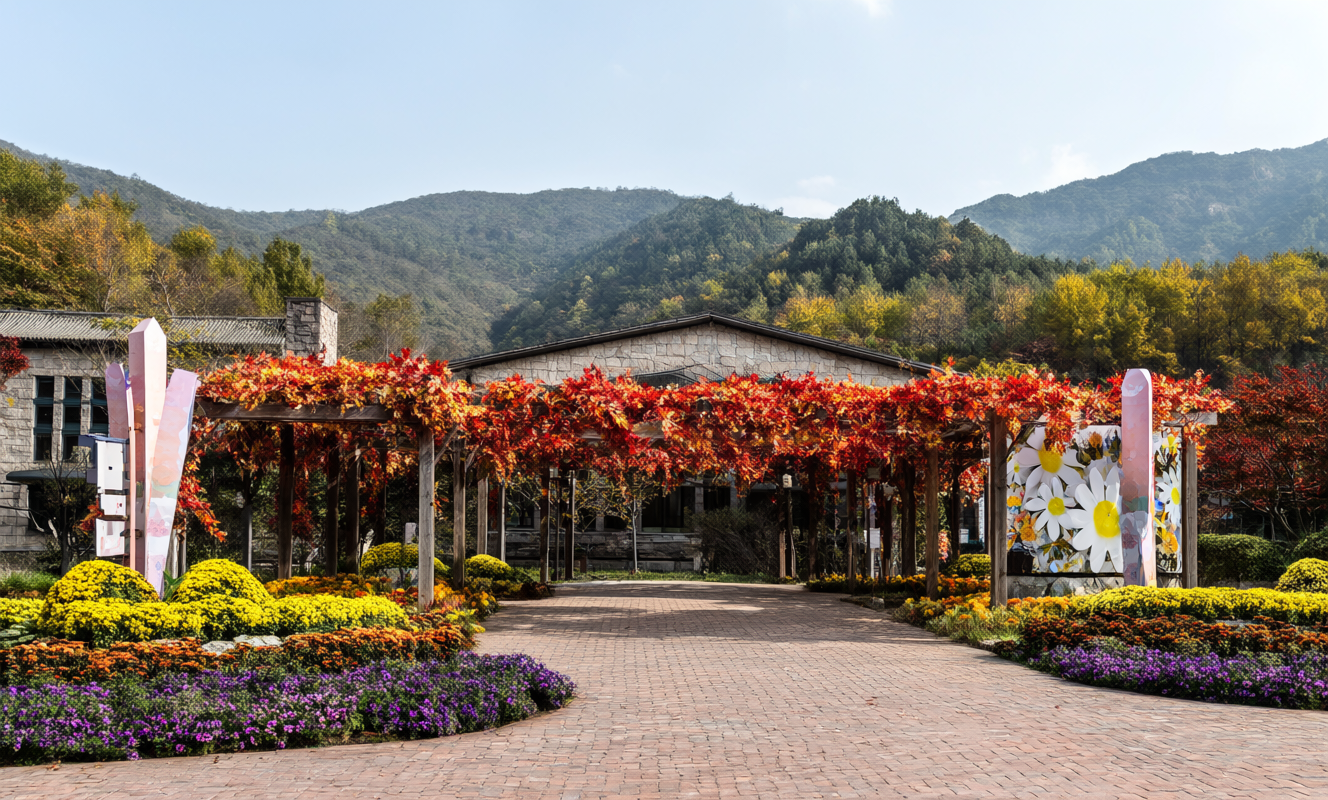
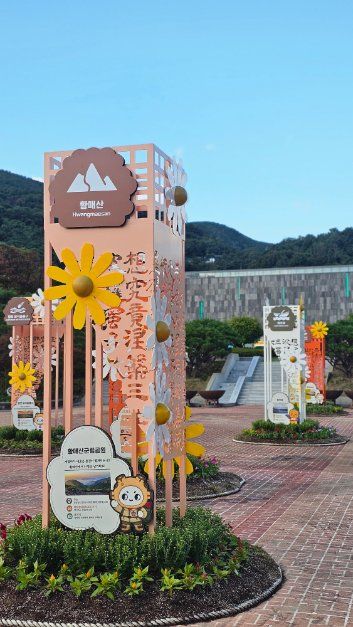
KTO’s Korean record describes a four-step walking route through the grounds. A “departure station” opens the route with the mascot. A set of “stops” then stands in for Hapcheon landmarks, and a flower path follows. The route finishes at a “terminus” that KTO describes as a small camping-style space. Local news places the end of the route at the park’s Millennium Plaza. The displays use chrysanthemums and other autumn flowers, flower-bouquet and chrysanthemum-girl figures, and character sculptures made for photographs.
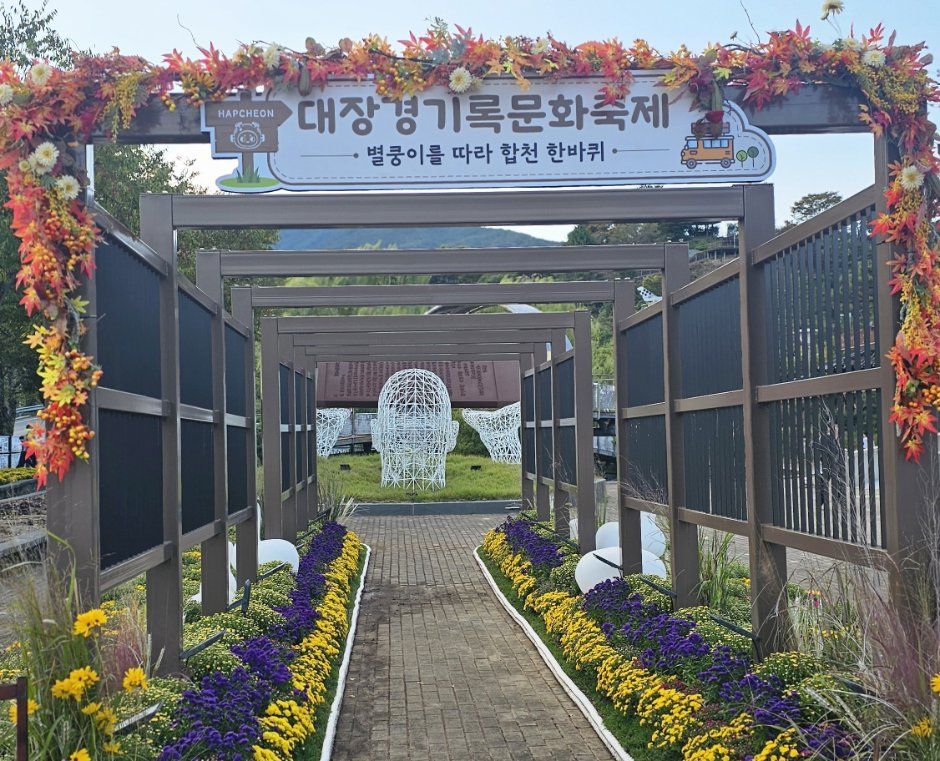
Two photos supplied by KTO show the scale. One is a tall flower-and-daisy signpost with a Hapcheon landmark panel, and the other is a timber pergola covered in autumn garlands. Both are staged for photos rather than being deep exhibitions, so expect a stroll, not a museum visit.
The park’s permanent halls are separate from the festival. A December 2025 Korean feature on the park describes a Tripitaka exhibition hall, a 5D film hall about how and why the woodblocks were made, a records-culture hall, a light-and-sound hall and a simple printing activity. Whether each hall is open and included in the ticket during the festival was not confirmed.
Programme and timetable
KTO lists two strands. Exhibitions are the flower installations and photo zones, a chrysanthemum bonsai display and a display of award-winning works from the national Palman Daejanggyeong art competition. Local news dates the art display to October 20-24 (the tenth edition of the competition) and the chrysanthemum bonsai to from October 24. That makes October 24 the one day that overlaps both.
Experiences are aimed at families: silk-screen printing, mother-of-pearl keyrings, chrysanthemum painting and dappo (a decorative cloth) making, soap, ceramic gonggi game stones, caricatures, calligraphy of a family motto, pottery and a tea ceremony. KTO’s overview also mentions a coffee-grounds fridge-magnet activity. Local reports add VR and a 5D cinema. A booth-by-booth timetable was not available, so do not assume that every activity runs all day.
Tickets, fees and booking
KTO records the festival as paid entry with experiences charged separately. The only price list we found is Hapcheon County’s page for the theme park: 5,000 won for adults, 3,000 won for middle and high school students, and 2,500 won for elementary children, soldiers and people aged 65 and over. Groups of 20 or more pay less, and several categories get in free, including Hapcheon residents with ID and children under 7. That page is a general park list, not an announcement for this festival, so treat it as the likely price and not a guarantee.
Prices for individual craft booths and for the VR and 5D cinema were not published. This guide lists no booking system because none was found. For questions, call the organiser, Hapcheon County, on 055-930-4696.
Getting there without a car
There is no direct service from Seoul. The most straightforward chain is a KTX or SRT train from Seoul to Dongdaegu, which public timetable sources put at about 1 hour 40 minutes at best and around 1 hour 50 minutes on most trains. From there, Daegu Metro Line 1 reaches Seobu (West) Bus Terminal in roughly 20 minutes, according to a trail-guide source. A May 2026 listing shows 14 intercity buses a day from Daegu West to Haeinsa, the first at 06:40 and the last at 20:00, taking about 1 hour 30 minutes for 8,900 won. These figures add up to about 3.5 hours of riding before waits, but that total is our own sum and not a published journey time.
Two links in this chain are unverified. First, the listings name Haeinsa’s bus terminal, and we could not confirm that these buses stop at the theme park. Second, no source gave the local distance or a verified bus link between Haeinsa and the park. A taxi from the Haeinsa side is the likely fallback, but its price was not checked. Ask the bus company or the festival office which stop is nearest before you board.
On foot, the Gayasan Sori-gil trail links the park with Haeinsa along a valley. Sources put it at about 6 km to Yeongsangyo bridge (roughly 2.5 hours one way) and 7.3 km to the temple. That is a walk of a few hours, not a transfer.
Parking and traffic
Hapcheon County lists the park’s parking lots as numbers 4 to 6 (Yacheon-ri). Fees, capacity and whether a festival shuttle runs were not published. No traffic-control notice for the festival was found, so check with the organiser before driving on a weekend.
Day trip or overnight
A day trip from Seoul is possible but uncomfortable. The park’s hours end at 18:00, while the ride alone is around 3.5 hours each way by our sum, so you would arrive late morning at best and have to leave early enough for the last bus, which we could not verify for the return. Overnight stays near Haeinsa or in Hapcheon would give you time to also walk part of Sori-gil, but we did not check prices or availability, so we recommend no particular property.
News from mid-October also mentions a Hapcheon autumn mobile stamp tour with banners at major festival sites, including this festival. Headlines say visitors who eat and stay in Hapcheon can win prizes of up to 20,000 won. Details and whether short-stay foreign visitors can take part were not verified.
Food on site and nearby
No source lists stalls, menus or prices at the festival, so none are named here. Hapcheon’s county food pages describe a long-standing local pork and rice soup, and the county’s mountain-vegetable bibimbap is associated with the Haeinsa tourist area. Both are regional recommendations, not claims about what is sold at the park. Whether the food at the park accepts foreign cards was not checked.
Honest assessment
The festival’s real appeal is a gentle, photogenic autumn afternoon with something for children to make. It sits in a fine setting in the foothills of Gayasan, and it pairs naturally with Haeinsa and the Sori-gil walk if you have more than a day. The cost is modest on paper, and the language barrier is low for printing, keyring and painting activities, though English signage and interpreters were not checked.
The weak points are the access and the missing details. The journey is long, local transport from the main bus terminal is unverified, and the programme grid, craft prices and the Monday closure question are all unanswered. It is also easy to arrive with the wrong expectation: the original woodblocks are at Haeinsa, not here. Come for the flowers and the crafts, check what Haeinsa allows if the woodblocks are your goal, and call the organiser before travelling on a Monday.
Local specialties to try
Hapcheon pork and rice soup (합천 돼지국밥)
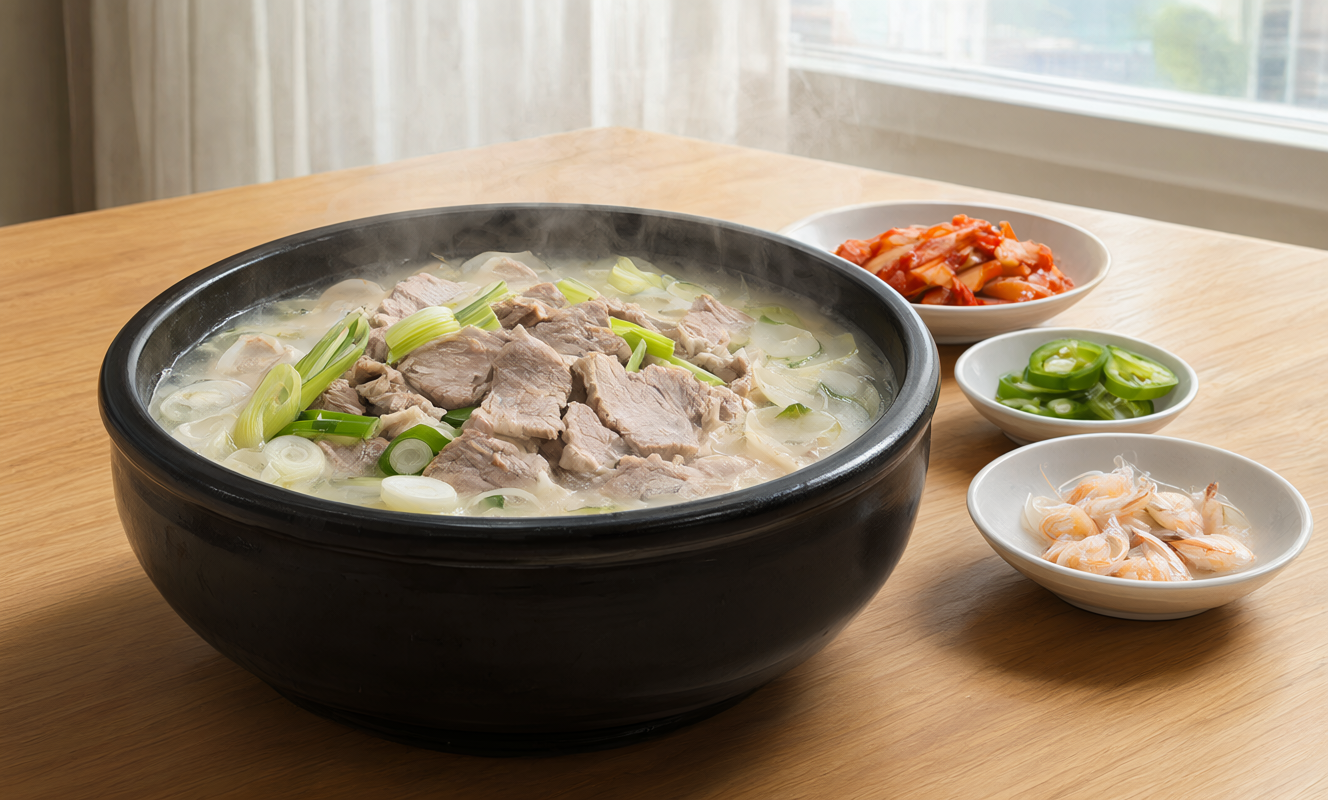
Hapcheon County's food pages describe dwaeji-gukbap as a long-standing local dish that began as a market-day soup and is now on menus across the county, made with Hapcheon pork and known for a generous amount of meat. It is a county specialty, not a promise about what festival stalls will sell.
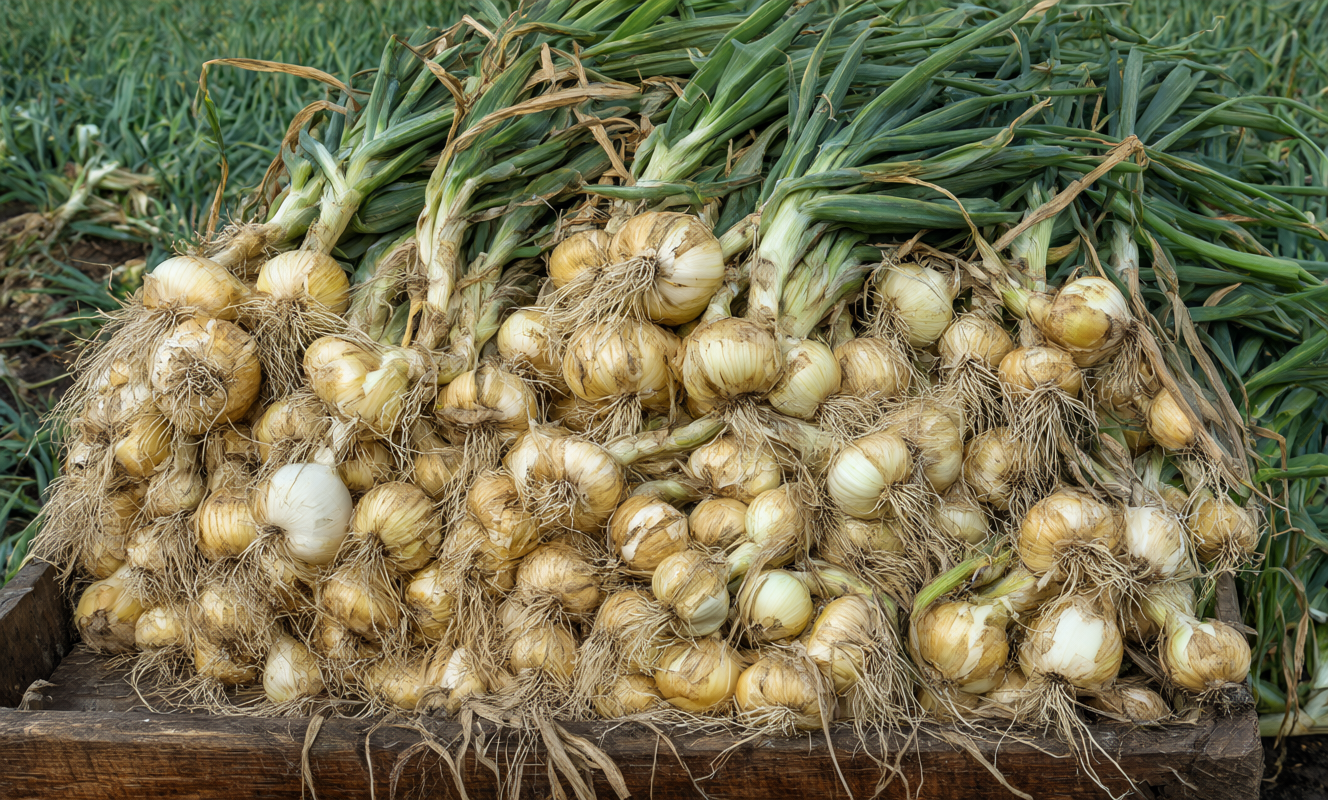
Hapcheon onion (합천양파)
The Encyclopedia of Korean Culture lists Hapcheon onion among the county's eight designated representative products, alongside Hapcheon beef, pork, rice, garlic, apple watermelon, melon and a rice-cake soup. Onions are a field crop, so this is a regional product rather than something you will necessarily eat at the festival.
Questions worth asking
Can I see the original Tripitaka Koreana woodblocks at the festival?
No. The festival is held at the Tripitaka Koreana Theme Park, an exhibition and activity venue. The original woodblocks, more than 81,000 of them, are kept at Haeinsa temple, which is a separate site. Haeinsa's own visiting rules, including any reservation or fee, were not verified for this guide, so check its website before planning a visit.
What are the 2026 dates and opening hours?
October 9 to November 1, 2026, 24 days in total, with programme hours of 09:00-18:00 according to the Korea Tourism Organization. Hapcheon County's general listing for the park gives a shorter 17:00 close in its winter season, and it does not say which dates count as winter, so do not plan to arrive late on the last days.
How much does it cost?
Entry is paid and experience booths cost extra. Hapcheon County's park price list shows 5,000 won for adults, 3,000 won for middle and high school students and 2,500 won for elementary children, soldiers and those 65 and over, with free entry for several groups including Hapcheon residents and children under 7. It is a general list rather than a festival notice, and craft prices were not published.
Which hands-on activities are offered?
KTO and local reports list silk-screen printing, mother-of-pearl keyrings, chrysanthemum painting and dappo making, soap making, ceramic gonggi game stones, caricatures, calligraphy of a family motto, pottery and a tea ceremony. Reports also mention VR and a 5D cinema. Which booths run on which day was not published.
Is the park closed on Mondays during the festival?
Not confirmed. General listings give a Monday closure (and January 1) for the park, but no source says whether the festival suspends it. Mondays in the festival period include October 26. Call 055-930-4696 before going on a Monday.
Before you goFestival Etiquette in Korea: What Visitors Get WrongBooking KTX Trains and Intercity Buses as a Foreign VisitorGetting Out of Incheon Airport and On to a FestivalKorean Festivals With Children: Toilets, Strollers and TimingStaying Online in Korea: SIM, eSIM and the Apps That MatterEating at a Korean Festival Without Speaking KoreanRain, Typhoons and Cancelled Festivals: How to Plan Around ThemHow to Pay for Things in KoreaT-money and Transit Cards in KoreaWhat to Wear to a Korean Festival, Season by Season
LAST UPDATED · Oct 19, 2026